Worksheets
Geometry Semester 1 Review
Total questions: 172
Worksheet time: 9hrs 39mins

Solve for TU
(a)

Find KL
(a)

(a)

(a)
Which represents the converse of an if-then statement?
Q --> P
P --> Q
~P --> ~Q
~Q --> ~P
A statement that can be written using the phrase if and only if, is called a (a) statement
Alternate Interior Angles are
congruent
supplementary
complementary
none of the these
Consecutive Interior Angles are
congruent
complementary
supplementary
none of these
Parallel lines have the (a) slope.
How many congruent sides do isosceles triangles have?
0
1
2
3
In an equiangular triangle, all angles are
congruent
complementary
acute
obtuse
True or False:
SSA is a valid method of proving triangles congruent
True
False

Which side is the shortest in the triangle shown?
AB
BC
CA

Which angle is the LARGEST in the triangle shown?
O
G
E
Write the equation of the line parallel to y = 4x + 3 and passing through the point (-4, -5)
y = -1/4x - 6
y = -1/4x + 8
y = 4x - 2
y = 4x + 11

7
20
10
4

17
28
77
103

90
120
60
45
Find the inverse of the statement, “We can’t go swimming if there is a lightning storm”.
If we can go swimming, then there is no lightning storm.
If there is a lightning storm, then we can’t go swimming.
If we can’t go swimming, then there is a lightning storm.
If there is not a lightning storm, then we can go swimming.


Describe the translation of point A(2, 1) to point A'(5, 3).
(x, y) - (x – 3, y + 2)
(x, y) - (x – 3, y – 2)
(x, y) - (x + 3, y + 2)
(x, y) - (x + 3, y – 2)

x = 23, y = 3
x = 3, y = 23
x = 3, y = 18
x = 1.5, y = 18

9
52
28
15
Use the Law of syllogism to write a new conditional statement that follows from the pair of true statements.
If angles form a linear pair, then they are supplementary.
If angles are supplementary, then their sum is 180°.
If angles form a linear pair, then their sum is 180°.
If angles have a sum of 180°, then they form a linear pair.
If angles are supplementary, then they form a linear pair.
If angles have a sum of 180°, then they are supplementary.


Find the value of y?
16
12
4
8
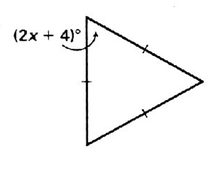

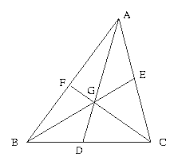

Mario, Jessica, and Farlene are hanging out on the football field in the form of a triangle. Which point of concurrency would be the same distance between all three of them?
Circumcenter
Incenter
Neither
Bilateral
Which point of concurrency is the center of gravity for a triangle?
Centroid
Incenter
Orthocenter
Circumcenter


15, 12, 9

What is another name for Plane P?
Plane DAB
Plane ABC
Plane ACn
Plane PBC

Name an angle adjacent to <AOB?
Angle AOE
Angle COD
Angle AOC
Angle EOB
Find the midpoint between the points (-1,6) and (2,8)
(9, 4)
(1/2, 1)
(1.5, 1)
(1/2, 7)
Find the distance between (-1, 6) and (2, 8)
3.6
14
2.2
3.7

m∠JHI=46o and m∠GHI=19o
m∠JHI=27o and m∠GHI=78o
m∠JHI=19o and m∠GHI=46o
m∠JHI=23o and m∠GHI=52o

Reflexive
Symmetric
Transitive

50
40
90
30

What is the reason for step 2?
Addition POE
Subtraction POE
Division POE
Multiplication POE

a.
b.
c.
d.
Determine whether the line through (0,4) and (2,0) and the line through (-2,3) and (-4,2) are parallel, perpendicular, or neither.
parallel
perpendicular
neither
What are the coordinates of the point of the directed line segment from A(-5,-4) to B(5,1) that partitions the segment into a ratio of 3 to 2?
(3,1)
(-3,1)
(3,-1)
(-3,-1)
What are the coordinates of the point of the directed line segment from A(-18,-2) to B(0,6) that partitions the segment into a ratio of 1 to 3?
(-13.5,0)
(13.5,0)
(4,5)
(27,0)

a.
b.
c.
d.

Which is a reflection in the y-axis?
a.
b.
c.
d.

reflection in the y-axis
translation up4, left 6
translation left 4, down 6
translation right 4, down 6

a.
b.
c.
d.

EF
DE
DF

x=67, y=124
x=68, y=74
x=67, y=106
x=50, y=124

x=72
x=36
x=108
x=18

x=15
x=10
x=20
x=17

x=3
x=10
x=7
x=17
The sum of the angles in a triangle is ________.
180°
45°
90°
360°

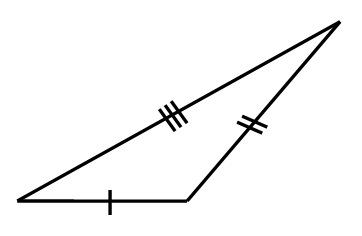
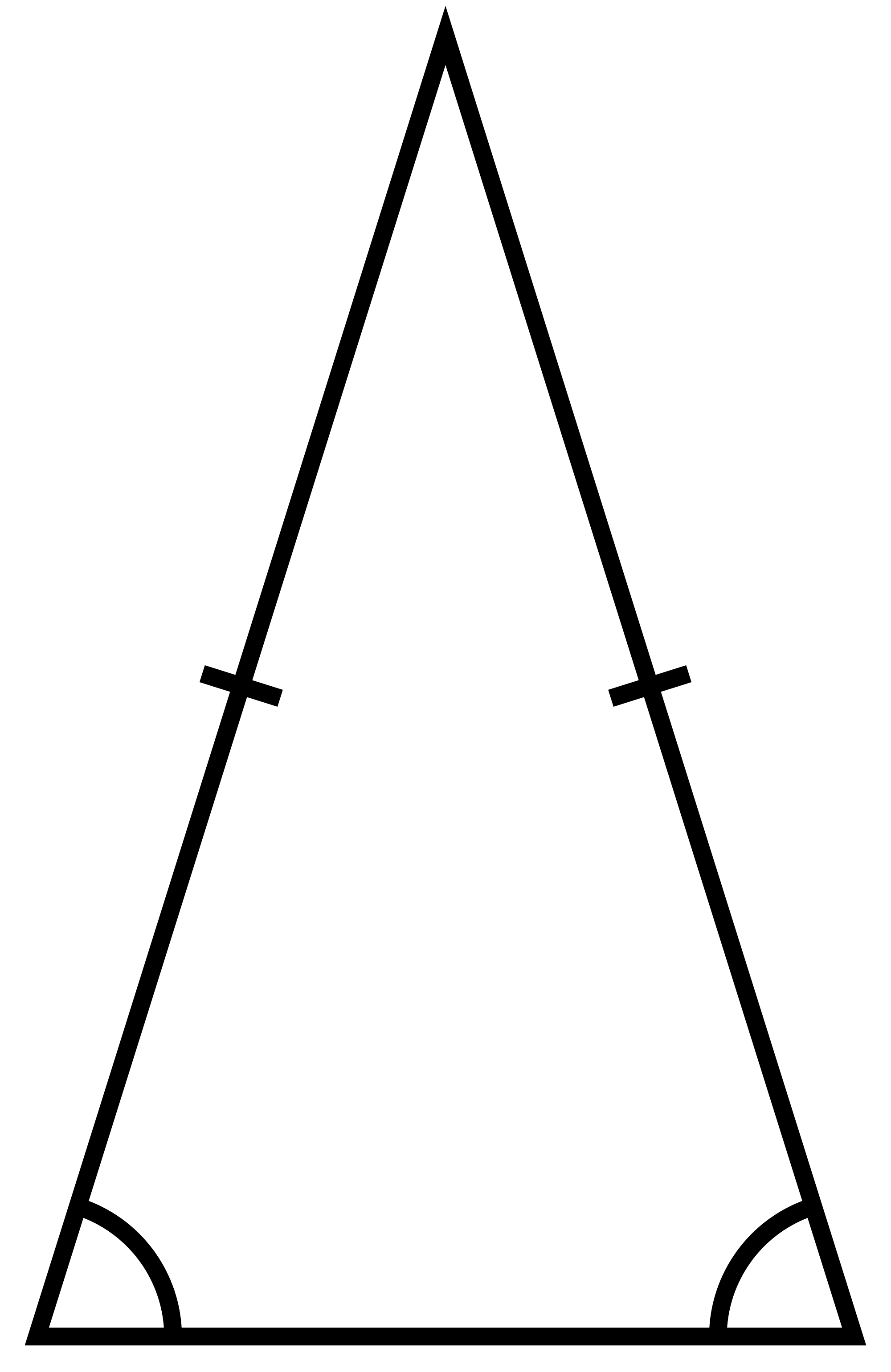


A triangle with 3 congruent sides is called a(n) ______
Isosceles Triangle
Equilateral Triangle
Obtuse Triangle
Irregular Triangle


Find the value of x.
x = 130
x = 31
x = 44
x = 180

Find the value of x.
x = 11
x = 45
x = 16
x = 5
If angle A is 40 degrees and angle B is 140 degrees, then the two angles are _________.
Congruent
Corresponding
Supplementary
Vertical

What is the value of x?
x = 234
x = 54
x = 126
x = 36
Angles with the same measure are called ...
Congruent
Similar
Supplementary
Transversal
A line that intersects at least two other lines is called a ...
Supplementary Angle
Parallel Line
Transversal
Tarantula

Find the measure of angle A.
∠A=82°
∠A=98°
∠A=180°
∠A=8°
A student is trying to construct triangles using four different sets of angles. The angles in each set are given below. Which set will form a triangle?
45°, 65°, 70°
150°, 110°, 100°
50°, 50°, 50°
90°, 90°, 90°
The angles inside an equilateral triangle are all ...
20 degrees
50 degrees
60 degrees
45 degrees


What is the measure of angle x?
70
160
135
20
Can a triangle be formed with sides of
6, 9, and 11?
Yes
No
10, 12, 22
4, 7, 10
17, 9, 30
Two side measures of a triangle are given. What is the range of values for the third side?
10 and 24
5 < x < 12
14 < x < 34
33 < x < 13
13 < x < 33
Two side measures of a triangle are given. What is the range of values for the third side?
9 and 7
6 < x < 14
2 < x < 13
2 < x < 16
2 < x < 15
Solve for x
43=8x
(a)


Are the following figures similar? Why or why not?
Yes, the ratios of the corresponding sides are equal.
No, the ratios of the corresponding sides are not equal.
No, the corresponding angles are not equal.
Yes, the corresponding angles are equal.
Corresponding angles in similar figures are congruent.
True
False

Lance the alien is 5 feet tall. His shadow is 8 feet long. At the same time of day, a tree's shadow is 32 feet long. How tall is the tree?
20 feet
24 feet
29 feet
51 feet

Which side length corresponds with EF?
MN
LM
OL
EH


An architect built a scale model of a music theater using a scale in which 4 inches represents 30 feet. The height of the theater is 120 feet.
What is the height of the scale model in inches?
1 in.
75 in.
16 in.
120 in.

The point A (8, 12) was dilated to become point A' (2, 3). What was the scale factor?
½
¼
4
2
What is the formula for scale factor?
oldnew
newold

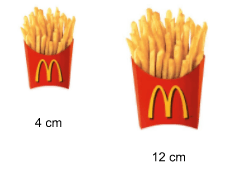
What is the scale factor from the small fry to the large fry?
1/3
48
4
3

ABC ~ XYZ. What is the scale factor of the dilation of ABC to XYZ?
32
23
2
3

Dilate the figure by a scale factor of 3. What are the coordinates of the image?
A(3,3) B(6,6) C(9,3)
A'(9,9) B'(18,18) C'(27,9)
A'(6,6) B'(9,9) C'(12,6)
A'(0,0) B'(3,3) C'(6,0)
A'(1,1) B'(2,2) C'(3,1)


BD bisects ∠CBA
Find the m∠CBA
120°
65°
130°
125°

AB bisects ∠CAD .
Find the value of x.
8.5
8
33
7

BD bisects ∠ABC
Find the value of x
20
6
10
30

Find XZ, if XY = 13 and YZ = 4.
(a)
Find YZ, if XY = 8 and XZ = 24.
(a)
Find a, if XZ = 18, XY = 2a + 5 and YZ = 3a - 7.
(a)


If an isosceles triangle has a base angle measuring 40°, then what measure is the VERTEX angle?
120°
100°
40°
80°

What is the measure of BC?
12
6
9
10
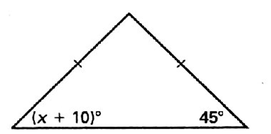

What is the measure of ∠S?
not enough information
30
60
180
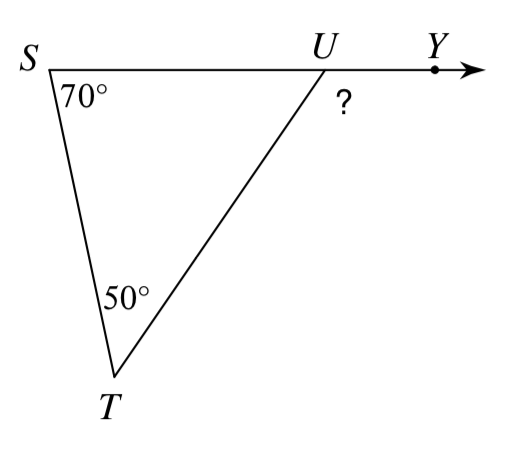
What is the value of the missing angle?
90
100
20
120
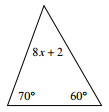
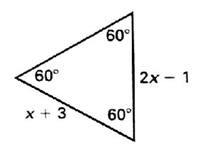
Find x
3
4
2
10

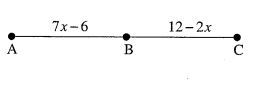
Find PM and MQ, given that M is the midpoint of the segment.
PM = 22, MQ = 22
PM = 11, MQ = 22
PM = 11, MQ = 11
PM = 22, MQ = 11

In the figure IG = 18. What is the length of IJ?
(a)
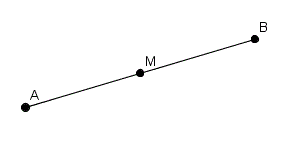
Given that M is the midpoint of
AB and AB=30 find AM.15
30
10
not enough information

If KM bisects ∠LKJ and m∠JKM=22° find m∠LKM .
22
44
11
68
not enough information given

Solve for x.
2
3
4
5
7.4


Find x if the length of PR is 45 units in length. [Refer to the figure]
3
44
5
6
If angle AVB has a measure of 70 degrees and VM is its angle bisector, what is the measure of angle AVM?
59
34
45
90
In ΔABC , the measure of angle A is five more than twice the measure of angle B. The measure of angle C is eleven less than three times the measure of angle B. What is the measure of angle C?
(a)
Point A is between points C and R on the number line. CR is 27 units long. If point C is at -7 and point A is at 4, on which number on the number line would you find point R?
(a)
In ΔABC, AB=BC . If m∠A=(4x−30)° and m∠C=(2x+10)° , find m∠B .
(a)
Given that AS bisects ∠CAR . If m∠SAR=(3x−4)° and m∠CAR=(5x+1)° , what is m∠CAS ?
(a)

In the diagram, a∥b , Find m∠1 .
(a)

Use the diagram to find m∠B .
(a)
On a number line, E is between T and N. T is at -7 and N is at 15. If TE is seven more than twice a number and EN is three times that same number, where is E on this number line?
(a)

In the diagram, AT is the angle bisector. Find m∠MAH .
(a)

In the diagram, a∥b . Find x .
(a)
Given that ∠1 and ∠2 are vertical angles, m∠1=(6x+5)° and m∠2=(7x) , what is the measure of the complement of ∠1 ?
(a)
∠1 and ∠2 form a linear pair. m∠1=(2x+7)° and m∠2=(4x+5)° Find the measure of the complement of ∠1 .
(a)

Use the diagram to find the measure of angle 8.
(a)

(a)

What is the measure of angle x ?
(a)

What is the measure of angle c ?
(a)
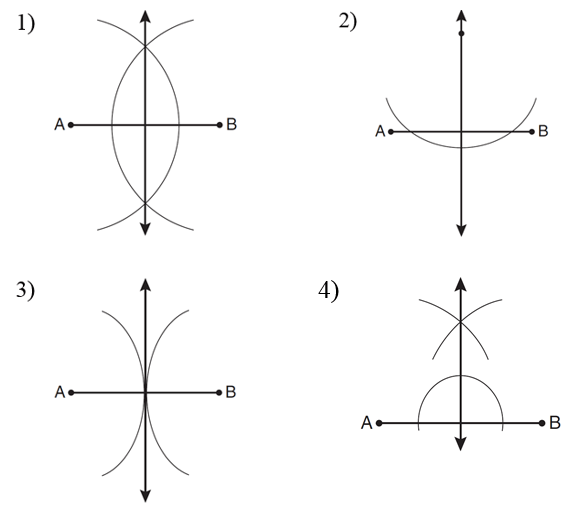
Which one is the correct construction for a perpendicular bisector?
1
2
3
4
Which one is the correct construction for a perpendicular bisector?
1
2
3
4

What must be true?
1
2
3
4


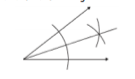


Eric was attempting to construct a perpendicular bisector to the segment AB with a compass and straight edge. Which of the below statements explains what Eric may have done wrong?
Eric should have started by putting the compass needle point at the midpoint of the segment AB.
On the second step, Eric should have placed the compass needle point where the first arc intersected the segment AB.
Erick just needed to open the compass more to create arcs that have a radius of more than half the length of the segment AB.
Erick didn’t do anything wrong he just needs to connect the opposite endpoints of each arc to finish the construction.
Which is the basis for the procedure used in the construction of a line parallel to a given line through a point not on the line?
Corresponding Angles Theorem
Alternate Exterior Angles Theorem
Alternate Interior Angles Theorem
Consecutive Interior Angles Theorem