
 Worksheets
American Literature Final
Total questions: 90
Worksheet time: 2hrs 30mins

Who is considered the father of the Enlightenment?
Thomas Hobbes
John Locke
Isaac Newton
Voltaire
What was the role of philosophers during the Enlightenment?
Promoting rational thinking, challenging traditional authority, and advocating for individual rights and freedoms.
Advocating for the suppression of free speech and expression
Encouraging superstition and belief in the supernatural
Supporting absolute monarchy and divine right of kings

What was Jonathan Edwards' role in the First Great Awakening?
Preacher and theologian
Professional athlete
Famous actor
Military general
In which year did Jonathan Edwards deliver his famous sermon 'Sinners in the Hands of an Angry God'?
1800
1741
1776
1620
What was the main message of 'Sinners in the Hands of an Angry God'?
To highlight the importance of material wealth and success
To encourage people to ignore the concept of sin and punishment
To emphasize the idea of God's wrath and the consequences of sin
To promote the idea of living a carefree life without consequences
How did Jonathan Edwards' preaching style contribute to the impact of the First Great Awakening?
His preaching style was boring and unengaging
He used a monotone voice and lacked passion
His delivery was too calm and soothing
His intense emotional delivery and vivid imagery captivated his audience and evoked strong emotional responses.
What were some of the criticisms of Jonathan Edwards' theology and preaching methods?
His intense focus on sin and damnation, fear-based tactics, and strict Calvinist beliefs.
His focus on love and forgiveness
His preaching methods were too lenient
His theology was not based on the Bible
What were some of the key themes addressed in 'Sinners in the Hands of an Angry God'?
The importance of forgiveness and redemption
The concept of God's wrath, human sinfulness, and the urgency of repentance
The power of positive thinking
The benefits of living a righteous life
Name one key figure who played a significant role in the Great Awakening.
Benjamin Franklin
Thomas Jefferson
George Washington
Jonathan Edwards

Who were some key figures and leaders of the Great Awakening?
Alexander Hamilton, James Madison, and John Jay
Benjamin Franklin, Thomas Jefferson, and John Adams
Jonathan Edwards, George Whitefield, and Gilbert Tennent
Abraham Lincoln, George Washington, and Thomas Paine
What were some of the main changes in religious practices as a result of the Great Awakening?
No change in religious practices, emphasis on individualism, and the decline of traditional denominations
Increased political involvement, emphasis on social justice, and the decline of religious denominations
Increased religious fervor, emphasis on personal salvation, and the rise of new denominations
Decreased religious fervor, emphasis on communal salvation, and the decline of new denominations

In which book did Ben Franklin discuss his moral development and self-improvement journey?
The Great Gatsby
Moby Dick
Pride and Prejudice
The Autobiography of Benjamin Franklin
What are the 13 virtues outlined by Ben Franklin in his autobiography?
Temperance, Silence, Order, Resolution, Frugality, Industry, Sincerity, Justice, Moderation, Cleanliness, Tranquility, Chastity, Humility
Anger, Hatred, Envy, Pride, Lust, Gluttony, Sloth
Kindness, Generosity, Compassion, Forgiveness, Patience, Tolerance, Understanding
Laziness, Dishonesty, Greed, Arrogance, Impulsiveness, Negligence, Deceit
How did Ben Franklin track his daily adherence to his virtues?
Through meditation and deep breathing
Using a chart with a row for each virtue and a column for each day of the week
By asking his pet parrot
Using a magic 8-ball
What was the purpose of Franklin's daily schedule?
To become a professional athlete
To learn how to cook
To achieve moral perfection and self-improvement
To become a famous musician
How did Franklin's approach to self-improvement differ from traditional religious practices of his time?
Franklin believed in the concept of original sin and atonement
Franklin focused on traditional religious rituals and practices
Franklin relied on the guidance of religious leaders for moral improvement
Franklin focused on practical virtues and moral perfection through self-examination and self-discipline.
What role did Franklin's autobiography play in promoting the idea of moral perfection?
It outlined Franklin's journey and the virtues he aimed to cultivate.
It discouraged people from striving for moral perfection
It had no impact on promoting moral perfection
It was a fictional story about a perfect person
Name one of Ben Franklin's famous inventions or scientific discoveries.
discovered the moon is made of cheese
lightning rod
invented the internet
created the first smartphone
What role did Ben Franklin play in the American Revolution?
Inventor of the light bulb
Commander of the Continental Army
Diplomat, statesman, and founding father
King of England
How did Ben Franklin's legacy impact American society?
Ben Franklin's legacy only impacted American society through his political career
Ben Franklin's legacy had no impact on American society
Ben Franklin's legacy only impacted American society through his inventions
Ben Franklin's legacy impacted American society through his contributions to science, politics, and diplomacy, as well as his advocacy for education and the abolition of slavery
What was the name of Ben Franklin's famous publication?
Poor Richard's Almanack
Good Richard's Almanack
Wealthy Richard's Almanack
Rich Richard's Almanack
What is one of Ben Franklin's famous quotes?
The only thing we have to fear is fear itself
Early to bed and early to rise makes a man healthy, wealthy, and wise.
To be or not to be
A penny saved is a penny earned

What role did Samuel Adams play in the American Revolution?
French military leader during the American Revolution
Spanish diplomat who negotiated peace with the American colonies
Leader of the Sons of Liberty and one of the Founding Fathers
British loyalist who opposed the American Revolution
How did Samuel Adams oppose British taxation and what impact did it have?
Encouraging colonists to pay the taxes and comply with British rule
Writing letters of support to the British government, which led to increased taxation
Supporting the British soldiers in enforcing the taxes on the colonists
Organizing protests, boycotts, and encouraging colonists to resist the taxes. This had a significant impact on the growing resistance to British rule and ultimately contributed to the American Revolution.
What were some of the key events or actions that Samuel Adams is known for during the American Revolution?
Organizing the Boston Tea Party, leading the Sons of Liberty, and advocating for independence from Britain
Leading the British Army
Supporting the Stamp Act
Negotiating peace with Britain

Who wrote the original version of 'Yankee Doodle'?
Thomas Jefferson
George Washington
Dr. Richard Shuckburgh
Benjamin Franklin
Explain the meaning of the lyrics in 'Yankee Doodle'.
Yankee Doodle was sung by British soldiers to mock the American colonists, but the Americans embraced the song and turned it into a symbol of their patriotism and independence.
The lyrics of 'Yankee Doodle' were written by American soldiers to mock the British
The lyrics of 'Yankee Doodle' were written by a famous poet
The lyrics of 'Yankee Doodle' were originally a love song
What is the the cultural significance of 'Yankee Doodle'.
Yankee Doodle has no cultural significance
Yankee Doodle is a symbol of American patriotism and has been associated with the American Revolutionary War.
Yankee Doodle is a symbol of French patriotism
Yankee Doodle is a traditional Russian folk song
What is the significance of the term 'Yankee' in the song?
It refers to British soldiers during the Revolutionary War.
It symbolizes the Native American tribes during the Revolutionary War.
It represents the French allies of the American colonists during the Revolutionary War.
It refers to American colonists during the Revolutionary War.

What role did John Dickinson play in the American Revolution?
He was a farmer
He was a political leader, writer, and a song writer
He was a British loyalist
He was a military general
Why is the Liberty Song significant in the context of American history?
It was only popular in the southern colonies
It was used as the national anthem of the United States
It was written by a famous British composer
It was one of the first patriotic songs written during the American Revolution, and it became a popular rallying cry for the colonists.
What message does the Liberty Song convey to the people of colonial America?
The Liberty Song conveys a message of surrender and acceptance of British rule.
The Liberty Song conveys a message of support for British rule and loyalty to the crown.
The Liberty Song conveys a message of resistance and determination to fight for freedom and independence from British rule.
The Liberty Song conveys a message of indifference and lack of concern for freedom.

Who is known for the famous speech 'Give me liberty or give me death'?
Patrick Henry
Benjamin Franklin
George Washington
Thomas Jefferson
What role did Patrick Henry play in the Virginia Convention?
Advocated for peaceful negotiations with the British
Delivered a famous speech urging delegates to take up arms against the British
Refused to participate in the Virginia Convention
Served as a mediator between the British and the American colonies
What are some key themes in Patrick Henry's famous speech?
War, destruction, chaos, and violence
Love, forgiveness, peace, and compromise
Liberty, independence, patriotism, and the fight against tyranny
Authority, obedience, submission, and conformity

What was the early life and education of Phillis Wheatley?
Phillis Wheatley was born in Asia and was raised by her biological parents who were wealthy and educated.
Phillis Wheatley was born in South America and never received any formal education.
Phillis Wheatley was born in Europe and received a prestigious education from a young age.
Phillis Wheatley was born in West Africa and was sold into slavery at the age of seven. She was purchased by the Wheatley family in Boston, Massachusetts, and received an education from the family.
How did Phillis Wheatley impact American literature?
She was the first African American woman to publish a book of poetry in the United States.
She was a famous actress in the 18th century
She invented the first American dictionary
She was a pioneer in the field of quantum physics
What are the main themes in Phillis Wheatley's poetry?
Religious and moral themes
Science fiction and fantasy themes
Political and revolutionary themes
Romantic and love themes
How did Phillis Wheatley's work challenge the prevailing stereotypes of African Americans during her time?
By promoting negative stereotypes of African Americans
By demonstrating the intellectual and literary capabilities of African Americans during her time.
By refusing to acknowledge the achievements of African Americans
By reinforcing the idea that African Americans were not capable of intellectual or literary pursuits
What was the historical context in which Phillis Wheatley lived and wrote?
Victorian Era and Industrial Revolution
Renaissance and Age of Exploration
American Revolutionary War and the Enlightenment period
French Revolution and Romanticism

Who wrote the pamphlet titled "Common Sense"?
Alexander Hamilton
Benjamin Franklin
Thomas Jefferson
Thomas Paine
What was the main idea behind Thomas Paine's 'Common Sense' pamphlet?
Promoting peace and reconciliation between America and Britain
Advocating for American annexation by another European power
Advocating for American independence from British rule
Supporting British rule over the American colonies
In which year was 'Common Sense' published?
1900
1750
1800
1776
What was the significance of 'Common Sense' in shaping public opinion towards independence?
Presenting clear and persuasive arguments for independence
Arguing for the expansion of British colonial rule
Advocating for increased taxation by the British government
Promoting loyalty to the British monarchy
What impact did Thomas Paine's writings have on the Declaration of Independence?
Caused the Declaration of Independence to be delayed
Influenced the ideas and language used in the Declaration of Independence
Had no impact on the Declaration of Independence
Led to the rejection of the Declaration of Independence
Which Founding Father was greatly influenced by Thomas Paine's writings?
Alexander Hamilton
Benjamin Franklin
Thomas Jefferson
John Adams
Who was Thomas Paine writing to in Common Sense?
The colonists
The King
His wife
The Senate
What documents did Common Sense inspire?
The Manual of Life and the Manual of Death
Declaration of Independence and the Constitution
The Bible and the Koran
The Legend of the Navajo Indians and the Creation Myth
Why did Thomas Paine choose to remain anonymous in his texts?
He didn't like his real name.
He wanted to look suspicious.
He could have lost his life by committing treason.
The Legend of the Navajo Indians and the Creation Myth
How did 'The American Crisis' impact American morale during the Revolutionary War?
It had no impact on American morale
It led to widespread desertion and surrender among American soldiers
It caused American morale to decline
It boosted American morale by inspiring and encouraging the soldiers and the public.
According to Thomas Paine, what were some of the key challenges faced by the American forces during the Revolutionary War?
Overwhelming support from the British forces, lack of strategic advantage, and internal conflict
Lack of supplies, training, and experience
Lack of motivation, discipline, and leadership
Abundance of supplies, extensive training, and vast experience
How did Thomas Paine's writing style in 'The American Crisis' contribute to its impact on the American people?
His writing style was difficult to understand and unrelatable
His writing style was too emotional and off-putting
His clear, persuasive, and emotionally stirring writing style resonated with the American people during a time of crisis.
His writing style was boring and unconvincing
What are some key ideas and arguments presented in 'The American Crisis'?
The American Crisis argues for the importance of monarchy
The American Crisis emphasizes the need for surrender and defeat
The American Crisis promotes the idea that the American Revolution is an unjust cause
The key ideas and arguments presented in 'The American Crisis' include the importance of independence, the need for perseverance and determination, and the idea that the American Revolution is a just cause.

What role did Thomas Jefferson play in the American Revolution?
Principal author of the Declaration of Independence
Inventor of the steam engine
Commander of the British Army
Leader of the Loyalist forces
In which year did Thomas Jefferson author the Declaration of Independence?
1820
1776
1803
1789
How did Thomas Jefferson's role in the American Revolution impact his political career?
His role in the American Revolution had no impact on his political career
His role in the American Revolution made him unpopular with the public
His role in the American Revolution led to his exile from the country
His role in the American Revolution helped to establish his reputation as a leader and statesman, which ultimately impacted his political career.
What were some of the challenges Thomas Jefferson faced while writing the Declaration of Independence?
Expressing ideas clearly and persuasively, addressing concerns of diverse delegates
Finding a good recipe for chocolate chip cookies, choosing the right outfit
Learning to play the piano, dealing with a broken arm
Deciding what to watch on TV, learning to juggle
Who was the primary author of the Declaration of Independence?
John Adams
Benjamin Franklin
Thomas Jefferson
George Washington

What were the main ideas expressed in the Declaration of Independence?
Rights to property, pursuit of wealth, and freedom of speech
Rights to equality, justice, and fair treatment; government deriving power from divine right of kings
Rights to life, liberty, and the pursuit of happiness; government deriving power from consent of the governed; right to alter or abolish government
Government deriving power from military force and control; right to suppress opposition

What impact did the Declaration of Independence have on the American Revolution?
It caused the American colonies to remain under British rule
It declared the 13 American colonies independent from British rule, leading to the American Revolution.
It had no impact on the American Revolution
It led to the French Revolution instead of the American Revolution
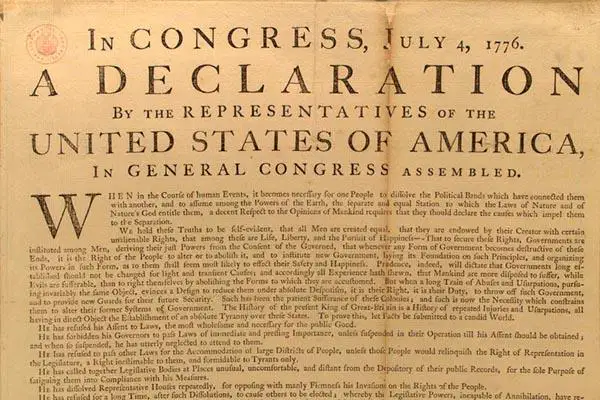
What were the key principles outlined in the Declaration of Independence?
Equality, unalienable rights, and the right to alter or abolish government
Slavery, discrimination, and oppression
Monarchy, dictatorship, and oligarchy
Freedom, justice, and democracy

How did Enlightenment ideas influence the writing of the Declaration of Independence?
Enlightenment ideas promoted the concept of absolute monarchy and divine right of kings.
Enlightenment ideas promoted the concepts of natural rights, social contract, and government based on the consent of the governed.
Enlightenment ideas had no influence on the writing of the Declaration of Independence.
Enlightenment ideas focused on the importance of a strong central government with unlimited power.
What is the concept of natural rights as mentioned in the Declaration of Independence?
Individuals have no rights
Natural rights can be taken away by the government
All individuals have inherent rights that cannot be taken away by government or other individuals.
Natural rights are granted by the government
How did the Declaration of Independence contribute to the formation of the United States as a nation?
It had no impact on the formation of the United States
It caused the American colonies to remain under British rule
It led to the division of the American colonies into smaller territories
It declared the 13 American colonies as independent states and outlined the reasons for separation from British rule, laying the foundation for the formation of the United States as a nation.
In what ways did the Declaration of Independence inspire other independence movements around the world?
Supporting the idea of a dictatorship
Promoting the idea of self-governance, individual rights, and the pursuit of happiness
Encouraging monarchy and absolute rule
Advocating for colonialism and imperialism

Which philosopher's ideas of natural rights and the social contract heavily influenced Thomas Jefferson's wording of the Declaration of Independence?
John Locke
Immanuel Kant
Thomas Hobbes
Jean-Jacques Rousseau

In which year did the American Revolution begin?
1775
1492
1607
1861

What was the main cause of the American Revolution?
Desire for a monarchy
Unfair taxation and desire for independence
Unfair treatment of British soldiers
Lack of access to tea and coffee

What was the significance of the Revolutionary War?
It resulted in the expansion of British territory in North America.
It led to the establishment of a monarchy in the United States.
It led to the independence of the United States from British rule.
It had no significant impact on the history of the United States.

What were the major events leading up to the American Revolution?
The Great Depression, the Dust Bowl, the Prohibition Era
The American Civil War, the Louisiana Purchase, the Emancipation Proclamation
The War of 1812, the Mexican-American War, the California Gold Rush
Events such as the French and Indian War, the Stamp Act, the Boston Tea Party, the Intolerable Acts, and the First Continental Congress.

Explain the role of James Madison in drafting the United States Constitution.
He played a key role in drafting the United States Constitution.
He opposed the drafting of the United States Constitution.
He only provided minor input in drafting the United States Constitution.
He had no involvement in drafting the United States Constitution.
What were James Madison's contributions to the Federalist Papers?
Only contributed 5 essays to the Federalist Papers
Co-wrote 29 essays with Alexander Hamilton and John Jay
Had no involvement in writing the Federalist Papers
Served as the primary author of all 85 essays
How did James Madison's ideas in the Federalist Papers influence the ratification of the Constitution?
By remaining silent on the issue and not contributing to the ratification of the Constitution
By promoting the idea of a monarchy and disregarding the balance of power
By providing a strong argument in favor of a strong central government and addressing concerns about individual rights and the balance of power.
By advocating for a weak central government and ignoring concerns about individual rights
What were the major challenges faced by James Madison during the drafting of the United States Constitution?
Establishing a national language for the United States
Building a strong military force
Negotiating trade agreements with European countries
Balancing state and federal power, representation of large and small states, and the protection of individual rights.
How did James Madison's Virginia Plan influence the final version of the Constitution?
It proposed a strong national government with three branches.
It suggested the creation of a single legislative body
It called for the abolition of the presidency
It proposed a return to British rule
Discuss the significance of James Madison's role in the creation of the Bill of Rights.
Madison only played a minor role in the creation of the Bill of Rights
Madison, with suggestions from George Mason, was the primary author of the amendments and worked to ensure their inclusion in the Constitution.
Madison opposed the inclusion of the amendments in the Constitution
Madison had no involvement in the creation of the Bill of Rights

What is the purpose of the Preamble in the United States Constitution?
Outlines the purpose and goals of the document
Gives a detailed history of the founding fathers
Provides a list of all the amendments
Describes the duties of the President
Which phrase in the Preamble establishes the principle of Popular Sovereignty?
Provide for the common defence
We the people
Establish justice
Promote the general welfare
Explain the concept of Separation of Powers in the United States Constitution.
Giving the Supreme Court power over all branches of government
Combining all governmental responsibilities into one branch
Division of governmental responsibilities into distinct branches
Allowing the President to make all legislative decisions
What is Federalism and how is it reflected in the United States Constitution?
Federalism is a system of government in which power is divided between the federal government and local businesses
Federalism is a system of government in which power is concentrated in the hands of a single ruler
Federalism is a system of government in which power is divided between the federal government and foreign nations
Federalism is a system of government in which power is divided between a central authority and constituent political units. In the United States Constitution, federalism is reflected through the division of powers between the federal government and the state governments.
What is the main function of the Legislative branch in the United States government?
Make laws
Enforce laws
Interpret laws
Appoint judges
What is the main function of the Executive branch in the United States government?
Make laws
Enforce laws
Interpret laws
Execute laws
What is the main function of the Judicial branch in the United States government?
Make laws
Enforce laws
Interpret laws
Execute laws
The federal executive branch is headed by...
the President
The Supreme Court
Congress
state officials.
Checks and balances ensure...
that laws are made.
that no branch of government has more power than another.
the lower courts’ power.
the power of the veto.

What are the first 10 amendments in the United States Constitution collectively known as?
Declaration of Independence
Articles of Confederation
Bill of Rights
Constitutional Amendments

What is the main purpose of the First Amendment?
To protect the freedom of speech, religion, and the press, as well as the right to assemble and petition the government.
To promote censorship and control of the press
To limit freedom of speech and religion
To restrict the right to assemble and petition the government
What is the purpose of the Second Amendment?
It establishes the right to trial by jury
It protects the right to keep and bear arms.
It guarantees the right to free speech
It protects against unreasonable search and seizure
What does the Fourth Amendment protect against?
Unlimited searches and seizures
No protection against searches and seizures
Reasonable searches and seizures
Unreasonable searches and seizures
What does the Eighth Amendment prohibit?
Right to bear arms
Excessive bail
Cruel and unusual punishment
Unreasonable searches and seizures

