wayground logo

Free Printable Worksheets

NEW

Font size

S
M
L
XL
Worksheets

Trend of Periodic Properties

Total questions: 20

Worksheet time: 49mins

Name
Class
Date
1.
Which periodic group has the smallest atomic radius?
a)
Alkali metals
b)
Halogens
c)
Noble Gases
d)
Transition metals
2.
Ionization energy is...
a)
the energy required to add an electron to a specific atom
b)
how much energy it takes to remove an electron from an atom
c)
the energy required to shield the outer electrons from the nucleus
d)
a measure of the ability of an atom to attract electrons
3.
Electronegativity is...
a)
how good an atom is at attracting electrons
b)
the ability of an atom to lose electrons
c)
the energy required to remove an electron from a specific atom
d)
how easy it is to make friends. 
4.
As you move across the periodic table atoms tend to get smaller because, ______________.
a)
the atoms have more mass.
b)
the atoms have less mass
c)
the atoms have more protons.
d)
the atoms have less electrons.
5.
Atoms that have a high electronegativity, _______________.
a)
give up their electrons more easily.
b)
hold on to their electrons more tightly.
c)
have more electron shells.
6.

Which of the following is NOT a trend that varies periodically in the periodic table?

a)

Electronegativity

b)

Ionization energy

c)

Symbols of elements

d)

Atomic radius

7.

The atomic radius across period

a)

decrease from left to right

b)

Increase from left to right

c)

decrease from right to left

d)

stay the same

8.

As you move down a Group on the periodic table, what happens to the size of the atoms?

a)

they stay the same

b)

they get larger

c)

they get smaller

9.

What property is being measured in this diagram?

a)

Density

b)

Ionization Energy

c)

Atomic Radius

d)

Atomic Mass

10.

Electronegativity __________ from left to right across a period and __________ from top to bottom down a group.

a)

decreases, increases

b)

increases, increases

c)

increases, decreases

d)

stays the same, increases

11.

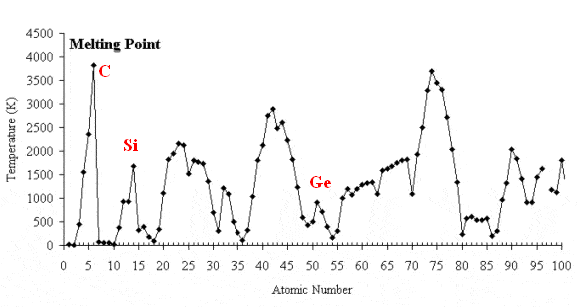
Which element in Period 3 has the highest melting point?

a)

Silicon (Si)

b)

Germanium (Ge)

c)

Carbon (C)

d)

Argon (Ar)

12.
What is the term that describes the adding of energy levels as you move down the periodic table?
a)
multiplying
b)
Shielding
c)
growing 
d)
layering
13.
Why are periodic trends significant in predicting element properties?
a)
Periodic trends allow us to determine the exact mass of an element
b)
Periodic trends help us understand the reactivity and behavior of elements
c)
Periodic trends can be used to calculate the atomic radius of an element
d)
Periodic trends provide information about the number of neutrons in an atom
14.
Which of the following periodic trends increases as you move across a period?
a)
Metallic character
b)
Atomic radius
c)
Electronegativity
d)
Ionization energy
15.
Which of the following periodic trends decreases as you move down a group?
a)
Atomic radius
b)
Ionization energy
c)
Metallic character
d)
Electronegativity
16.
Sodium (Na) and potassium (K) are in the same group on the periodic table. Based on their locations, which statement about sodium and potassium is true?
a)
Sodium is less electronegative than potassium. 
b)
Sodium has fewer energy levels than potassium. 
c)
Sodium has a larger ionic radius than potassium. 
d)
Sodium has lower ionization energy than potassium. 
17.
Fluorine, chlorine, bromine, and iodine all have the same number of valence electrons and have a tendency to gain electrons. Which element has the greatest ionization energy and electronegativity?
a)
fluorine
b)
chlorine 
c)
bromine 
d)
iodine 
18.
All elements found on the left side of the Periodic Table of the Elements have what properties in common?
a)
They conduct heat and electricity 
b)
They are all gases 
c)
They are brittle and dull
d)
They are radioactive
19.

As you move down a group, shielding

a)

increases because there are more shells

b)

increases because there are more protons

c)

decreases because the atomic radius increases

d)

stays constant because the number of valence electrons stays the same

20.
Silicon is a semiconductor and has properties of both metals and nonmetals. What type of element is Silicon? 
a)
Metal
b)
Nonmetal
c)
Metalloid
d)
Pretty