
 Worksheets
Grade 6 Human Geography
Total questions: 33
Worksheet time: 1hrs 15mins
Which is the most populous continent in the world?
Europe
South America
Antarctica
Asia
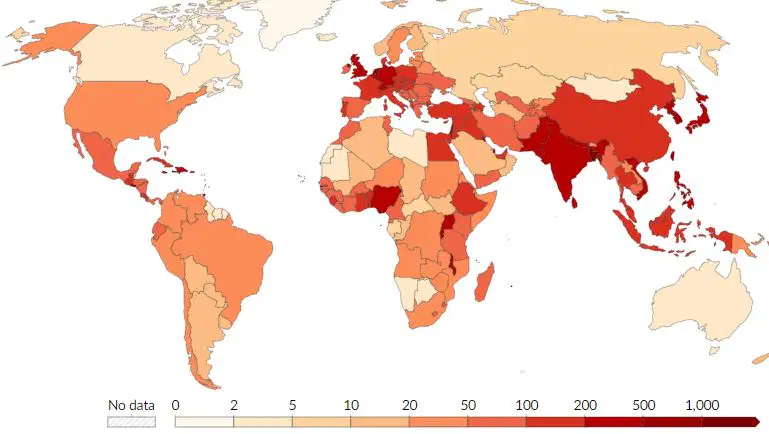
Name one country with a high population density.
India
Canada
Australia
Brazil
Name one major world religion and its primary location of followers.
Buddhism - Africa
Hinduism - Middle East
Islam - Australia
Christianity - Europe and the Americas
What is the difference between a democracy and a dictatorship?
Democracy and dictatorship are the same thing.
Democracy is ruled by a small group, while a dictatorship allows people to choose their leaders.
Democracy is a form of government in which the leader is chosen by birthright, while a dictatorship is elected by the people.
Democracy allows people to choose their leaders, while a dictatorship is ruled by one person or a small group.
Give an example of a renewable resource and a non-renewable resource.
Renewable: Geothermal energy; Non-renewable: Trees
Renewable: Nuclear energy; Non-renewable: Natural gas
Renewable: Wind energy; Non-renewable: Water
Renewable: Solar energy; Non-renewable: Coal
In this style of government, the people govern themselves by voting on individual issues directly.
Oligarchy
Direct Democracy
Representative Democracy
Totalitarianism
What is the world's estimated population as of 2025?
42
8 Billion
350 Million
8.6 Million
Population growth occurs when the birth rate is lower than the death rate.
True
False
Which of the following has NOT contributed to the large population of the world?
Increases in food production
Discoveries in medical science
Improvements in sanitation
Increased CO2 in the atmosphere
Most of the world's population lives in...
North America
Europe
Africa
Asia
One problem faced by the world's population today is:
a decrease in the use of natural resources.
unevenly distributed resources.
not enough food.
too many jobs.
Due to an increase in food supply and better medical care, the world's population has recently
rapidly increased.
made educational gains.
slowly decreased.
remained the same.
Monotheism is the belief in
one god
many gods
all gods
all of the above
What are push factors for population movement? Select all that apply.
a bad economy
no food
war
job opportunities
What are the pull factors that attract people to an area?
freedoms
family
war
money
What type of government is ruled by one person with absolute power?
democracy
monarchy
dictatorship
dialect
Which of the following are examples of nonrenewable resources? Select all that apply.
fossil fuels (oil, gas)
metals
water
trees
Which type of economy is completely controlled by the state (government)?
Market economy
(capitalism)
Traditional economy
Mixed economy
(socialism)
Command economy
(communism)
People tend to settle where there is: (select 3)
Water
Soil for food
Good climate
Other people
In which economic system do people or businesses control prices and goods?
Capitalism
Socialism
Communism
Which two religions have the largest numbers of followers?
Hinduism
Buddhism
Christianity
Islam

Which continent has the lowest population density?
Australia
Europe
North America
Asia
Which of the following is an example of a non-renewable resource?
Hydropower
Solar
Coal
Wind
What is a key characteristic of a monarchy?
Leaders are elected by the people
Power is held by a single ruler, often inherited
All citizens vote on every law
Businesses control the government
Which country is known for having a monarchy?
China
India
United Kingdom
United States
Factors Influencing Human Population Growth
Farming helped human populations grow. When people learned how to farm, they could grow more food. This meant they did not have to move around as much. New ideas like watering crops and planting different crops each year helped food grow better. With more food, more people could live and grow.
Medicine also helped the population grow. Doctors found ways to stop sickness. Vaccines and medicines helped people stay healthy. Clean water and better cleanliness stopped germs from spreading. Because of this, more people lived longer lives.
Money and jobs also helped populations grow. Factories and businesses gave people work. Cities grew as more people moved there. People could go to school, see doctors, and use new tools. But as populations grew, people had to learn how to share food and resources.
What was one of the key factors that allowed humans to produce food more efficiently?
Development of farming techniques
Discovery of vaccines
Industrialization
Advances in sanitation
Which medical innovation helped combat deadly diseases and save countless lives?
Crop rotation
Vaccines
Urbanization
Irrigation systems
How did economic development influence population growth?
By reducing the risk of famine
By improving living standards and access to resources
By introducing crop rotation
By discovering antibiotics
Which of the following is a reason for urbanization?
Decrease in technology
More farmland in cities
Availability of jobs in cities
Increase in rural population
Which of the following best describes international trade?
Trading only with neighboring cities
Exchange of goods and services within a country
Exchange of goods and services between countries
Buying only local products
What is a tariff?
A tax on imported goods
A type of currency
A shipping method
A trade agreement

