
Font size
S
M
L
XL
 Worksheets
CY1U3 - Intro Cyber Security
Total questions: 54
Worksheet time: 28mins
Name
Class
Date
1.
A denial of Service 9DoS) attack is an attack on confidentiality
a)
True
b)
False
2.
Crash Course is a YouTube channel that students and educators use for educational purposes. this entity would likely value the confidentiality of its videos over availability.
a)
True
b)
False
3.
Cyber systems are susceptible to attack from human adversaries
a)
True
b)
False
4.
Cyber attacks can influence history, as they can result in deaths, thefts, or other losses that would not have occurred if the attack had been prevented
a)
True
b)
False
5.
Minimizing vulnerabilities will decrease the likelihood of successful attacks
a)
True
b)
False
6.
Natural disasters and phenomena fall within the category of computer threats
a)
True
b)
False
7.
Which of the following best describes something related to cyber?
a)
Computers
b)
Cell Phones
c)
Internet of things devices
d)
All of the choices are correct
8.
The Creeper was _____________.
a)
The German system for making secret codes
b)
A term for people who create computer viruses
c)
A mechanism for breaking code
d)
A self-replicating program found on the ARPNET
9.
Which area is impacted by cybersecurity?
a)
Communication
b)
Healthcare data (medical records)
c)
Blanking information ( financial records)
d)
Shopping
e)
All of the items listed
10.
Which term defines weaknesses or potential exploits in a computer system?
a)
Threat
b)
Hacking
c)
Vulnerability
d)
Risk
11.
On December 24, 2014, the PlayStation Network and Xbox live were disrupted by a hacker group known as "Lizard Squad". The group overloaded the systems of both services by generating fake access requests thus triggering a denial-of-service error. this is an example of which of the following?
a)
Vulnerability
b)
Hack
c)
Threat
d)
Attack
12.
Anything that can exploit a vulnerability (wether intentionally or accidentally) that obtains, damages, or destroys an assets is which of the following?
a)
Vulnerability
b)
Hack
c)
Threat
d)
Attack
13.
In 2018, an employee at the Coca-Cola company downloaded sensitive data of around 8,000 co-workers on an external hard drive. The sensitivity of the data copied varied from employee to employee. This attack is an example of which of the following threats?
a)
Insider
b)
Nation-State
c)
Criminal Organization
d)
Script Kiddies
14.
A hacker group known as "Turla" has been behind numerous global attacks against political targets for years. The group uses malware from the 'Gazer" family and phishing campaigns and is believed to be backed by the Russian government. Which of the following threat categories best describes Turla?
a)
Insider
b)
Nation-State
c)
Hacktivist
d)
Criminal Organization
15.
Groups that utilize malware such as ransomware and phishing to commit petty crimes for personal gain; these are the threats that internet users are most at risk to encountering online. Which of the following threat actor categories best fits the description?
a)
Insider
b)
Nation-State
c)
Hacktivist
d)
Criminal Organization
16.
In 2007, the Internet vigilante group known as "Anonymous" identified online predator Chris Forcand leading to his arrest by Canadian officials. The group has been behind numerous attacks on targets in the name of social justice. Which of the following threat categories best describes the Anonymous group based on this information?
a)
Insider
b)
Nation-State
c)
Hacktivist
d)
Script Kiddies
17.
in 2015, a 15-year-old hacker was arrested for an attack and subsequent data breach of a major telecom group in the UK. The amateur hacker used combined SQL injection and DDOS techniques to gain access to unencrypted data, which they held to ransom as an extortion attempt to receive payment. the hacker was arrested after a failure to hide their location from cybersecurity professionals. Which of the following threat categories best describes the individual responsible?
a)
Insider
b)
Nation-State
c)
Hacktivist
d)
Script Kiddies
18.
Which of the following is NOT a benefit of the Internet?
a)
Banking and shopping
b)
Collaboration
c)
Entertainment
d)
Loss of Privacy
19.
What are the three components of the CIA triad?
a)
Cybersecurity, information, and accessibility
b)
Cybersecurity, integrity, and authorization
c)
Confidentiality, Integrity, and authorization
d)
Confidentiality, Integrity, and availability
20.
What are some things that threaten CIA?
a)
natural disasters
b)
human error
c)
attackers
d)
none of the above
e)
all of the above
21.
The Trickbot malware was sent out in hundreds of COVID-19-related emails. Trickbot was designed to acquire a user's financial information. this is an attack on ____. Choose the best answer.
a)
Confidentiality
b)
Availability
c)
Integrity
d)
Auditing
e)
All of the above
22.
Faketoken is malware capable of hijacking a user's cell phone and sending out offensive text messages that appear to be form the user. This is an attack on _____.
a)
Confidentiality
b)
Integrity
c)
Availability
d)
Cryptography
23.
Albert wants to send a message to Bernie, but he fears that Elaine may try to intercept the message. Albert should consider _______ the message.
a)
Texting
b)
Encrypting
c)
Resending
d)
Duplicating
24.
In 2019, in order to avoid Black Friday website outages, many retailers opted to increase their cloud capacity. On which component of CIA are the retailers focusing?
a)
Confidentiality
b)
Assurance
c)
Integrity
d)
Availability
25.
The National State Bank has a limited budget to spend on cybersecurity. Which component of the CIA triad would likely be their main focus?
a)
Confidentiality
b)
Availability
c)
Customer satisfaction
d)
None of the above
26.
Passwords, one-time pins, and biometrics (such as fingerprint or eye scanner) are all methods of
a)
Authorization
b)
Authentication
c)
Non-repudiation
d)
Encryption
27.
Which of these disciplines is primarily focused on the protection of computer systems and information from theft, attack, and vulnerabilities
a)
Cybersecurity
b)
Information Technology
c)
Computer Science
d)
Software Engineering
28.
Which of these aspects of daily life rely on software and hardware?
a)
All of the above
b)
Sharing travel and food pictures on Instagram
c)
Getting money out of the ATM
d)
Playing video games
e)
Using Google maps to find a new friend's house
29.
Cybersecurity professionals protect against the people who seek to steal or do harm while sing computer systems. what are these people known as?
a)
Attacks
b)
System penetrators
c)
Cyber villians
d)
Adversaries
30.
Which of the following is NOT a benefit of cybersecurity?
a)
Protects data from theft
b)
Protects system against viruses, worms, spyware, and unwanted programs
c)
Reduces accessibility for the user
d)
Provides confidentiality and privacy through security policies
31.
Which of these is NOT an example of a common computer vulnerability
a)
Insecure passwords
b)
lack of adequate antivirus protection
c)
The use of outdated applications
d)
Multi-factor authentification
e)
unlocked doors and entryways
32.
How does the growing number of devices connected to the internet affect the likelihood that adversaries will be successful in their attacks?
a)
The likelihood of attack increases due to the connected nature of the devices
b)
The likelihood of attack decreases due to increased awareness of Internet safety policies among device users
c)
The likelihood of attack stays the same because the growing number of devices does not affect the number of attackers
d)
There is no relation between the number of Internet-connected devices and the likelihood of attacks
33.
Which term is defined as the measure of the potential damage a vulnerability could cause weighed against the likelihood of an adversary exploiting that vulnerability?
a)
Threats
b)
Countermeasure
c)
Risk
d)
Attack Vector
34.
Which aspects should be considered when calculating risk?
a)
Threats and vulnerabilities
b)
Level of harm and asset value
c)
Likelihood of the event occuring
d)
All of the above
e)
None of the above
35.
When threats take action against vulnerabilities
a)
Attacks
b)
Threats
c)
Vulnerabilities
d)
Authentication
e)
Non-Repudiation
36.
Weaknesses in a computer system
a)
Vulnerabilities
b)
Threats
c)
Attacks
d)
Authentication
e)
Non-Repudation
37.
People or things that can cause damage to a computer system in any form
a)
Threats
b)
Vulnerabilities
c)
Attacks
d)
Authentication
e)
Non-Repudiation
38.
The process of verifying the integrity of the information that has been transmitted using hashing or some other method to ensure the information is complete and unchanged.
a)
Non-Repudiation
b)
Threats
c)
Vulnerabilities
d)
Attacks
e)
Authentication
39.
The first step in any security process by which you verify that someone is who they claim to be
a)
Authentication
b)
Threats
c)
Vulnerabilities
d)
Attacks
e)
Non-Repudiation
40.
Control over the kind and amount of personal information that you share with others
a)
Privacy
b)
Threats
c)
Vulnerabilities
d)
Attacks
e)
Authentication
41.
The process of establishing if the authenticated user is permitted to have access to, and/or act on a resource; can be used interchangeably with access control.
a)
Authorization
b)
Script Kiddies
c)
Cyber Criminals
d)
Corporate Spies
e)
Insiders
42.
Organized groups and individuals who use ransomware phishing, and social engineering to exploit Internet users' vulnerabilities; their main motivation is money (theft)
a)
Cyber Criminals
b)
Authorization
c)
Script Kiddies
d)
Corporate Spies
e)
Insiders
43.
Hackers who are motivated by economic espionage to penetrate rival corporations' systems by using phishing and remote access trojans among other techniques.
a)
Corporate Spies
b)
Authorization
c)
Script Kiddies
d)
Cyber Criminals
e)
Insiders
44.
Amateur hackers with little experience; use scripts and programs made by someone else
a)
Script Kiddies
b)
Authorization
c)
Cyber Criminals
d)
Corporate Spies
e)
Insiders
45.
Highly skilled organized threats who seek to disrupt critical services, create panic or steal data in an attempt to cripple another nation
a)
Nation-States
b)
Authorization
c)
Script Kiddies
d)
Cyber Criminals
e)
Corporate Spies
46.
Usually employees who use social engineering and insider access to steal data or snoop around in files
a)
Insiders
b)
Authorization
c)
Script Kiddies
d)
Cyber Criminals
e)
Corporate Spies
47.
Use denial of service attacks and website graffiti among other methods of attacks to disrupt, vandalize, or bring attention to a topic; their motivations are usually social/political in nature
a)
Hacktivists
b)
Spyware
c)
Trojan Horses
d)
Logic Bomb
e)
Ransomware
48.
Infects a computer or network to render it useless and displays a message that demands a fee to be paid in order to get the contents back
a)
Ransomeware
b)
Hacktivists
c)
Spyware
d)
Trojan Horses
e)
Logic Bomb
49.
Viruses that pose as (or hide within) real software or files
a)
Trojan Horses
b)
Hacktivists
c)
Spyware
d)
Logic Bomb
e)
Ransomeware
50.
Usually bundled with legitimate software; makes unwanted advertisements pop up on the user's screen
a)
Adware
b)
Hacktivists
c)
Spyware
d)
Trojan Horses
e)
Logic Bomb
51.
Gathers private user data from the computer and sends the information to the attacker
a)
Spyware
b)
Hacktivists
c)
Trojan Horse
d)
Logic Bomb
e)
Ransomware
52.
Lie dormant on a system and are only activated to perform their malicious action when certain conditions are met
a)
Logic Bomb
b)
Hacktivists
c)
Spyware
d)
Trojan Horses
e)
Ransomeware
53.
utilizes psychological tricks and human error rather than technical hacking in order to gain the victim's trust and deceive them into giving the attacker access to sensitive information.
a)
Social Engineering
b)
Hacktivists
c)
Spyware
d)
Trojan Horses
e)
Logic Bomb
54.
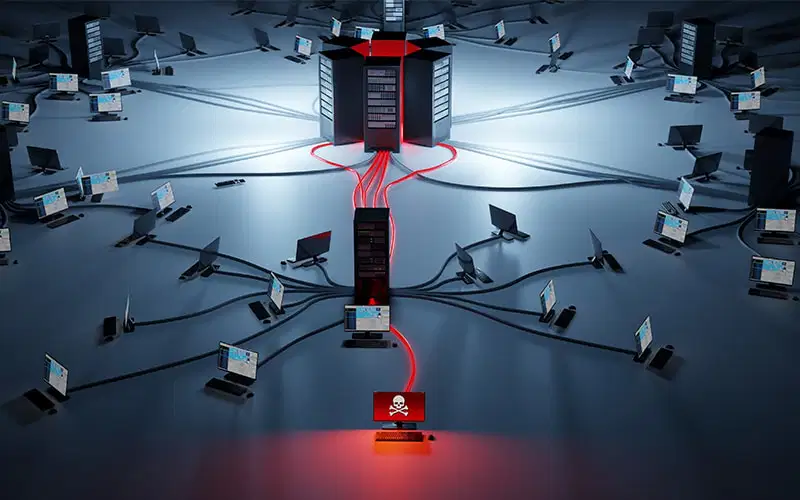
(a) can (b) operations, compromise data integrity, and (c) the enterprise's (d) .
Choose from the below words
Botnets
disrupt business
damage
reputation
Reset

