
NEW
Font size
 Worksheets
Evolution and Natural Selection Quiz
Total questions: 15
Worksheet time: 1hrs 6mins
What is evolution?
The process of animals ADAPTING to their environment
The process of CREATING new species through genetic engineering
The process of organisms staying the SAME over time
The process by which species of organisms CHANGE over time.
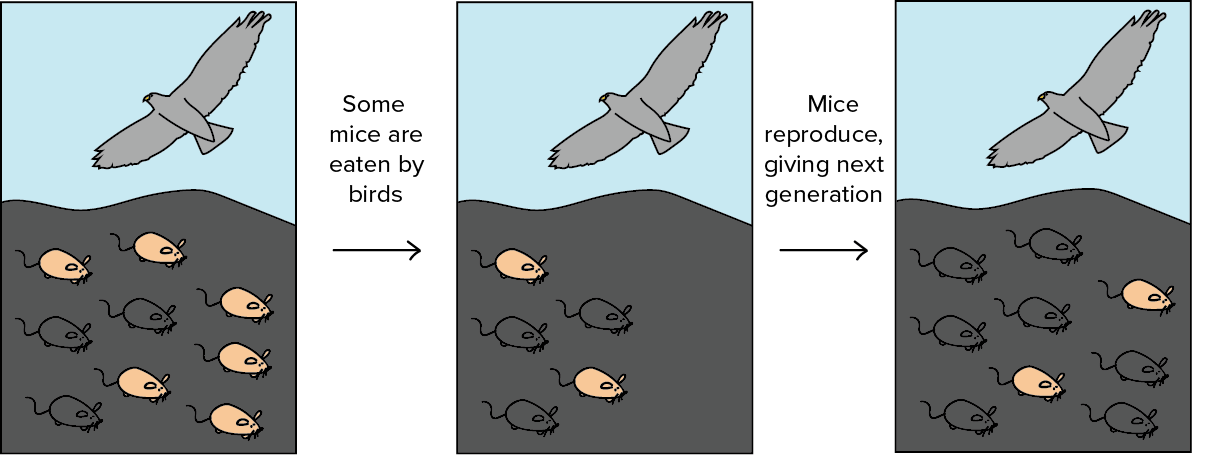
Explain the process of natural selection.
Organisms that are the most colorful tend to survive and produce more offspring.
Organisms that are the biggest in size tend to survive and produce more offspring.
Organisms better adapted to their environment tend to survive and produce more offspring.
Organisms randomly change their genetic makeup over time.
Provide an example of natural selection in action.
Giraffes growing longer necks to reach higher leaves
Peppered moth in England during the industrial revolution
Dogs evolving to have wings and fly
Polar bears turning white to blend in with the snow
How does the concept of adaptation relate to natural selection?
Adaptation is the result of environmental changes forcing organisms to evolve.
Adaptation is the result of natural selection favoring traits that increase an organism's fitness in a particular environment.
Adaptation is the result of organisms choosing to change their traits.
Adaptation is the result of random mutations in an organism's DNA.
What are the different types of evidence that support the theory of evolution?
Fossil records, comparative anatomy, embryology.
Fossil records, astrology, and mythology
Embryology, phrenology, and palmistry
Comparative anatomy, alchemy, and numerology
Who was famous for creating the Theory of Evolution
Carlos Lineaus
Charles Darwin
Mr. Concannon
Watson and Crick
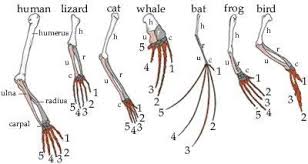
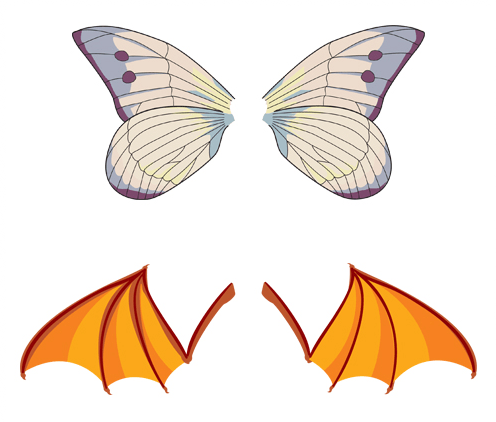
What is this an example of?
Homologous structure
Analogous structure
Vestigial organs
Functional adaption

Which process of evolution is demonstrated below?
Comparative anatomy
Homologous structures
Comparative embryology
Vestigial structures
What is an example of a human vestigial structure?
Wisdom Teeth
Liver
Heart
Tongue
Humans and chimpanzees sharing 98% of the same DNA sequences supports the theory that human and chimpanzees...?
are basically the same species.
have a common ancestor.
developed from each other, and humans evolved from chimpanzees.

