
 Worksheets
3º ESO - Graphic Representation
Total questions: 10
Worksheet time: 5mins
One of the edges of an object measures 75 cm and in the drawing it measures 15 cm. We can say this object has been drawn to a scale of...
5:1
1:5
50:1
0.2
We want to draw a plot of land measuring 3,000 × 900 m. What will the drawing measurements be if we use a scale of 1:50,000?
60 × 18 mm
60 × 18 m
16.6 × 55.5 mm
16.6 × 55.5 m
The primary views of an object are:
The front elevation, the plan and the left or right elevation
The front elevation, the plan and the right elevation
The front elevation, the plan, the left elevation, the right elevation, the rear elevation and the bottom plan
The front elevation and the plan
In cavalier perspective...
The axes can be drawn with any angle of separation between them, as long as it is not the same.
All three axes (X, Y, Z) are separated by the same angle: 120 degrees.
The Y and Z axes form 90-degree angles and the Z axis forms a 120-degree angle.
Two axes form a 90-degree angle with each other and two angles (135 degrees each) with the third axis.
In isometric perspective...
The axes can be drawn with any angle of separation between them, as long as it is not the same.
All three axes (X, Y, Z) are separated by the same angle: 120 degrees.
The Y and Z axes form 90-degree angles and the Z axis forms a 120-degree angle.
Two axes form a 90-degree angle with each other and two angles (135 degrees each) with the third axis.
Indicate which of the following statements about dimensioning is true:
Heavy lines are used for visible outlines.
Fine lines are used for dimension lines and auxiliary dimension lines.
Fine dashed lines are used for hidden outlines.
All the above answers are true.
Indicate which of the following statements is true:
We can scale drawings in three different ways (scaling down, scaling up and full scale) according to the proportion between the object and the drawing.
We can scale drawings in three different ways (scaling down, scaling up and full scale). But normally we only use scaling up and scaling down.
We can scale drawings in two different ways (scaling down and scaling up).
All the above answers are false.
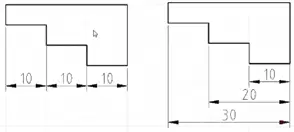
Which of the following figures is correctly dimensioned?
The first one
The second one
Both
None of them

In the figure...
A is a dimension line end point and B is an auxiliary dimension line.
A is an auxiliary dimension line and B is a dimension line end point.
A is a dimension line and B is an auxiliary dimension line.
A is an auxiliary dimension line and B is a dimension line.
Indicate which of the following statements is true:
In cavalier perspective, the figure is represented with its actual size on the X and Y axes.
In cavalier perspective, a reduction coefficient is applied to the Z axis.
In isometric perspective, a reduction coefficient of 4:5 it applied to the three axes but, as this is equal to the three axes, we can produce the drawing without reduction and it will remain proportional.
All the above answers are true.

