
 Worksheets
Finger/Hand
Total questions: 15
Worksheet time: 9mins
Select the 2nd digit PIP and 4th digit DIP.
What is the most common patient position when imaging the fingers or hand?
Standing
Supine
Seated
Recumbent
Select all that apply: Extending the digit(s) prevents...
foreshortening of digit
Rotation of digit
Open IP joints
Closed IP joints
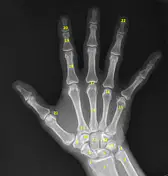
Where is the CR centered in this projection?
2nd PIP
3rd DIP
3rd MCP
2nd MCP
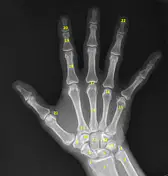
What projection is the thumb positioned for?
PA
PA OBL
Lateral
AP
For the lateral projection of the 4th digit, what side of the hand is against the IR?
Medial side
Lateral side
When performing a PA Obl hand projection, the digits are positioned
parallel to IR
with finger tips touching IR
So that the IP joints are parallel to IR
So that the IP joints are perpendicular to the CR
For the AP thumb projection select the bones that are to be included in the image.
Distal phalanx
Proximal phalanx
Metacarpal
Trapezium
middle phalanx
An image of a correctly positioned lateral projection of the thumb, the proximal phalanx demonstrates
Concavity on the anterior aspect
Concavity on the posterior aspect
Convexity on the posterior aspect
Convexity on the anterior aspect
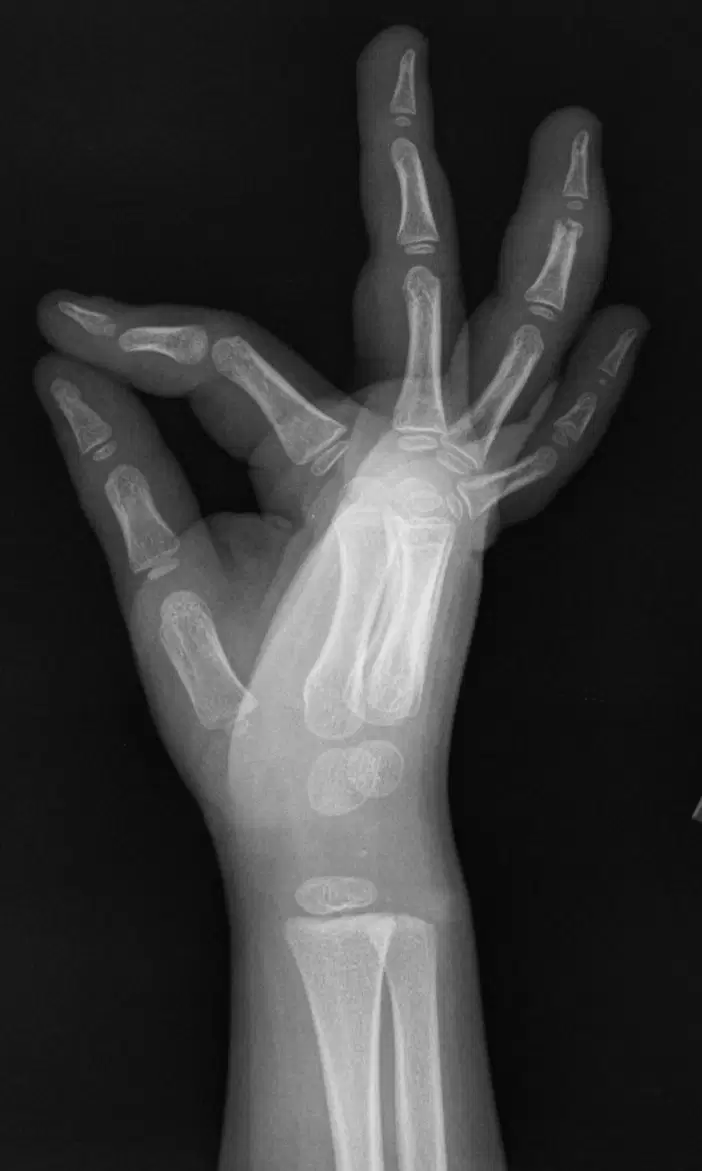
In this lateral projection of a pediatric hand, the scaphoid is positioned
Posteriorly
Anteriorly
How much of the radius is to be included for the PA Obl projection of the hand?
.5 inch of distal radius
.5 of proximal radius
1 inch of proximal radius
1 inch of distal radiaus
What degree of rotation is used for the 3rd digit, PA obl projection?
40 degrees
45 degrees
50 degrees
55 degrees
When imaging the 2nd digit, the forearm is positioned slightly higher than the wrist.
True
False
A lateral projection of a hand demonstrates the 5th MC anterior to the 2nd MC, How was the hand positioned?
Under rotated
True lateral
Over rotated
A PA projection of the 4th digit demonstrates a closed IP joint, what positioning mistake occurred?
Fingers were not separated
Digit was rotated externally
Finger was not extended

