Worksheets
Surah Muminoon Quiz 2 (pg. 327-339)
Total questions: 60
Worksheet time: 41mins

What objection did the chieftains of Prophet Noah's people raise against him?
He lacked clear proof of his prophethood.
He claimed to be superior to them.
He wanted to turn them away from their ancestral worship.
None of the above
How did the Messengers of Allah (Nuh) respond to the objection raised by the people?
They brought clear proof of their prophethood.
They sought the assistance of angels as messengers.
They emphasized that they were human beings like the people.
It is not mentioned in the passage.

What false basis did the people of Noah use to raise objections about the sending of angels as messengers?
They believed that angels could not address humans directly
They claimed that Allah's will was not sufficient.
It is not mentioned in the passage.
They claimed that Allah's will was not sufficient.

According to the passage, what was the response to the people's objection about not hearing of messengers from their forefathers?
The people's forefathers were guided, so there was no need for messengers.
The people's forefathers were not guided, so they should praise and thank Allah.
It is not mentioned in the passage.
Both a and b.
What lesson can be learned from the passage?
Prophets and messengers are chosen by Allah and are human beings.
Objections to the messengers based on false arguments are not valid.
Ignorance should not be used as a basis for rejecting the message of the messengers.
All of the above.

What do the arguments given by the rejecters of their Prophet indicate?
Extreme gratitude and openness
Extreme ignorance and misguidedness
Complete agreement and acceptance

Why did the rejecters claim that the Prophet Nuh wanted to make himself superior to them?
They believed he had rational thinking abilities
They were deceived by his leadership qualities
They wanted to warn others against him

How does Allah respond to those who oppose Him and His Messengers?
He rewards them with wealth and power
He exposes and disgraces them
He forgives them unconditionally

Why did Prophet Nuh ask Allah for help?
Because he was angry with the disbelievers
Because he wanted to mislead the disbelievers
Because the disbelievers rejected and neglected Allah's command and Messenger
How did Allah respond to Prophet Nuh's call?
Allah punished the disbelievers immediately
Allah left the disbelievers on earth
Allah answered his call excellently

What means of saving himself did Allah inspire Prophet Nuh with?
To build an ark under Allah's supervision
To seek help from other people
To leave the disbelievers and save himself

What did the command from Allah entail? (Hint: for building the ark.)
Sending a flood to punish the disbelievers
Creating springs bursting forth from the earth
Saving every living soul from the disbelievers

Whom did Prophet Nuh take on board the ark?
Every animal on earth
Only his family members
A pair (male and female) of every animal species, except those against whom the sentence had already been passed

Why did Prophet Nuh and those with him praise Allah?
For saving them from the evildoers
For granting them safety on the ark
For fulfilling their supplication
What did Prophet Nuh ask Allah for after being on the ark?
To grant blessings upon the communities with them
To bring the evildoers to justice
To make it easy for them to land at a blessed place
None of the above

Where did the ark come to rest?
Mount al-Judi
Mount Everest
Mount Sinai
Mount Shabab

What did Allah say to Prophet Nuh when the ark came to rest?
Disembark with safety granted by Us
Gather the communities and start anew
Stay on the ark for a while longer

What did the ark symbolize according to Allah?
A sign of Allah's mercy towards His slaves
A punishment for the people of the earth
A test for Prophet Nuh and his followers
What nation came after the destruction of Prophet Nuh's people?
Thamood
'Ad
Madyan
Quraysh

What was the occupation of the Messenger (prophet Salih peace be upon him) sent to the Thamood people?
Prophet
King
Shepherd

What was the primary message of the Messenger sent to the Thamood people?
Believe in the meeting in the Hereafter
Worship Allah and abandon idol worship
Seek ease and comfort in this worldly life
Run a marathon.
How did the chieftains of the Thamood people react to the Messenger's message?
They disbelieved, denied the meeting in the Hereafter, and were comfortable in their worldly life
They believed in the meeting in the Hereafter
They denied the existence of idols

What argument did the chieftains of the Thamood people use against the Messenger?
They claimed he was an angel who doesn't eat or drink
They accused him of being a man of a different nationality
They argued that he had no special qualities as he ate and drank like them
Why did the chieftains of the Thamood people consider following a man like themselves as a sign of losing?
They believed that following a human leader was against their intelligence
They thought it would lead to error and madness
They feared they would regret their decision later
Regretful

What was the attitude of those who refused to follow the Messenger chosen by Allah?
They were considered wise and intelligent
They regretted their decision and submitted to him later
They were arrogant and sank to the level of worshipping trees and rocks

How did the Thamood people describe the Messenger (Prophet Salih) sent to them?
An insolent liar
A person who possessed great wisdom and knowledge
A man chosen by Allah for His revelation
None of the above

What did the Thamood people fear would happen if they followed the Messenger?
They would lose their intelligence
They would regret their decision
They would fall into error and madness

Why did the Thamood people reject the idea of following a "single human" as their leader?
They believed the message should have been sent to all of them collectively
They considered themselves superior to the Messenger
They thought following a human leader was against their traditions

What did the Thamood people deny in relation to the Messenger's message?
The existence of resurrection after death
The significance of good deeds
The importance of faith in Allah

How did the Thamood people view the promise of resurrection after disintegration?
Highly probable and believable
Unlikely and far-fetched
Certain and undeniable
What flaw was present in the Thamood people's view?
They underestimated the power of Allah
They compared their own abilities to that of the Creator
They misunderstood the teachings of the Messenger

What is the proof mentioned in the text regarding resurrection?
The scientific evidence supporting resurrection
The ability of Allah to revive dead earth
The testimonies of believers who witnessed resurrection

How did the disbelievers respond to the Messenger's message of resurrection?
They acknowledged its truth and embraced it
They considered it strange and farfetched
They remained indifferent and didn't express any opinion

What did Allah mention in response to the disbelievers' denial of resurrection?
The preservation of their records after death
The knowledge of what the earth consumes of them
The consequences of their disbelief in the hereafter

How did the disbelievers describe the Messenger? (Hint: Prophet Salih peace be upon him)
A man with great wisdom and knowledge
A person with madness and insanity
A respected leader chosen by Allah
What did the Prophet pray for in response to the rejection of the disbelievers?
Patience and perseverance for himself
Forgiveness and guidance for the disbelievers
Destruction and disgrace for the disbelievers

What was the response of Allah to the Prophet's supplication?
A promise of regret for the disbelievers
Immediate punishment for the disbelievers
Help and support for the Prophet
How did the Thamood people respond to the Messenger's message after his supplication? (Hint: prophet Salih)
They embraced Islam and repented for their disbelief
They expressed regret and sought forgiveness from Allah
They persistently rejected the message and remained in disbelief

Why was the punishment inflicted upon the Thamood people considered justified?
Because of their wrongdoing
As a result of an unjust divine decree
Due to their innocence and righteousness

How were the Thamood people likened to refuse swept away by a torrent?
They were physically swept away by a powerful flood
They were scattered and destroyed like dry stubble
They were condemned and rejected by the entire community
In what manner did heaven and earth react to the destruction of the Thamood people?
They wept and mourned for their loss
They neither wept for them nor gave respite
They rejoiced over their downfall

What was the customary attitude of the wicked and disbelieving nations towards the Messengers?
They readily accepted and embraced their messages
They rejected and disbelieved in them
They remained indifferent and unresponsive

What did each Messenger bring that would be sufficient basis for belief?
Miraculous signs and wonders
Logical arguments and philosophical insights
Material wealth and prosperity

What happened to the dwellings of the disbelieving nations after they were gone?
They were destroyed and their dwellings stood empty after they were gone
They were inhabited by new nations
They remained intact and unchanged
What purpose did the stories of the disbelieving nations serve?
To warn and guide the pious
To entertain future generations
To glorify the disbelievers' actions
A punishment to the disbelievers

How are the disbelieving people described in the text?
As fortunate and successful individuals
As wretched and unfortunate losers
As righteous and pious believers

According to the unnamed scholar mentioned, what did Allah prescribe as a way to deal with stubborn deniers after sending Prophet Moses and revealing the Torah?
Eradicating the nations through punishment
Implementing jihad as a means of addressing denial
Offering forgiveness and guidance to the deniers

How did the unnamed scholar likely reach the conclusion about the prescription of jihad?
Through personal revelation and divine inspiration
Based on reflections on the mentioned verses and others
By consulting other scholars and studying historical accounts
What did Allah send to Prophet Moses after the destruction of the previous nations? (Hint: Prophet Musa Peace be upon him)
The Injeel (Gospel)
The Zabur (Psalms)
The Torah (Book)

What did the Torah contain, according to the text?
Guidance for people and enlightenment for mankind and mercy.
Historical accounts of previous nations' destruction
Punishments for stubborn deniers

What does the verse from Surah al-Qasas indicate about the timing of giving Prophet Moses the Book (Torah)?
It was given to him before the destruction of the previous nations
It was given to him simultaneously with the destruction of the previous nations
It was given to him after the destruction of the previous nations
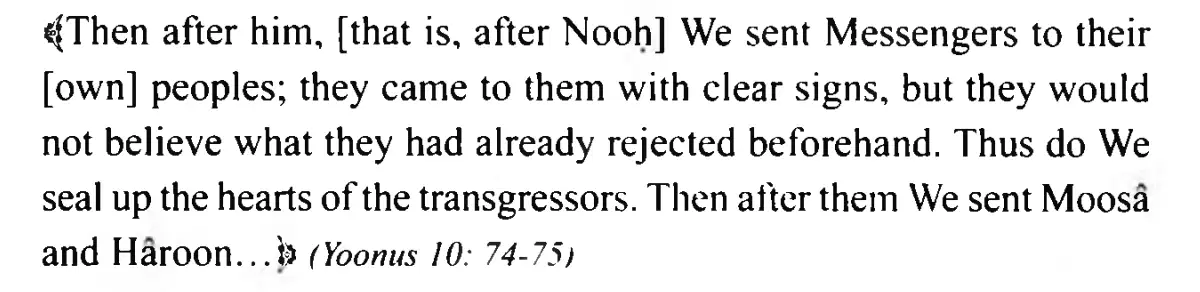
How did the hearts of the transgressors become sealed, according to the mentioned verses?
As a result of their ignorance and lack of understanding
Due to their rejection of the Messengers' signs and they had already rejected beforehand
Because of their sincere belief in the Messengers' message
What is the significance of Prophet Musa and his brother Prophet Haroon mentioned in the text?
They were renowned for their wisdom and leadership
They were known for their close relationship with Allah
They were Messengers sent to their respective peoples
What is another name for Musa ibn Imran?
Kaleem ar-Rahman
as-Sadiq ul-Amin

What did the clear signs and compelling proofs brought by Prophet Moses and Haroon demonstrate?
The sincerity and truthfulness of their message
The power and authority of the Pharaoh
The ignorance and disbelief of the Children of Israel
How did Pharaoh respond to Prophet Musa signs and request for the release of the Children of Israel?
He recognized the truth and released the Children of Israel
He accused Moses of being bewitched or enchanted
He sought guidance and wisdom from Musa and Haron
What did Prophet Musa emphasize to Pharaoh regarding the signs and evidence?
They were the result of his own power and authority
They were sent by the Lord of the heavens and the earth
They were insignificant and had no real significance
How many clear signs were given to Moses, as mentioned in the text?
Three clear signs
Six clear signs
Nine clear signs
Fifty clear signs
What impact did the compelling proofs have on the hearts of the believers and the stubborn?
The hearts of the believers were strengthened, while the stubborn remained unchanged
The hearts of the believers submitted to them, and the clear proof was established against the stubborn
The hearts of both the believers and the stubborn were hardened
Draw the page number you stopped on