
 Worksheets
Fusion g6 Unit 1 and Unit 3 What are the characteristics of cell
Total questions: 162
Worksheet time: 3hrs 33mins
An organism with more than one cell is known as a/an
organ system
multicellular organism
unicellular organism
Which organism represents a multicellular organism?


What does mitochondria do for the cell?
provides the cells energy
is the cell's control center
fills and supports the cell

What does cytoplasm do for the cell?
provides energy
stores water, food, and wast
fills and supports the cell structure

Which structure represents the mitochondria?
A
B
C
D
E
Which structure enables a plant to perform photosynthesis?
cell wall
cell membrane
mitochondria
chloroplast
Which part of the cell allows materials to move in an out of the cell?
cell wall
cell membrane
vacuole
nucleus
When an organism has many organs working together for the same purpose, they form a/an
tissue
organ
organ system
multicellular organism
A cell is-
an organism made up of one cell.
a structure that stores food and water.
the smallest unit of a living organism.
Which of the following is a plant cell?


The control center of the cell is known as...
cytoplasm
mitochondria
nucleus
chloroplast
What is the purpose of the nucleus?
supply energy to the cell
control the cell functions
store waste, water, and food
make food for the organism
The difference between a prokaryotic cell and a eukaryotic cell is that
only one has a nucleus
they are not different
one is blue, the other is red
An organism with only one cell is known best as...
a disease
plankton
multicellular organism
unicellular organism
An organism is...
a membrane within a cell
a multicellular or unicellular creature
the smallest unit of a living thing
a liver, heart, brain, or lung in your body
The purpose of the cell wall is to provide
energy
storage
support
sugar
Which level of organization is missing?
- organism
- organ system
- organs
- __________
- cell
- organelle
tissue
prokaryotic
multicellular
eukaryotic


1. Made of many cells
2. Each cell has a nucleus
3. Eats other organisms
4. Can move itself around
Which word would describe this organism?
1. Cells have nuclei
2. Cannot move itself
3. Makes its own food
4. Made of many cells
Which word would NOT describe this organism?
1. Cannot move itself around
2. Absorbs food particles
3. Made of many cells
4. Cells have nuclei
Which word cannot be used to describe this organism?
1. Has a nucleus
2. Made of one cell
3. Has cilia for movement
4. Makes its own food
Which word would describe this organism?
The building block of living things
Structure
Function
Cell
unicellular
Creature with only one cell
unicellular
multicellular
cell
organism
Creature with many cell
unicellular
multicellular
cell
organism
Any complete living thing
Cell
Function
Structure
Organism
What can a scientist use microscope to determine?
If it is multicellular
If it is unicellular
If it can be safely eaten
If it is non-living
If it is living
Prokaryotic organisms are always
single celled
multicellular
non-living
hungry
function
Eukaryotic cells can be found in
bacteria
plants
animals
fungi
unicellular organisms
unicellular organisms are
eukaryotic
non-living
prokaryotic
structure and function
What is an example of a function in a part of the body?
Your arm is made from two bones
An adult mouth has 32 teeth in it
Every eukaryotic cell has a nucleus
The cell wall lets things in and out of the cell
How can a scientist best determine if an organism is multicellular or unicellular?
See if the cells have organelles
Look to see how many cells there are
Determine the size of the cells
Look it up in an encyclopedia
This is the basic unit of all life.
prokaryotic cell
eukaryotic cell
cell
cell membrane
A scientist found some weird slime near a pond. What would he need to do to determine if some part of the slime were a living thing?
Stir up the slime and see if anything moves
Look with a microscope for the presence of cells
Put the slime in the pond and see what happens
Collect some slime and see if anything grows from it
The genetic material in all cells is called
DNA
cytoplasm
eukaryotic
prokaryotic
Plants & animals have some things in common. Like all living things, one of the things they have in common is
They learn how to do many things
They all communicate with each other
They all consume some other organism for energy
They all are made of one or more cells
What type of cells are you made of?
Eukaryotic cells
Prokaryotic cells
Plant cells
Fungi cells
Which is true?
Prokaryotic cells are larger than eukaryotic cells
Eukaryotic cells are larger than prokaryotic cells
Cells are mostly the same size
How can you tell if a cell is prokaryotic or eukaryotic?
Take its temperature
Use a telescope to look at it from far away
Use a microscope to look for a nucleus in the cell
Measure the cell's mass

What type of cell is this?
prokaryotic
eukaryotic

What type of cell is this?
Prokaryotic cell
Eukaryotic cell
What do prokaryotic cells & eukaryotic cells have in common?
Both have a nucleus
Both are found in multicellular organisms
Both have genetic material
Both have a cell wall

Where is the DNA located in this cell?
K (pointing from top left)
L (pointing from top right)
M (pointing from bottom right)

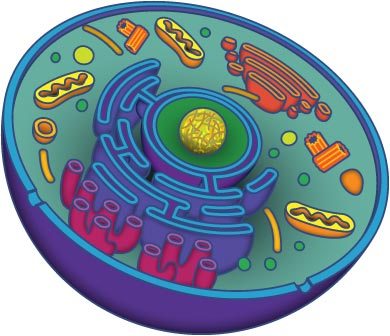
Identify the purple stuff in this cell.
cell membrane
cytoplasm
nucleus
DNA

Identify the purple structure with the yellow center
cell membrane
cytoplasm
nucleus
prokaryote

What identifies this cell as eukaryotic?
presence of DNA
presence of a cell membrane
presence of a nucleus
absence of DNA
All organisms are composed of one or more
bones
cells
DNAs
cell membranes
All living things share some characteristics. For example, all organisms -
are made up of one or more cells.
make their own food from sunlight.
have a skeleton to provide support.
emerge, at birth, from some type of egg.
Unlike prokaryotic cells, eukaryotic cells have their genetic material centrally located in a –
chloroplast.
vacuole.
lysosome.
nucleus.
Human beings share some characteristics with all other organisms. Humans, and all other living things, -
communicate emotions through facial expressions.
must consume other organisms for energy.
are made up of one or more cells.
require several years to reach full maturity.
A eukaryotic cell can be distinguished from a prokaryotic cell because only a eukaryotic cell will have -
DNA.
a cell wall.
a nucleus.
cytoplasm.
In order to classify a cell as prokaryotic or eukaryotic, it must be determined if the cell –
grows larger throughout its life.
can move from place to place.
is able to make copies of itself.
has its genetic material in a nucleus.
1-The smallest tiny structures that build up all living organism's bodies are...........................
a. systems.
b. cells.
c. organs.
d. bricks.
2. We can see the cell of ................................................without using a microscope.
a. bacteria
b. plant
c. human
d. bird's egg
3. The ...................... is responsible for the entry and exit of water into and out of the cell.
a. cell membrane
b. muscle cell
c. nucleus cell
d. bone cell
4. The number of cells which build up a baby's body is........................... which build up his father's body. the number of cells which build up the number of the father's cell
a. more than
b. less than
c. equal to
d. double
5-The structure(s) found in the plant cell and not found in animal cell is/are............................
a. cell membrane only.
. b. cell wall only.
c. cell membrane and nucleus.
d. cell wall and nucleus.
6. The cell needs ............................................to get its needed energy and to stay alive.
a. oxygen only
b. water only
c. food and water only
d. food, oxygen and water
7. Growth of a living organism is resulted from increasing the.................................of cells in its body
a. length
b. size
c. number
d. mass
8. The body of........................................... . is composed of one cell only.
a. human
b. bacteria
c. a big tree
d. an elephant
9. All the following living organisms bodies are build up of many cells , except...........................................
a. human
b. fish
c. plant
d. bacteria.
All things are made up of one or more cells.
True
False
All cells are the same size.
True
False
All cells come from existing cells.
True
False
Who observed thin slices of cork under the microscope and named the boxlike structures "cells "?
Anton Van Leeuwenhoek
Robert Hooke
Theodore Schwann
Rudolf Virchow
He concluded that plants are made of cells.
Anton Van Leeuwenhoek
Robert Hooke
Theodore Schwann
Matthias Schleiden
He was the first person to describe actual living cells when he looked at a drop of pond water under a microscope.
Anton Van Leeuwenhoek
Robert Hooke
Theodore Schwann
Matthias Schleiden
In 1839, he determined that all animal tissues are made of cells.
Anton Van Leeuwenhoek
Robert Hooke
Theodore Schwann
Matthias Schleiden
In 1858, ___________ proposed that cells could form only from the division of other cells.
Theodore Schwann
Rudolf Virchow
Matthias Schleiden
Anton Van Leeuwenhoek
It is a protective layer that covers a cell's surface.
cytoplasm
cell membrane
nucleus
organelle
It is a genetic material that provides instructions for all cell processes.
cytoplasm
cell membrane
DNA
organelle
Organisms made up of just one cell are called__________.
homocellular
unicellular
multicellular
heterocellular

The region inside the cell that includes the fluid and all the organelles except for the nucleus.
cell wall
cell membrane
cytoplasm
vacuole
A membrane-bound organelle that contains DNA.
cytoplasm
cell membrane
mitochondrion
nucleus
Single-celled organisms that do not have a nucleus or membrane-bound organelles.
unicellular
eukaryotes
prokaryotes
homocellular
All eukaryotes are multicellular organisms.
True
False
Organisms made up of cells that contain DNA in a nucleus, membrane-bound organelles, and ribosomes.
unicellular
multicellular
eukaryotes
prokaryotes
Which organism has its DNA in the cytoplasm?
eukaryote
prokaryote

Solve for the surface area to volume ratio of this cube if each side measures 7 cm.
7cm² : 6cm³
6cm² : 5cm³
6cm² : 7cm³
5cm² : 6cm³
A substance that cannot be broken down into a simpler substance.
atom
element
compound
molecule
A group of atoms held together by chemical bonds.
molecule
compound
A substance made up of atoms of two or more elements joined by chemical bonds.
molecule
compound
element
Which cell type tends to be smaller?
Prokaryote
Eukaryote
there is not a size difference
The presence of which of the following characteristics differentiates prokaryotic and eukaryotic cells?
DNA
Ribosomes
Nucleus
Cytoplasm
Plant and animal cells are examples of
prokaryotic cells
eukaryotic cells
Which of the following is only found in EUKARYOTIC cells?
nucleus
DNA
cell membrane
ribosomes

A table with characteristics of three different cells is shown. Cell 2 is a _____.
prokaryote
eukaryote
The smallest unit of a living thing are
atoms
cells
DNA
organelles
Bacteria is an example of a(n)
prokaryotic cell.
eukaryotic cell.
What is NOT apart of the Cell Theory?
all cells come from existing cells
all cells have a nucleus
all living things are made of cells
cells are basic unit of structure and function in living things
A table with characteristics of three different cells is shown. Cell 1 is a _____.
prokaryote
eukaryote
True or False: Eukaryotic cells are small, simple cells
True
False
1. Made of many cells
2. Each cell has a nucleus
3. Eats other organisms
4. Can move itself around
Which word would describe this organism?
1. Cells have nuclei
2. Cannot move itself
3. Makes its own food
4. Made of many cells
Which word would NOT describe this organism?
1. Cannot move itself around
2. Absorbs food particles
3. Made of many cells
4. Cells have nuclei
Which word cannot be used to describe this organism?
1. Has a nucleus
2. Made of one cell
3. Has cilia for movement
4. Makes its own food
Which word would describe this organism?
Organelles are tiny organ like structures found in cells that have specific jobs.
True
False
A protective boundary of a cell that lets substances in and out of the cell
cell wall
ribosomes
cell membrane
nucleus
What is the function of the cytoplasm?
To store food, water and other materials
A fluid inside the cell that organelles float in and are kept in place
A stiff structure outside the cell that protects the cell from attack from viruses and other harmful substances
Provides energy for the cell

Which 2 organelles are found only in plant cells?
Cell wall
nucleus
chloroplast
mitochondria
An organelle that produces (makes) proteins is called
Golgi Apparatus
Nucleus
Ribosome
Cell membrane
The smooth part of this organelle that helps remove harmful substances from the cell
Endoplasmic Reticulum
cytoplasm
nucleus
ribosome
An organelle that stores food, water and other materials
mitochondria
cell wall
nucleus
Vacuole
An organelle that prepares proteins for their job and then packages them to be sent around the cell
Golgi Apparatus
Mitochondria
cell membrane
cytoplasm
An organelle that use light energy to make food (glucose)
ribosome
chloroplast
cell wall
nucleus
The organelle that controls all the cell's activities
mitochondria
cytoplasm
nucleus
cell membrane
True or false: All cells are the same shape and size and job
True
False
True or false: Animal cells and plant cells have all of the same organelles.
True
False
An organelle that provides plants structure, support and protection
nucleus
cell wall
cytoplasm
ribosome
The organelle that powers the cell through chemical reactions
cell membrane
mitochondria
nucleus
ribosome
True or false: Anything can enter and leave a cell.
True
False
1. The body of unicellular organism consists of............................
a. one cell only.
b. three cells only.
c. six cells only.
d. many cells.
2. All the following organisms are examples of multicellular organisms, except...........................
a. human.
b. horse.
c. bacteria.
d. apple tree.
3- The gelatinous liquid which is found inside the cell is known as.........................
a. nucleus.
b. cytoplasm.
c. cell membrane.
d. organelles.
4-All the following parts are from the main parts of animal cell, except...........................
a. cell membrane.
b. cytoplasm.
c. cell wall.
d. nucleus.
5-Nucleus is responsible for controling ..............................
a. formation of proteins only.
b. cell division only.
c. formation of proteins and cell division.
d. formation of proteins and energy production.
6-The organelles which provide the cell with the needed energy are called............................
a. endoplasmic reticulum.
b. golgi apparatus.
`
c. mitochondria.
d. cell membrane.

