
 Worksheets
Latihan TEP
Total questions: 11
Worksheet time: 6mins
READING SECTION
A number of factors related to the voice reveal the personality of the speaker. The first is the broad area of communication, which includes imparting information by use of language, communicating with a group or an individual, and specialized communication through performance. A person conveys thoughts and ideas through choice of words, by a tone of voice that is pleasant or unpleasant, gentle or harsh, by the rhythm that is inherent within the language itself, and by speech rhythms that are fl owing and regular or uneven and hesitant, and finally, by the pitch and melody of the utterance. When speaking before a group, a person’s tone may indicate unsureness or fright, confidence or calm. At interpersonal levels, the tone may reflect ideas and feelings over and above the words chosen, or may belie them. Here the conversant’s tone can consciously or unconsciously reflect intuitive sympathy or antipathy, lack of concern or interest, fatigue, anxiety, enthusiasm or excitement, all of which are .usually discernible by the acute listener. Public performance is a manner of communication that is highly specialized with its own techniques for obtaining effects by voice and / or gesture. The motivation derived from the text, and in the case of singing, the music, in combination with the performer’s skills, personality, and ability to create empathy will determine the success of artistic, political, or pedagogic communication. Second, the voice gives psychological clues to a person’s self-image, perception of others, and emotional health. Self-image can be indicated by a tone of voice that is confident, pretentious, shy, aggressive, outgoing, or exuberant, to name only a few personality traits. Also the sound may give a clue to the facade or mask of that person, for example, a shy person hiding behind an overconfident front. How a speaker perceives the listener’s receptiveness, interest, or sympathy in any given conversation can drastically alter the tone of presentation, by encouraging or discouraging the speaker. Emotional health is evidenced in the voice by free and melodic sounds of the happy, by constricted and harsh sound of the angry, and by dull and lethargic qualities of the depressed.
Question : What does the passage mainly discuss?
The function of the voice in performance
The connection between voice and
personality
Communication styles
The production of speech
A number of factors related to the voice reveal the personality of the speaker. The first is the broad area of communication, which includes imparting information by use of language, communicating with a group or an individual, and specialized communication through performance. A person conveys thoughts and ideas through choice of words, by a tone of voice that is pleasant or unpleasant, gentle or harsh, by the rhythm that is inherent within the language itself, and by speech rhythms that are fl owing and regular or uneven and hesitant, and finally, by the pitch and melody of the utterance. When speaking before a group, a person’s tone may indicate unsureness or fright, confidence or calm. At interpersonal levels, the tone may reflect ideas and feelings over and above the words chosen, or may belie them. Here the conversant’s tone can consciously or unconsciously reflect intuitive sympathy or antipathy, lack of concern or interest, fatigue, anxiety, enthusiasm or excitement, all of which are .usually discernible by the acute listener. Public performance is a manner of communication that is highly specialized with its own techniques for obtaining effects by voice and / or gesture. The motivation derived from the text, and in the case of singing, the music, in combination with the performer’s skills, personality, and ability to create empathy will determine the success of artistic, political, or pedagogic communication. Second, the voice gives psychological clues to a person’s self-image, perception of others, and emotional health. Self-image can be indicated by a tone of voice that is confident, pretentious, shy, aggressive, outgoing, or exuberant, to name only a few personality traits. Also the sound may give a clue to the facade or mask of that person, for example, a shy person hiding behind an overconfident front. How a speaker perceives the listener’s receptiveness, interest, or sympathy in any given conversation can drastically alter the tone of presentation, by encouraging or discouraging the speaker. Emotional health is evidenced in the voice by free and melodic sounds of the happy, by constricted and harsh sound of the angry, and by dull and lethargic qualities of the depressed.
Question : What does the author mean by stating that “At interpersonal levels, tone may reflect ideas and feelings over and above the words chosen” (lines 9-10)?
Feelings are expressed with different words than ideas are
The tone of voice can carry information beyond the meaning of words.
A high tone of voice reflects an emotional communication.
(A) Feelings are more difficult to express than ideas
A number of factors related to the voice reveal the personality of the speaker. The first is the broad area of communication, which includes imparting information by use of language, communicating with a group or an individual, and specialized communication through performance. A person conveys thoughts and ideas through choice of words, by a tone of voice that is pleasant or unpleasant, gentle or harsh, by the rhythm that is inherent within the language itself, and by speech rhythms that are fl owing and regular or uneven and hesitant, and finally, by the pitch and melody of the utterance. When speaking before a group, a person’s tone may indicate unsureness or fright, confidence or calm. At interpersonal levels, the tone may reflect ideas and feelings over and above the words chosen, or may belie them. Here the conversant’s tone can consciously or unconsciously reflect intuitive sympathy or antipathy, lack of concern or interest, fatigue, anxiety, enthusiasm or excitement, all of which are .usually discernible by the acute listener. Public performance is a manner of communication that is highly specialized with its own techniques for obtaining effects by voice and / or gesture. The motivation derived from the text, and in the case of singing, the music, in combination with the performer’s skills, personality, and ability to create empathy will determine the success of artistic, political, or pedagogic communication. Second, the voice gives psychological clues to a person’s self-image, perception of others, and emotional health. Self-image can be indicated by a tone of voice that is confident, pretentious, shy, aggressive, outgoing, or exuberant, to name only a few personality traits. Also the sound may give a clue to the facade or mask of that person, for example, a shy person hiding behind an overconfident front. How a speaker perceives the listener’s receptiveness, interest, or sympathy in any given conversation can drastically alter the tone of presentation, by encouraging or discouraging the speaker. Emotional health is evidenced in the voice by free and melodic sounds of the happy, by constricted and harsh sound of the angry, and by dull and lethargic qualities of the depressed.
Question : The word “evidenced” in line 25 is closest in meaning to
questioned
repeated
indicated
exaggerated
Amanda Way’s career as a social reformer ____ in 1851 when, at an antislavery meeting in Indiana, she called for a state woman’s rights convention.
begin
began
have begun
to have begun
The celesta, an orchestral percussion instrument, resembles ___
a small upright piano
how a small upright piano
a small upright piano is
as a small upright piano
_____ primarily from plant oils, perfumes were used in ancient times as incense in religious rites, in medicines, and later for adornment.
Made them
They made
Made
By making
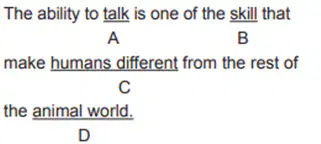
The four underlined parts of the sentence are marked (A), (B), (C), and (D). Identify the one underlined word or phrase that must be changed in order for the sentence to be correct. Then, on your answer sheet, fi nd the number of the question and fi ll in the space that corresponds to the letter of the answer you have chosen.
A
B
C
D
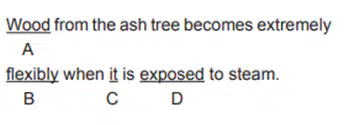
The four underlined parts of the sentence are marked (A), (B), (C), and (D). Identify the one underlined word or phrase that must be changed in order for the sentence to be correct. Then, on your answer sheet, find the number of the question and fill in the space that corresponds to the letter of the answer you have chosen.
A
B
C
D
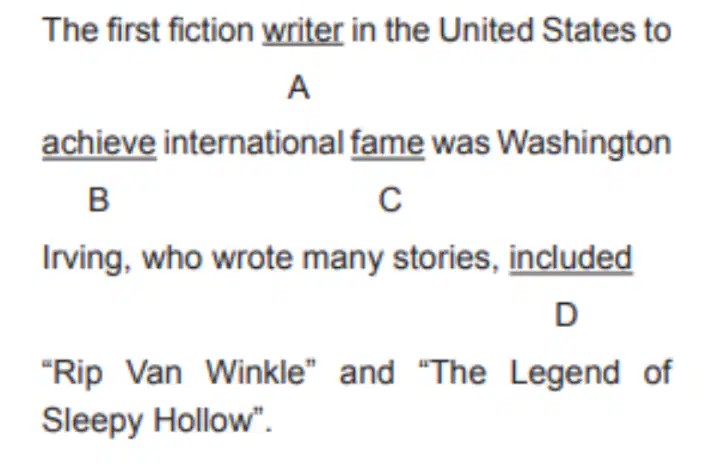
The four underlined parts of the sentence are marked (A), (B), (C), and (D). Identify the one underlined word or phrase that must be changed in order for the sentence to be correct. Then, on your answer sheet, find the number of the question and fill in the space that corresponds to the letter of the answer you have chosen.
A
B
C
D
The synchronization of music with repetitive exercise provides enhanced physical performance helping people both work out for longer and_____
more training effectively
trained more effectively
more trains effectively
train more effectively

It is inferred that fluoride____
Stimulates saliva production
Makes teeth whiter
Replaces the function of brushing and flossing in dental care
Can strengthen tooth enamel

