
 Worksheets
NGE Intro 2017
Total questions: 40
Worksheet time: 54mins
The letter following ν (nu), ξ (xi/ksi), ο (omicron) in the Greek alphabet is
ρ (rho)
χ (chi)
τ (tau)
π (pi)
The letter preceding ι (iota), κ (kappa), λ (lambda) in the Greek alphabet is
θ (theta)
ξ (xi/ksi)
χ (chi)
ψ (psi)
The letter phi in the Greek alphabet is
β
η
ω
φ
A Greek transliteration of the English word kyrie is
χγριε
ξυρυε
κυριε
ζυρυε
The preposition διά means
around
under
through
from
The prefix which means “all” is
εὐ
ἀπό
πᾶν
σύν
The author known as the “Father of Tragedy” who produced the Oresteia trilogy is
Aeschylus
Sophocles
Euripides
Thucydides
In Greek history, the Spartan king who commanded the 300 at the Battle of Thermopylae in 480 BC was
Alexander the Great
Darius I
Leonidas
Pericles
The upper case (capital) equivalent of the letter η (eta) in the Greek alphabet is
Δ
Η
Γ
Ν
The Greek god who rules over the oceans and carries a trident is
Hermes
Zeus
Poseidon
Hades
The Greek goddess who punished Arachne by turning her into a spider is
Hestia
Hera
Athena
Aphrodite
The dative plural of the definite article ἡ is
τῶν
τάς
τῇ
ταῖς
The genitive singular of the definite article τό is
τοῦ
τά
τῶν
τῷ
The noun phrase that completes a sentence beginning with the verb “λέγεις ...” is
οἱ λόγοι
τοὺς λόγους
τῶν λόγων
τοῦ λόγου
The adjective which matches τέχνῃ is
δικαῖα
δικαίᾳ
δικαίας
δικαίαις
The Greek equivalent of “we make” is
ποιεῖ
ποιοῦσιν
ποιοῦμεν
ποιῶ
The infinitive form of ποιέω is
ποιεῖ
ποιεῖτε
ποιεῖν
ποιοῦσιν
ὁ κύριος μανθάνει τὸν τῆς εἰρήνης βίον ὑπὸ τοῦ ἡλίου μετὰ τῶν ἵππων.
The part of speech of the word ἔθελει in the sentence above is a/an
verb
adjective
noun
adverb
ὁ κύριος μανθάνει τὸν τῆς εἰρήνης βίον ὑπὸ τοῦ ἡλίου μετὰ τῶν ἵππων.
The direct object in the sentence above is
τὸν βίον
τῆς εἰρήνης
τοῦ ἡλίου
τῶν ἵππων
ὁ κύριος μανθάνει τὸν τῆς εἰρήνης βίον ὑπὸ τοῦ ἡλίου μετὰ τῶν ἵππων.
The case and number of the word εἰρήνης in the sentence above is
nominative singular
genitive singular
nominative plural
genitive plural
ὁ κύριος μανθάνει τὸν τῆς εἰρήνης βίον ὑπὸ τοῦ ἡλίου μετὰ τῶν ἵππων.
The best translation of the word ὑπό in the sentence above is
from
on
under
through
ὁ κύριος μανθάνει τὸν τῆς εἰρήνης βίον ὑπὸ τοῦ ἡλίου μετὰ τῶν ἵππων.
The case and number of the word ἵππων in the sentence above is
accusative singular
genitive singular
genitive plural
dative plural
The part of speech of the word μετά in the sentence above is
verb
noun
adjective
preposition

On the map, the location of the Ionian Sea is most near:
4
5
7
8
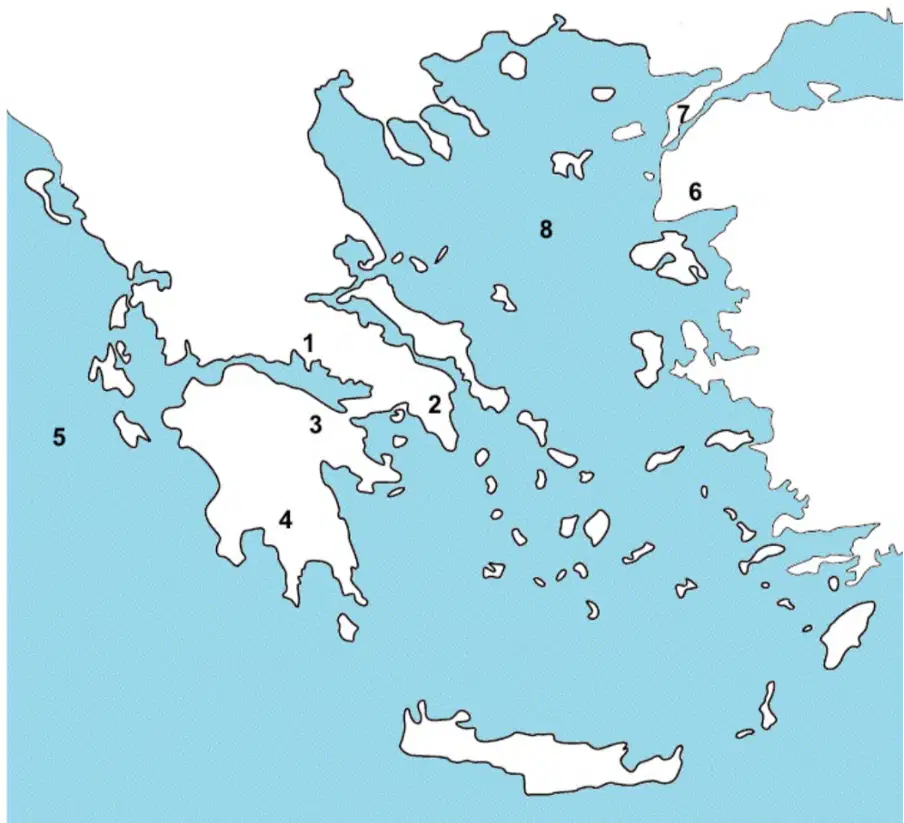
On the map, the location of Sparta is most near:
1
2
4
6
ὁ Ἀντώνιος τοῦ τῶν Ῥωμαίων στρατοῦ ἄρχει.
ὁ Ἀντώνιος: Antony / ὁ Ῥωμαῖος: Roman / ὁ στρατός: army
In this sentence, the noun στρατοῦ is this gender:
masculine
feminin
neuter
common (both masculine and feminine)
ὁ Ἀντώνιος τοῦ τῶν Ῥωμαίων στρατοῦ ἄρχει.
ὁ Ἀντώνιος: Antony / ὁ Ῥωμαῖος: Roman / ὁ στρατός: army
In this sentence, we learn that Antony
dismisses his army
is attacked
leads his army
is overthrown by his arm
μετὰ τὴν μάχην οἱ Ῥωμαῖοι δίψην πάσχουσιν.
ὁ Ῥωμαῖος: Roman
In this sentence, the case of the noun μάχην is
nominative
accusative
genitive
dative
μετὰ τὴν μάχην οἱ Ῥωμαῖοι δίψην πάσχουσιν.
ὁ Ῥωμαῖος: Roman
In this sentence, the verb πάσχουσιν is in this person and number
2nd singular
2nd plural
3rd singular
3rd plural
ὁ Ἀντώνιος τοῦ τῶν Ῥωμαίων στρατοῦ ἄρχει.
μετὰ τὴν μάχην, οἱ Ῥωμαῖοι δίψην πάσχουσιν.
ὁ Ἀντώνιος: Antony / ὁ Ῥωμαῖος: Roman / ὁ στρατός: army / ἡ δίψη: thirst
In these lines, we learn that:
the Romans were thirsty
many Romans died
the Romans were rained on
the Romans lost the battle
ὁ Ἀντώνιος κελεύει τὸν στρατὸν εὑρίσκειν ὕδωρ.
ὁ Ἀντώνιος: Antony / ὁ στρατός: army / εὑρίσκω: to find / τὸ ὕδωρ: water
In this sentence, the form of the verb εὑρίσκειν is
indicative
imperative
infinitive
subjunctive
οἱ μὲν Ῥωμαῖοι εὑρίσκουσι ποταμόν, ὁ δὲ ποταμὸς ἔχει ψυχρὸν ἀλλὰ δεινὸν ὕδωρ·
ὁ Ῥωμαῖος: Roman / εὑρίσκω: to find / ὁ ποταμός: river / τὸ ὕδωρ: water / ψυχρός-ά-όν: cold / ἀλλά = but / δεινός-ή-όν: dangerous
In this sentence, the word ψυχρόν modifies (describes)
Ῥωμαῖοι
ποταμός
ὕδωρ
ποταμοῦ
οἱ μὲν Ῥωμαῖοι εὑρίσκουσι ποταμόν, ὁ δὲ ποταμὸς ἔχει ψυχρὸν ἀλλὰ δεινὸν ὕδωρ·
ὁ Ῥωμαῖος: Roman / εὑρίσκω: to find / ὁ ποταμός: river / τὸ ὕδωρ: water / ψυχρός-ά-όν: cold / δεινός-ή-όν: dangerous / ἀλλά = but
In these lines, we learn that the Romans
find a natural impediment to their march.
see the enemy across the river.
cool down in the river.
encounter a tempting but perilous natural phenomenon.
τὸ δἐ τοῦ ποταμοῦ ὕδωρ φύτεύει ὀδύνας καὶ κακὴν δίψην,
ὁ ποταμός: river / τό ὕδωρ: water / ἡ ὀδύνη: stomach pain / φυτεύω: I cause / καὶ = and / η δίψη: thirst
In this phrase, the case of the noun ποταμοῦ is
nominative
accusative
genitive
dative
τὸ δἐ τοῦ ποταμοῦ ὕδωρ φύτεύει ὀδύνας καὶ κακὴν δίψην,
ὁ ποταμός: river / τό ὕδωρ: water / ἡ ὀδύνη: stomach pain / φυτεύω: I cause / καὶ = and / η δίψη: thirst
The form of the verb φύτεύει is
1st person singular
3rd person singular
2nd person plural
3rd person plural
τὸ δἐ τοῦ ποταμοῦ ὕδωρ φύτεύει ὀδύνας καὶ κακὴν δίψην,
ὁ ποταμός: river / τό ὕδωρ: water / ἡ ὀδύνη: stomach pain / φυτεύω: I cause / καὶ = and / η δίψη: thirst
The adjective κακήν modifies (describes)
ὕδωρ
ποταμοῦ
ὀδύνας
δίψην
τὸ δἐ τοῦ ποταμοῦ ὕδωρ φύτεύει ὀδύνας καὶ κακὴν δίψην, ἀλλ’ οἱ στρατιῶται ἔτι πίνουσιν.
ὁ ποταμός: river / τὸ ὕδωρ: water / φυτεύω: to cause / καί = and / ἡ δίψη: thirst
ἀλλά = but / ὁ στρατιώτης: soldier / πίνω: to drink
The gender of οἱ στρατιῶται is
masculine
feminine
neuter
common (both masculine and feminine)
τὸ δἐ τοῦ ποταμοῦ ὕδωρ φύτεύει ὀδύνας καὶ κακὴν δίψην, ἀλλ’ οἱ στρατιῶται ἔτι πίνουσιν.
ὁ ποταμός: river / τὸ ὕδωρ: water / φυτεύω: to cause / καί = and / ἡ δίψη: thirst
ἀλλά = but / ὁ στρατιώτης: soldier / πίνω: to drink
Here, we learn that the Romans
continue to drink the water
depart before they drink the water
get attacked near the water
find safety in the water
ὁ Ἀντώνιος, σοφὸς στρατηγός, πείθει τὸν στρατὸν μὴ πίνειν.
ὁ Ἀντώνιος: Antony / ὁ στρατηγός: general / σοφός-ή-όν: clever / ὁ στρατός: army / μή = not / πίνω: to drink
In this sentence, we learn that Antony:
gives sensible orders
obeys the will of the army
negotiates a truce
double crosses the enemy
In the passage you have just read, the biggest threat to the Romans is
Antony's poor leadership
a flash flood
drowning in the river
lack of safe drinking water

