
 Worksheets
Unit 2 Review
Total questions: 20
Worksheet time: 10mins
Why is it important that all cells have a cell membrane?
It supports the cell wall.
It controls all cellular functions.
It is responsible for making DNA for the cell.
It is the protective barrier that encloses the cell.
Which is the main purpose of the digestive system?
to add oxygen to food particles
to fill the stomach with food particles
to turn food into nutrients the body needs
to transfer food from one organ to another organ
Which term describes how the nervous and endocrine systems work together to create balance within the human body?
external function
homeostasis
equilibrium
instability
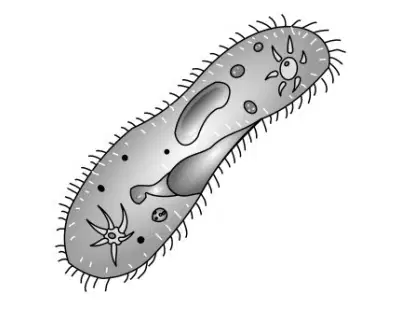
Ricky observed this organism under the microscope. Which organism did he observe?
a volvox, because it has cilia
a euglena, because it has cilia
an amoeba, because it has cilia
a paramecium, because it has cilia
Which statement best explains how organ systems in the human body function?
They work at different times to conserve energy.
They work together to benefit the entire organism.
They work at different times, depending on their job.
They work independently of each other, for efficiency.
Which systems are involved with the breakdown and delivery of nutrients from recently eaten food to the cells and the removal of waste materials from the body?
excretory, skeletal, and digestive
digestive, nervous, and endocrine
excretory, circulatory, and nervous
digestive, circulatory, and excretory
Which two body systems are most affected when a person is participating in a long jump?
skeletal and muscular
skeletal and digestive
endocrine and muscular
endocrine and digestive
Which explains how the circulatory system and respiratory system work together to sustain the human body?
The respiratory system takes in oxygen that is carried by the circulatory system throughout the body.
The respiratory system and circulatory system work to regulate temperature by cooling or warming the body.
The respiratory system takes in carbon dioxide that is carried by the circulatory system to cells for respiration.
The respiratory system and circulatory system both excrete waste to the digestive and excretory systems.
Marc eats a well-balanced diet and takes vitamins. Yet, test results show that Marc has a vitamin deficiency. Which of Marc’s body systems are most likely not functioning properly?
the respiratory and circulatory systems, because the vitamins are being released as waste
the digestive and excretory systems, because his body is not absorbing the vitamins in the food he eats
the respiratory and digestive systems, because the exchange of oxygen and carbon dioxide is being affected
the digestive and nervous systems, because the vitamins are not being transported to the right places in his body
What body system assists the respiratory system by pulling the rib cage down to allow air to flow in?
skeletal
muscular
endocrine
circulatory
Which sequence of biological structures within the human body is organized from simplest to most complex?
bone cells, bone tissue, bone, skeletal system
bone tissue, bone cells, bone, skeletal system
skeletal system, bone, bone cells, bone tissue
skeletal system, bone, bone tissue, bone cells
A doctor specializes in surgery involving the lungs and heart. For which level of organization is this doctor specialized?
atoms
cells
organs
tissues
Janie and Elijah are drawing a diagram to show the differences between animal and plant cells. Janie is selecting the terms to label the plant cell. Which set of terms will only Janie use?
vacuole, chloroplasts, cell wall
cytoplasm, mitochondria, ribosomes
vacuoles, cytoplasm, cell membrane
cell membrane, mitochondria, nucleus
Which organelles are found in both plant and animal cells?
cytoplasm and cell membranes
cell walls and cell membranes
cell walls and chloroplasts
cytoplasm and cell walls
Which is the function of a cell′s nucleus?
to create energy for the cell
to control what comes into the cell
to provide directions for cellular functions
to obtain nutrients to fuel cellular functions
Which statement describes the primary function of the chloroplasts in a plant cell?
They capture light energy from the sun and use it, along with water and oxygen, to produce sugars for food.
They release light energy from the leaves and use it, along with water and oxygen, to produce sugars for food.
They capture light energy from the sun and use it, along with water and carbon dioxide, to produce sugars for food.
They release light energy from the leaves and us
Which statement describes all protists?
They have nuclei.
They are multicellular.
They are unable to move on their own.
They can be seen with the unaided eye.
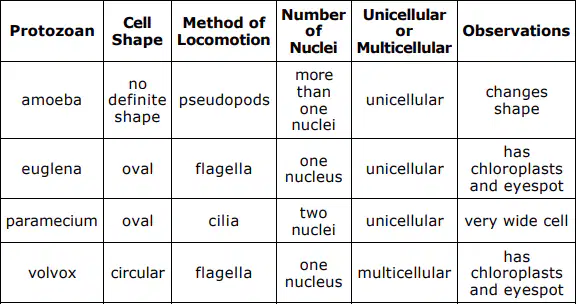
The chart below shows protozoan characteristics. Which is a difference between a euglena and a volvox?
shape
number of nuclei
method of locomotion
presence of chloroplast and eyespot
Which basic function of life is demonstrated by a single-celled organism using cilia, flagella, or pseudopodia?
homeostasis
growth
movement
response to stimuli
A person with the genetic disorder of sickle cell anemia may experience symptoms, including joint pain, from the red blood cells that are shaped like sickles. Which two body systems are most likely affected by
this disorder?
circulatory & digestive
circulatory & muscular
circulatory & nervous
circulatory & skeletal

