
 Worksheets
Photosynthesis
Total questions: 25
Worksheet time: 13mins
Photosynthesis is the
The process of converting light into sound
The process of converting light into energy for plants
The process of converting water into oxygen
Chloroplasts are found mainly in cells of
mesophyll
chlorophyll
cytokinesis
thylakoid
A typical mesophyll cell has _____ chloroplasts
20-50
30-40
10-20
20-30
The chlorophyll is in the membranes of
Thylakoid
mesophyll
chloroplast
Photosynthesis can be summarized as the following equation
6 CO2 + 12 H2O + Light energy ->
C6H12O6 + 6 O2 + 6 H2O
C6H12O6 + 6 O2 + 6 H2O + Light energy ->
6 CO2 + 12 H2O
CO2 + H2O →
C6H12O6 + O2
Photosynthesis is a redox process in which H2O is
oxidized
reduced
Photosynthesis is a redox process in which CO2 is
reduced
oxidized
what are the 2 stages of photosynthesis
Transcription and translation
Light reaction and Calvin cycle
Glycolysis and Krebs cycle
Anaerobic and aerobic phases
Substances that absorb visible light are known as
Invisibleators
See-throughizers
pigments
Transparency enhancers
leaves are green because Chlorophyll molecules of chloroplast absorb ____ and emit green light
blue- violet and red light
X-rays and transmit rainbow light
Infrared and transmit black light
Spectrophotometer is an instrument for
measuring the ability of a pigment to absorb various wavelengths of light
Counting the number of cells in a sample
Analyzing the chemical composition of rocks
The light reactions in the thylakoids Generate ATP from ADP by
Photoshopping them
photophosphorylation
Frying them in sunlight
Utilizing the power of dance
(3 types of pigments)
• participates directly in the light reactions
• Absorbs light
• Can be found in all photosynthetic plants, algae and cyanobacteria.
chlorophyll a
chlorophyll b
Carotenoids
(3 types of pigments)
• the accessory pigment
• Absorbs light
• Can be found in plants and green algae
chlorophyll a
chlorophyll b
Carotenoids
(3 types of pigments)
• group of accessory pigment
• Absorb violet and blue-green light
• Absorb excess energy and dissipate it as heat
chlorophyll a
chlorophyll b
Carotenoids
Photosystem is
composed of a reaction- center complex surrounded by several light-harvesting complexes
A secret society of plants that love taking selfies
A new smartphone app for nature photography
(Thylakoid membrane ps I & ps II)
The reaction-center chlorophyll a of photosystem II is known as
P680
P700
P99
(Thylakoid membrane ps I & ps II)
• the reaction-center complex of photosystem I is called
P200
P700
P680
(3 Phases of Calvin Cycle)
The Calvin cycle incorporates each CO2 molecule, by attaching it ribulose bisphosphate (abbreviated RuBP). The enzyme that catalyzes this first step is RuBP carboxylase, or rubisco. The product of the reaction is a six-carbon intermediate
Phase 1: Carbon Fixation
Phase 2: Reduction
Phase 3: Regeneration of the CO2 acceptor (RuBP)
(3 Phases of Calvin Cycle)
Each molecule of 3- phosphoglycerate receives an additional phosphate group from ATP, becoming 1,3 diphosphoglycerate. Next, a pair of electrons donated from NADPH reduces 1,3 diphosphoglycerate, which also loses a phosphate group, becoming G3P. There are six molecules of G3P formed (G3P is a sugar—the same three- carbon sugar formed in glycolysis by the splitting of glucose).
Phase 1: Carbon Fixation
Phase 2: Reduction
Phase 3: Regeneration of the CO2 acceptor (RuBP)
(3 Phases of Calvin Cycle)
G3P are rearranged by the last steps of the Calvin cycle into three molecules of RuBP. To accomplish this, the cycle spends three more molecules of ATP. The RuBP is now prepared to receive CO2 again, and the cycle continues.
Phase 1: Carbon Fixation
Phase 2: Reduction
Phase 3: Regeneration of the CO2 acceptor (RuBP)
For the net synthesis of one G3P molecule:
The Calvin cycle consumes a total of:
How many molecules of ATP?
How many molecules of NADPH?
The Calvin cycle consumes a total of 6 molecules of ATP, and 9 molecules of NADPH
The Calvin cycle consumes a total of 9 molecules of ATP, and 6 molecules of NADPH
The Calvin cycle consumes a total of 8 molecules of ATP, and 2 molecules of NADPH
The Calvin cycle consumes a total of 12 molecules of ATP, and 9 molecules of NADPH
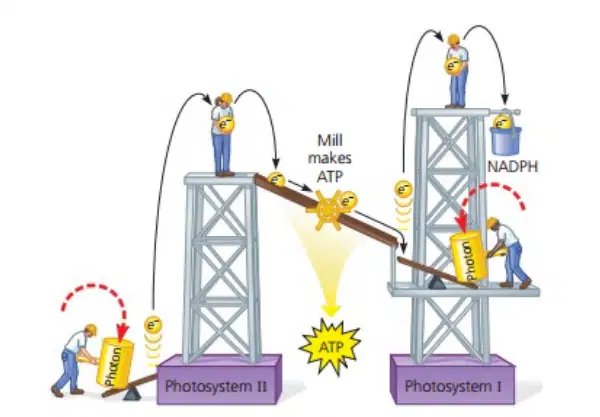
This mechanical analogy involving photosystem I
& photosystem II is an analogy for?
Cyclic electron flow
Linear Electron Flow
An alternative path that uses photosystem I
but not photosystem II
Linear Electron Flow
Cyclic Electron Flow
In this alternative path there is no
production of NADPH and no
release of oxygen
Cyclic Electron Flow
Linear Electron Flow

