
Font size
 Worksheets
Earth's Landforms
Total questions: 20
Worksheet time: 10mins
Which contributes to the formation of sand dunes?
deposition
erosion
weathering
terminus
Gravity pulls rainwater downhill and the flowing water erodes the landscape by _____.
forming sand dunes
washing away soil
forming a desert
forming moraines
Which of the following does not cause a quick change to the Earth's surface?
earthquake
erosion
avalanche
landslide
Which process created the Grand Canyon?
landslides
water erosion
wind erosion
earthquakes
The dropping off of sediments is called _____.
deposition
settling
delta
channels
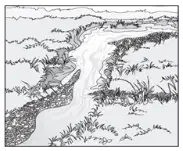
The weathered rocks found along the side of this stream were likely placed there by ______.
deposition
transport
erosion
weathering
Which statement best describes the amount of time it takes for wind, water, and ice to change the shape of landforms?
It takes a very long time for wind, water, and ice to wear away landforms.
Wind, water, and ice have no effect on landforms.
Wind, water, and ice change landforms very quickly.
Wind, water, and ice can change landforms quickly or slowly.
Gusts of wind can pile sand into large mounds in deserts and on beaches. These mounds are called _____.
mountains
sand dunes
hills
valleys
Which is not a feature found on the ocean floor?
rift valley
trench
continental shelf
estuary
For which landform would contour lines be closest together on a topographical map?
a sand dune
a plateau
a hill
plains
Which shows the elevation of an area using contour lines?
vegetation
rain shadow
topographical map
cartographer
Which of the following is not caused by the shifting of tectonic plates?
earthquake
landslide
hurricane
volcanic eruption
The surface of Earth is always changing and making new features. Which weather conditions have the greatest effect on the surface of Earth?
fog and light rain
cool temperatures and humidity
warm ocean temperatures and humidity
strong winds and heavy rains
Which is an example of a process that can slowly change the surface of Earth?
earthquakes
glaciers
volcanoes
landslides
What is another name for an underwater mountain range?
mantle
fault
mid-ocean ridge
tectonic plate
What is the name of the theory that explains how forces deep within Earth can cause ocean floors to spread and continents to move?
continental movement
tectonic kinetics
plate tectonics
wave motion
A _________ is a break in the Earth's crust where an earthquake might take place.
cave
fault
valley
gap
A _____ is a deep valley with very steep sides.
plain
hoodoo
river
canyon
A plateau is a tall landform with a top that is _____.
round
pointed
hollow
flat
Which feature is an underwater mountain?
abyssal plain
mid-ocean ridge
delta
trench

