
 Worksheets
23-24 1st Semester Review
Total questions: 60
Worksheet time: 40mins
The following are examples of what:
- He has kept among us, in times of peace, Standing Armies without the Consent of our legislatures.
- He has affected to render the Military independent of and superior to the Civil power.
- For Quartering large bodies of armed troops among us
Grievances
Agreements
Laws
Expectations
When Jefferson referred to unalienable rights in the Declaration of Independence, he was describing —
liberties belonging to all U.S. citizens
natural rights belonging to all humans
freedoms given by the local government
limitations on the rights of foreign-born citizens
Spain
To convert natives and search for gold
France
To profit from fur trading
England
To profit from agriculture and cash crops
Delivered to Congress by President James Monroe in December 1823, _________ warns European nations that the United States would not tolerate further colonization.
The Monroe Doctrine
The Adams-Onis Treaty
Common Sense
The Bill of Rights
What happened at the Constitutional Convention?
The 13 colonies declared independence from Britain
The Articles of Confederation were amended
The Constitution was written
All of the options are correct
None of the options are correct

What is representative government?
Rule by King or Queen
Rule by military leaders
Rule by elected officials
Rule by the people

What is the name of the document that limited the King of England
Mayflower Compact
Magna Carta
English Bill of Rights
House of Burgesses

What word means that is has two houses?
Dos houses
Unicameral
Bicameral
Tricameral

What is the name of America's first colonial assembly?
Mayflower Compact
House of Burgesses
Fundamental Order of Connecticut
Parliament

Why did the Pilgrims write the Mayflower Compact?
King didn't give them a charter
To advance the Christian faith
To honor their king and country
Make an agreement to self-govern in order to survive

Which of the following is the first constitution in the colonies?
Magna Carta
Mayflower Compact
House of Burgesses
Fundamental Orders of Connecticut
*Mayflower Compact
*Town hall meetings
The factors listed above contributed most to the
What document addressed colonial concerns about English policies?
Declaration of Independence
Mayflower Compact
U.S. Constitution
Bill of Rights
What were the three themes that outlined the colonists desire to be independent?
government, Parliament, monarchy
limited government, habeas corpus, goods
representation, tax, individual rights
consent of the governed, natural law, policy

A religious group that wanted to purify the Church of England. They came to America for religious freedom and settled Massachusetts Bay.
Debtors
Indentured Servants
Puritans
Catholics

An economic policy under which nations sought to increase their wealth and power by obtaining large amounts of gold and silver and by selling more goods than they bought
Mercantilism
Capitalism
Communism
Imperialism

In the Declaration of Independence, the term “unalienable right” refers to -
the rights citizens of other countries have
the right to freedom of religion
rights people are born with that cannot be taken away (without due process)
rights only people in Britain have if they maintain good standing with the King
According to Alexander Hamilton, the creation of a _________ would provide a place to deposit taxes, to provide a sound currency, and to make loans to the national government
National Bank
Judicial Branch
Legislative Branch
Executive Branch
Who asked congress to pass a high tariff, a tax on imported foreign goods, which would protect American industries from foreign competition?
Hamilton
Jefferson
Washington
Monroe
In order to establish credit for the US, Hamilton suggested that the US should...
assume the debts of the states
create a national bank
institute taxes to raise revenue
all of these are true

Led by Thomas Jefferson
Democratic Republicans
Federalists

Led by Alexander Hamilton
Democratic Republicans
Federalists

Believed in a strict interpretation of the constitution; exact wording
Democratic Republicans
Federalists
Believed in more power for the state governments; state over federal
Democratic Republicans
Federalists
Believed in a strong central government; federal over state
Democratic Republicans
Federalists
Believed economy should focus more on industry
Democratic Republicans
Federalists

Believed in a loose interpretation of the Constitution; read between the lines
Democratic Republicans
Federalists
Why did many farmers, artisans, and former Anti-Federalists support the Democratic-Republican Party?
The Democratic-Republicans favored the expansion of a strong national government
The Democratic-Republicans supported strict restrictions on immigration
The Democratic-Republicans supported the use of tariffs
The Democratic-Republicans favored states' rights and the rights of the common man
The first political parties in the United States formed mainly in response to disagreements over -
taxation without representation
the doctrine of judicial review
territorial expansion to the west
the extent of federal power
The Federalists and the Democratic-Republicans emerged as separate political parties partly as a result of disagreement over -
how the nation should develop economically
whether to enforce the Monroe Doctrine
how the nation should admit new states
whether to approve the Declaration of Independence
What do you think it was important to Washington to keep America out of European affairs (conflicts)?
Because he did not want to have to pick sides
Because it would take our young nation into a war that we may not be able to afford or survive
Because his cabinet could not decide what side they agreed with
What was George Washington’s advice in the Farewell Address (1796)?
Avoid political parties
Political Parties will benefit the country
Which of the following precedents did Washington establish? CHOOSE TWO
Presidential Cabinet
Two (2) terms, Four (4) years each
Political Parties


Which statement about the “Trail of Tears” is accurate?
President Andrew Jackson opposed the removal of the Cherokee Indians from Georgia.
Chief Justice John Marshall ordered the Cherokee Indians to move westwards.
Large numbers of Cherokee were forced to relocate during the winter months.
Where were the natives moved because of the Indian Removal Act?
west of the mississippi
into Florida
Back to England
Standoff between South Carolina and the federal government on the state's belief that it could overturn a federal law was?
Nullification Crisis
Trail of Tears
XYZ Affair

Which Headline describes an event that established guidelines for the admission of new states to the Union?
A. Northwest Ordinance Passed
B. Treaty of Paris Ratified
Bill of Right Ratified
D. Alien & Sedition Acts

A. Declaration of Independence
B. Treaty of Ghent
C. Northwest Ordinance
D. Louisiana Purchase Treaty
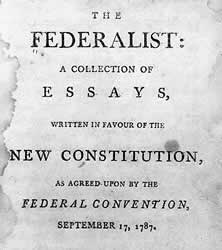
The "Federalist Papers" were written to:
Explain and convince the people into supporting the new U.S Constitution.
spark a new revolution among the American people against their government.
oppose a strong centralized government.
create a new monarchy.
What Principle: People in government have to obey the Constitution, including the President.
Individual Rights
Checks & Balances
Limited Government
What Principle: The government's power is divided between 3 branches.
Individual Rights
Checks & Balances
Separation of Powers
What Principle: Each branch has some power over the other two branches.
Checks & Balances
Limited Government
Separation of Powers
What Principle: Everyone has to follow Federal laws while states can also create their own laws.
Republicanism
Republicanism
Federalism
What Principle: The people have the power in government.
Popular Sovereignity
Republicanism
Federalism
What Principle: We have rights the government cannot take away.
Popular Sovereignity
Individual Rights
Limited Government
What Principle: The people vote for representatives to make laws and run the government.
Popular Sovereignty
Republicanism
Individual Rights

