Worksheets
Evolutionary Biology Quiz
Total questions: 15
Worksheet time: 11mins

The bones labeled A in the diagram have the same structure. What does this illustrate?
analogous structures
homologous structures
homozygous structures
vestigial organs
A group of students researching flying animals concluded that birds and bats must be closely related, evolutionarily speaking, since they both had wings and could fly. Is this a reasonable conclusion?
No. Birds and bats are only distantly related with wings that are analogous structures evolved for the common purpose of flight.
No. Birds and bats share no evolutionary common ancestor because they evolved on separate continents millions of years apart.
Yes. Birds and bats are closely related with wings that are homologous structures that only evolve in close evolutionary relatives.
Yes, Birds and bats are closely related because they are both mammals that share a recent common ancestor that evolved in Africa.

The diagram shows the fossil records of horses over the last 40 million years.
What can scientists conclude about the changing structure of the horses' foot?
As horses evolved, the structure and size of their feet became smaller.
As horses evolved, they developed toes that were better suited to their changing environment.
As horses evolved, they lost their toes and developed feet that were better suited to their environment.
As horses evolved, their toes remained as vestigial structures.

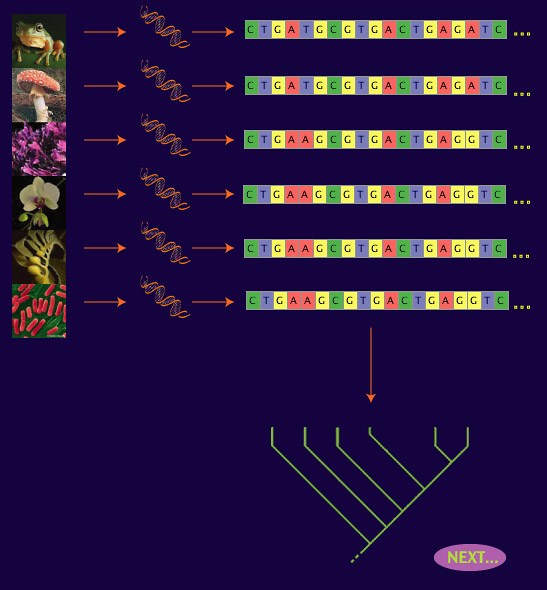
Cytochrome C is a protein that is found in almost all organisms and is used to help determine evolutionary relationships between organisms. The DNA sequences of the Cytochrome C gene from four different organisms are listed.
1 and 2
2 and 3
3 and 4
1 and 4

The image shows the analogous forelimbs of two animals that are adapted to live in water. What can be said about the two animals after studying the image?
The forelimbs are structurally alike as the animals have a common ancestor.
The forelimbs have become structurally alike due to exposure to similar habitats.
The forelimbs are structurally different as the animals belong to different vertebrate classes.
The forelimbs have become structurally different as the animals occupy different environmental niches.

Using anatomical data, scientists have shown that humans are most closely related to gorillas. Recent technological advances have allowed scientists to use amino acid sequences to determine evolutionary relationships. To examine the relationships of primates further, scientists compared the amino acid sequence for insulin in several primates.
How has this new data contributed to changes in the understanding of evolutionary relationships among modern primates?
The data shows that humans are most closely related to baboons.
The data shows that humans are most closely related to chimps.
The data shows that chimps are most closely related to lemurs.
The data shows that gorillas are most likesl y related to baboons.
A scientist found a fossil of an early primate. A close examination of the fossil revealed that the organism once walked on two legs and had a large and complex brain.
Which additional step would provide the scientist with information to trace the evolutionary history of the fossil?
Determine the chemical composition of the rock in which the primate fossil was found.
Compare the DNA sequences of the fossil with that of other primates.
Study the physiological processes in early primates and in humans.
Understand the interactions of the primate with other organisms of that time.
The earliest fossils indicate that microbial mats used to depend on hydrothermal vents for energy and chemicals for food, but later fossils show that they developed photosynthesis.
What can be inferred from this information?
The earliest life forms were multicellular.
The early Earth had an atmosphere without oxygen.
The early Earth was too hot for living organisms to survive.
The earliest life forms used to contain chlorophyll in their cells.
Bats and birds are only very distantly related, and both evolved wings for flight in very different evolutionary pathways.
What is the term that describes the wing structures that these species evolved?
analogous structures
divergent structures
embryonic structures
homologous structures
Match the type of evidence to its corresponding component of evolutionary support.
Reveals similarities in body structures and functions between organisms
Homologous Anatomical Structures
Determines time in which a species was living and reveals extinct species
Fossil Evidence
Reveals genetic sequence similarities and differences between organisms.
Molecular Evidence
What is natural selection and how does it contribute to the process of evolution?
Natural selection is the process of organisms randomly changing over time.
Natural selection is the process by which organisms better adapted to their environment tend to survive and reproduce, leading to evolutionary change.
Natural selection is the process of humans selecting which organisms will survive and reproduce.
Natural selection is the process of organisms adapting to their environment but not affecting evolution.
Discuss the role of mutations in driving evolutionary change and the importance of genetic variation.
Genetic variation is not important for natural selection
Mutations have no impact on genetic variation
Mutations introduce new genetic variations and genetic variation is important for natural selection.
Mutations only occur in non-essential genes