
NEW
Font size
 Worksheets
Chapter 8 - Work and power - Part 1
Total questions: 20
Worksheet time: 15mins

At which position does the child on the swing have the most gravitational potential energy?
W
X
Y
Z
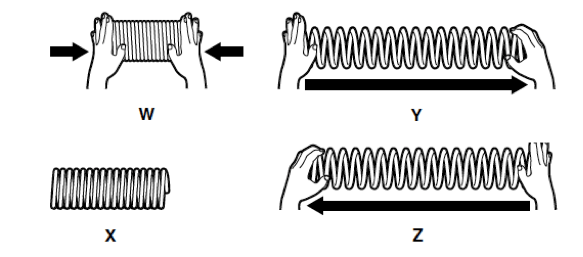
Elastic potential energy is energy stored in an object, such as a spring, due to the object being stretched or compressed. In which position is it most likely that the spring has lost its elastic potential energy?
W
Y
X
Z

All of the pictures are examples of what type of energy?
gravitational potential energy
elastic potential energy
chemical potential energy
kinetic potential energy
Long distance runners often eat special snacks partway through their run. What is most likely the reason for this?
Their bodies do not convert chemical energy into motion energy very efficiently.
They need to stay hydrated because they have sweated so much water out.
They cannot eat before they run because it will make them sick.
Much of the chemical energy in their bodies has been used up and must be replaced for them to continue working.
What kind of energy does an organism receive from eating food?
electrical
solar
chemical
mechanical

What is the energy transformation in photosynthesis?
chemical to glucose
thermal to chemical
chemical to geothermal
light energy to chemical
Which object shows an energy transformation from electrical to mechanical?


The statement that "the energy within a system remains constant and cannot be created or destroyed, only transformed" best sums up _________.
Something Mr. Lance likes to say.
Life
Law of Conservation of Energy
The scientific method
Newton's Third Law

Work is done ___________
only when force is applied
on an object
cause the object to move
into the opposite direction
as applied force.
only when force is applied
on an object
cause the object to move
into the same direction
as applied force.
The Unit of force is ______________
Kilogram (kg)
Newton(N)
The unit of distance is ___________
meter (m)
centimeter (cm)
millimeter (mm)
Units of work is ___________
Newton (N)
watt (w)
joule (J)
Time is measured in ______________
minutes (min)
hours (hrs)
seconds (s)

