
NEW
Font size
 Worksheets
Gravational and Electric Forces
Total questions: 14
Worksheet time: 11mins
Astronomers use tiny wobbles of distant stars to detect the presence of planets orbiting those stars. This occurs because the star exerts a gravitational pull on the planet while the planet
repels the star it orbits.
exerts no force on the star.
creates friction between itself and the star.
exerts a gravitational pull on the star it orbits.
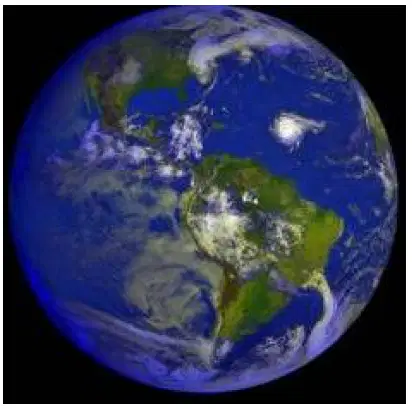
This force is a pull between all objects. It is the force that gives us weight here on Earth. And, if we throw a rock off of a cliff, it is the force that causes the rock to fall to Earth. What is this force?
gravity
friction
magnetism
air resistance
Two oppositely charged particles are held in place near each other. When the particles are released, they will most likely-
accelerate away from each other.
accelerate toward each other.
rotate in a clockwise direction.
rotate in a counterclockwise direction.
After turning off the television, you approach it. As you get close, but not touching it, the hairs on your arm start to stand up. This is an excellent example of static charge built up by
conduction.
convection.
friction.
induction.
Which is an example of gaining a static charge by conduction?
Rubbing a balloon against your hair.
Shuffling your shoes across a carpet.
Bringing a charged rod near an electroscope.
Touching your car on a cold day and getting a shock.
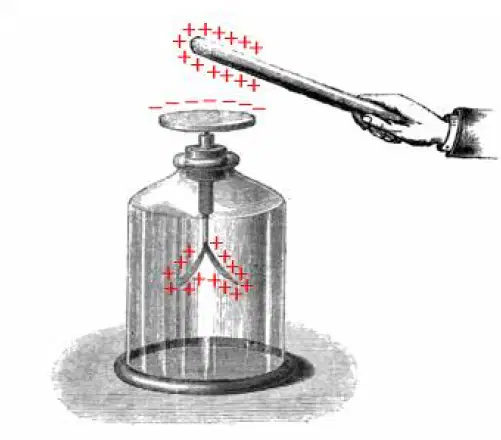
During induction, a positively charged rod is brought near to but not touching the electroscope. The presence of the charged object above the plate of the electroscope induces charges to move down into the gold leaves, giving the electroscope an overall positive charge. The positive leaves repel. The same process occurs when a negative rod is brought close to the electroscope. This time, the negative charges flow through the electroscope to the leaves. The leaves, once again, repel.
Whether the charge is positive or negative, in each case, the experiment shows that
like charges repel
opposite charges repel
friction produces a current
electrons produce a current
There are three ways to give an object a static charge. They are friction, conduction and induction. Two pieces of cellophane tape are stuck to a lab table. Each piece is quickly ripped off the table. A student attempts to bring the two pieces of tape together, but the tape is attracted to her hand. So, the tape clings to her hand. Formulate a possible explanation for this.
The adhesive on the tape sticks to the student's hand.
The charges are conducted onto the student's hand and then the tape is attracted to her hand.
The tape is charged by friction and her hand has an induced opposite charge. They therefore attract.
The tape is charged by friction and the human body is naturally charged. So, the tape is attracted to
her hand.
What happens when a positively charged rod touches a neutral metal sphere?
Electrons move from the rod to the sphere through insulation.
Protons move from the rod to the sphere through induction.
Protons move from the sphere to the rod through friction.
Electrons move from the sphere to the rod through conduction.
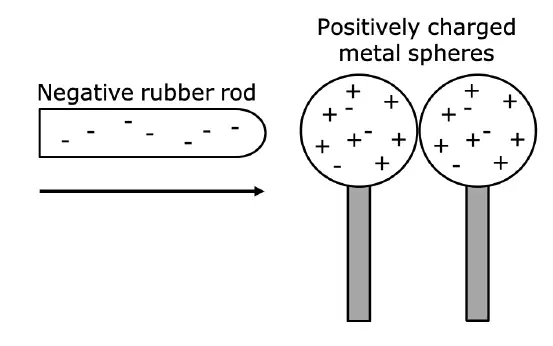
A student is investigating how a negatively charged rubber rod affects charges distributed on two positively charged steel spheres that are in contact, as shown in the diagram below.
Induction, because they not touching.
Friction, because one material is being rubbed on another.
Conduction, because they are touching.
Insulation, because they are not touching.
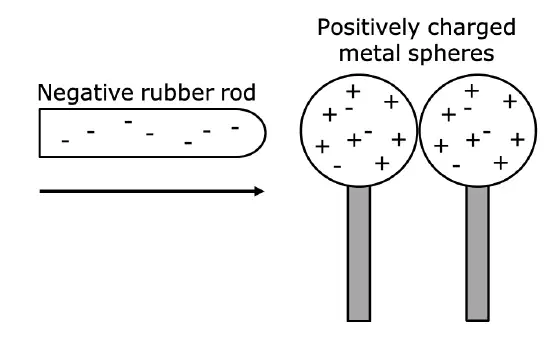
A student is investigating how a negatively charged rubber rod affects charges distributed on two positively charged steel spheres that are in contact, as shown in the diagram below.


In 1665 Sir Isaac Newton proposed the fundamental law of gravitation as a universal force of attraction between any two bodies. What does this theory state about the force that makes an apple fall and the force that keeps the Moon in its orbit?
They are unpredictable.
They are the same force.
They cannot be compared.
They act in opposite directions.
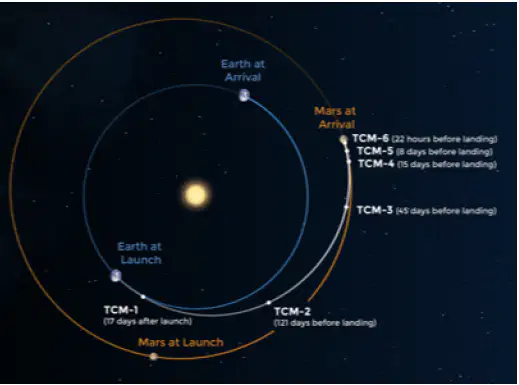
A team of scientists is calculating how to land an unmanned rocket on Mars. The image below shows the projected path in white.
The gas composition of a planet
The elemental composition of the planet
The magnetic pull of poles on celestial bodies
The gravitational pull of celestial bodies
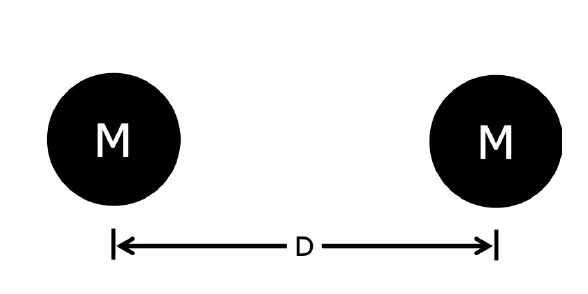
The diagram below shows two celestial bodies with the same mass, M, placed a distance, D, apart.
What would increase the gravitational force
between the two bodies?
Maintaining M and increasing D
Decreasing M and maintaining D
Decreasing M and increasing D
Increasing M and decreasing D
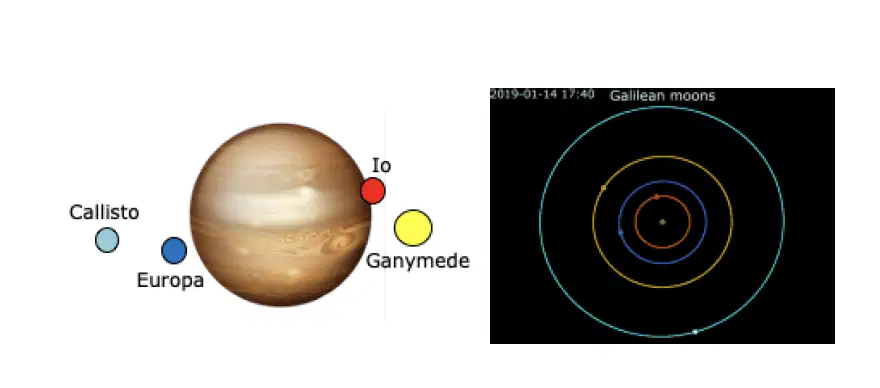
Jupiter is the largest planet in our solar system and has 79 moons that orbit it. The largest four moons, Io, Europa, Ganymede, and Callisto, were discovered in 1609 by Galileo Galilei. These four moons are referred to as the Galilean moon of Jupiter.
The moons and their paths around Jupiter are shown in the picture.
What force prevents the Galilean moons from traveling off into space away from Jupiter?
The Sun’s magnetic pull changes the velocity of the moons.
The moons’ positions are slightly bent towards Jupiter due to electromagnetic fields
The moons are being pulled closer and closer towards Jupiter due to centripetal force.
Jupiter’s gravitational pull changes the velocity of the moons.

