
 Worksheets
NE Natives Review Game
Total questions: 30
Worksheet time: 15mins
What was the effect of agriculture on the way of life of early Native Americans?
They no longer had to hunt.
They were able to set up villages and stay in one place.
They became stronger individuals.
They were able to sell food.
_____________________-"medicine man", tribe healer, believed to be able to communicate with the spirits
shaman
nomad
native american
sachem
Who made the decisions in the Iroquois Confederacy?
The Great Council
The Ojibwe
Young women
Older Men

Which geographic feature corresponds with G?
The Alps
Delaware River
Great Lakes
Atlantic Ocean
How did the Iroquois stop the fighting among neighboring tribes?
They moved across the country.
They held a potlatch ceremony and invited all the tribes.
They They invited all the tribes to play a game.
The nations formed the Haudenosaunee Confederacy.
Why did Iroquois hunters speak to and thank the animals they killed or the plants they ate?
The Iroquois knew the deer were listening.
The Iroquois believed it would bring good luck.
Because of their religious belief of animism.
They were vegetarians.
What are the three sisters?
beans, carrots, corn
broccoli, squash, corn
beans, squash, corn
zucchini, peas, cabbage
What did trade between the Algonquin and the Iroquois help accomplish?
The trade helped accomplish a stronger economy.
The trade helped the groups to have more rare or exotic items.
The trade strengthened alliances and connections between the groups.
The trade alleviated conflict between the groups.
How did trade between Algonquian tribes benefit their technological needs?
It allowed them to have access to more and better resources.
They no longer needed to make tools.
It helped them develop a better written language.
They became self-sufficient in gathering food.
What do dodems mean to the Ojibwe?
They are sacred objects used in rituals.
They tell the story of where the Ojibwe come from.
They mark the edges of each clan’s territory.
The dodems represent the clan and the trait that that clan has.
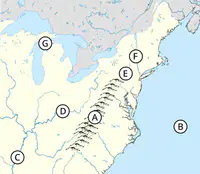
Which geographic feature corresponds with F?
Ohio River
Hudson River
Mississippi River
The Missouri River
What do priests in the Grand Medicine Society do?
teach about medicine
research medications and treatments
pray
performed religious rituals and served as healers
What is the principle of the seventh generation?
A home should last at least seven generations.
Each generation must have seven children.
Decisions should be made with the seventh generation in mind.
An entire generation must follow the same religion.
What does the seventh generation principle emphasize on?
Building a house that lasts for seven generations.
Having seven children in each generation.
Considering the impact of decisions on the seventh future generation.
Following the same religion for seven generations.
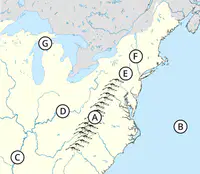
Which geographic feature corresponds to E?
Hudson River
Atlantic Ocean
Great Lakes
Delaware River
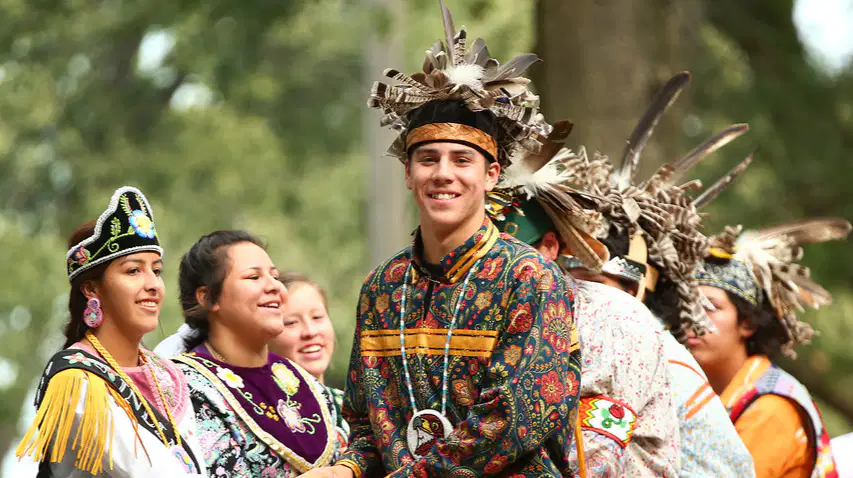
Why was the gustoweh so important to the men of the Eastern Woodlands?
The gustoweh symbolized who was a fighter in a tribe.
The gustoweh showed to which clan they belonged.
The gustowah represented duties within a nation.
The gustoweh represented the nation to which they belong.
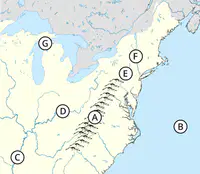
Which geographic feature corresponds to D?
Hudson River
Appalachian Mountains
Ohio River
Atlantic Ocean
What is the main cause of the formation of the Iroquois Confederacy?
The need for trading goods and materials.
To resolve conflict and live together peacefully.
To gain access to more land.
To spread animism.
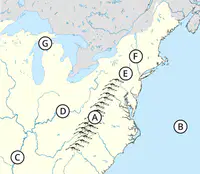
Which geographic feature corresponds with C?
Mississippi River
Delaware River
Appalachian Mountains
Ohio River
What is the meaning of the Mohican's name?
people of the wigwams
water that is never still
air that is always blowing
people of the longhouses
Who was the legendary chief of the Onondaga tribe around 1450 CE, to whom we attribute the formation of the Iroquois Confederacy?
Hiawatha
Huron
Erie
Deganawida
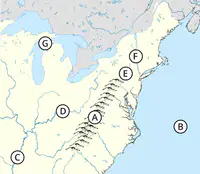
Which geographic feature corresponds to B
Great lakes
Mississippi River
The Atlantic Ocean
The Ohio River
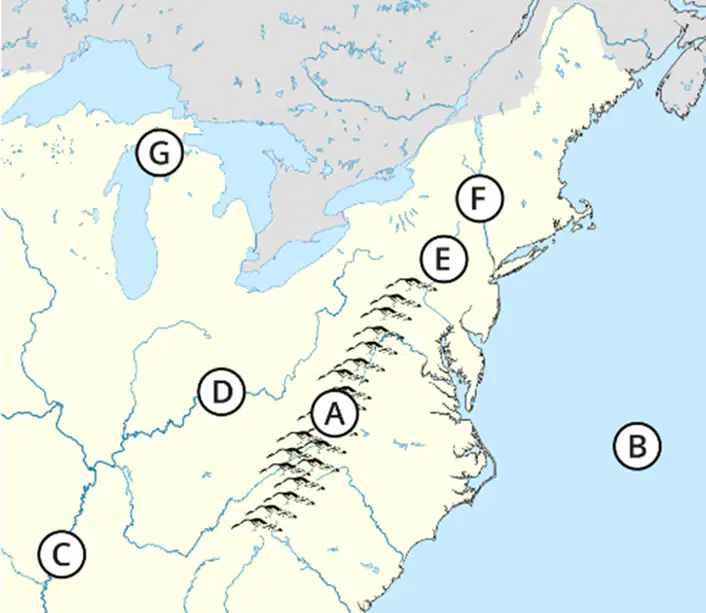
What geographic feature correspond with A?
Appalachian Mountains
Great Lakes
Hudson River
The Alps
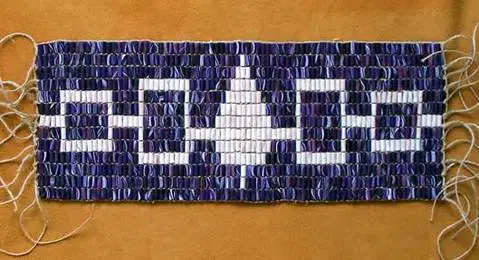
What was the main purpose of the wampum belts among the Iroquois? Choose 3.
Religious rituals/ ceremonies.
To record important events and treaties.
To serve as a decorative accessory.
To indicate the status of the wearer within the tribe.
Trade item.
How did the Iroquois stop the fighting among neighboring tribes?
They moved to the southwestern part of the United States.
They held a potlatch ceremony and invited all the tribes.
They formed a confederacy.
They invited all the tribes to play a game of Little War.
The Iroquois built their homes out of ---
Wood
Ice
Sand
Rock
How did the Algonquian mostly obtain their resources?
Farming
Fishing
Hunting and gathering
None of these
What were the Algonquin tribes known for trading with the Iroquois?
weapons and tools
furs and pelts
agricultural products
spiritual artifacts
Which statement best describes what the Indigenous people of the Northeast made their clothes from?
They wore clothes made from parts of trees.
They wore clothes made of animal skins.
They wore clothes that were made from cloth that was woven by women.
They wore clothes made from blankets.
Which tribe was the last to join the Iroquois the Confederacy?
Onondaga
Mohawk
Seneca
Tuscarora

