
NEW
Font size
 Worksheets
AUDITING - GT1
Total questions: 29
Worksheet time: 29mins
The principle of professional competence and due care imposes which of the following obligations?
To maintain professional knowledge and skill at the level required to ensure clients or employees receive competetent professional service
To refrain from disclosing confidential information obtained as a result of professional and business relationships without proper and specific authority unless there is a legal or professional right or duty
To comply with relevant laws and regulations and avoid any situations that may bring discredit to the profession.
Not to compromise professional orbusiness judgement because of bias conflict of interest or undue influence of others
Which of the folowing is not an assertion that is made in the financial statements by management concerning each major account balances?
Completeness
Rights and Obligations
Legality
Valuation
What type of assurance engagement is involved when the practitioner expresses a negative form of conlcusion?
Limited assurance engagement
Assertion-based assurance engagement
Negative assurance engagement
Reasonable assurance engagement
The primary objective in the conduct of an annual audit by a CPA firm is to
permit management and those charged with governance to avoid personal responsibbility for any deficiencies in the financial statements
provide assurance on the detection of fraud
provide assurance to investors and other external parties of the dependability of the financial statements
confrom with governmental requirements
The subject matter of a audit in general is/are:
Assertions
Financial Statement
Internal Control
COmpliance with laws and regulations
The different types of audit according to the nature of assertion or data being evaluated includes:
Financial statements audit
Operational Audit
COmpliance audit
All of the above
Which is not included in the elements of an assurance engagement?
Appropriate subject matter
Professional fees
Sufficient appropriate evidence
Written report
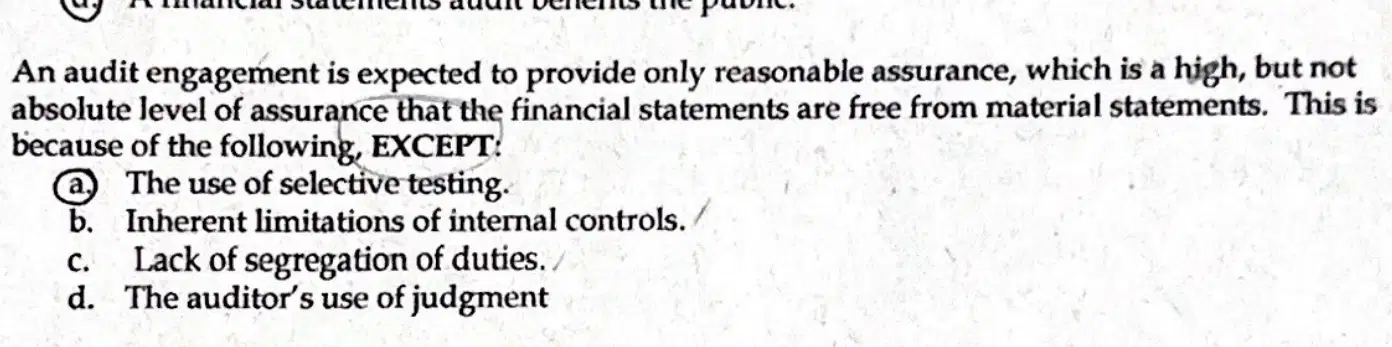
A
B
C
D
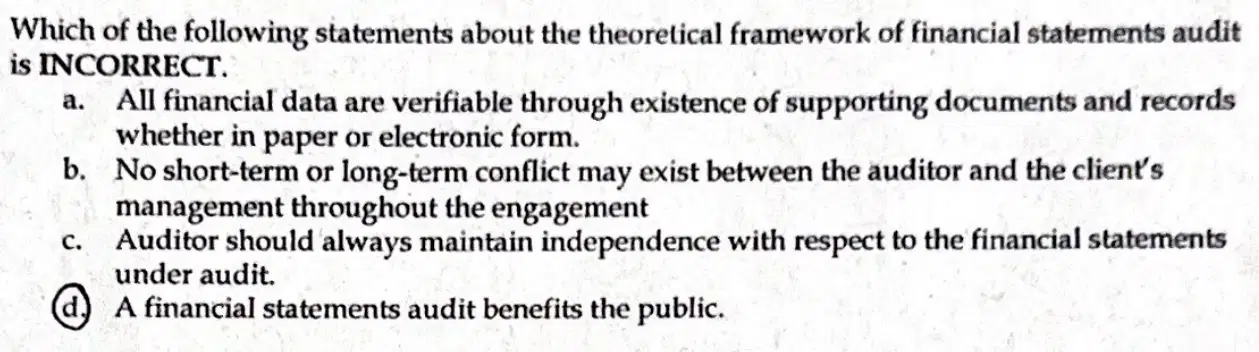
A
B
C
D
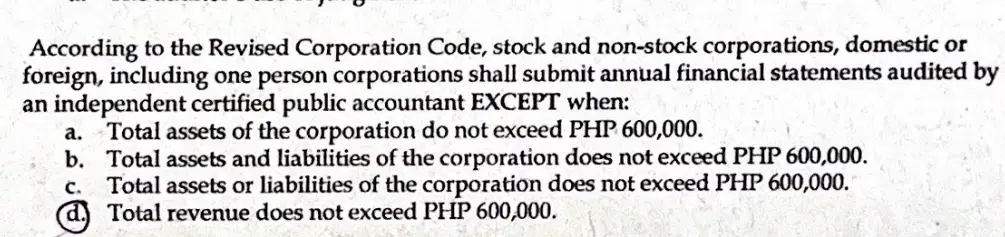
A
B
C
D
Which of the following statements about the theoretical framework of financial statements audit is INCORRECT:

Financial statements audit

Operational Audit

COmpliance audit

All of the above
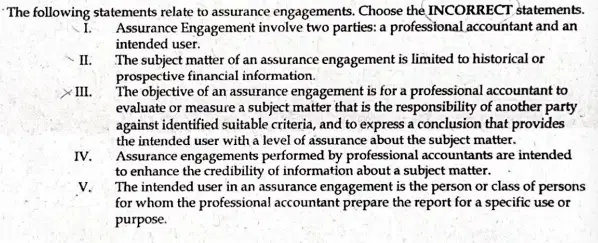
II, III, IV, V
II, IV, V
I, II ,II ,IV
I and II
Most difficult to use criteria across multiple assurance engagement
Financial reporting framework of a foreign jurisdiction
COSO
Governmental requirements
Operational effectiveness and efficiency
Most difficult to use criteria across multiple assurance engagement
Financial reporting framework of a foreign jurisdiction
COSO
Governmental requirements
Operational effectiveness and efficiency
Most difficult to use criteria across multiple assurance engagement
Financial reporting framework of a foreign jurisdiction
COSO
Governmental requirements
Operational effectiveness and efficiency
______ criteria allow reasonably consistent measurement or evaluation of the underlying subject matter, including, were relevant, presentation and disclosur, when used in similar circumstances by different practitioners
Neutral
Relevant
Complete
Reliable
When there are no representationfrom the responsible party about the evaluation or measurement of the subject matter, or if such assessment are not made available to the intended users, an assurance engagement is set to be structured as a/an _____
Direct Reporting
Attest
Reasonable assurance
Limited Assurance
One component of assurance engagement risk is controllable by the practitioner. Which of the following most likely fits this definition?
Control Risk
Risk of material misstatements
Inherent Risk
Detection Risk
Which of the following international standard setting body serves to set high quality, internationally appropriate ethics standards for professional accountants, inlcuding auditor independence requirements?
IAASB
IESBA
IFAC
IAESB
Which of the following attributes most clearly differentiates a CPA who audits management's financial statements as contrasted to management?
Independence
Integrity
Keeping informed on current professional developmements
COmpetence
Attestation risk is limited to a low level in which of the following engagements?
Both examination and reviews
Examinations, but not reviews
Reviews but no examination
Neither examinations nor review
In auditing financial accounting data, the primary concern is with:
determininig whether recorded information properly reflects the economic events that occured during the accounting period
determining if fraud has occured
determinig if taxable income has been calculated correctly
analyzing the financial information to be sure that it complies with governmement requirements
Financial statement users often receive unreliable financial information from companies. Which of the ffg is NOT a common reason for this?
Complex business transaction
large amounts of data
lack of firsthand knowledge about the business
each of these choices is common reason for unreliable financial information
It can be significantly affected by an audit
Inherent Risk
business risk
information risk
the rism free interest rate
The responsibility for adopting sound accounting policies and maintaining adequate internal control rests with the:
BOD
company management
financial statement auditor
company's internal audit department
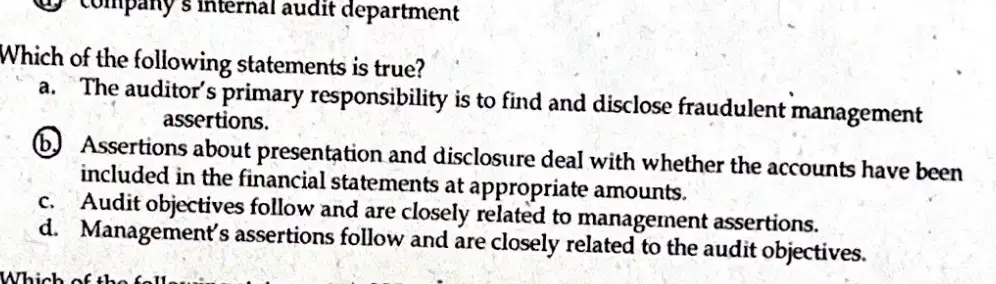
A
B
C
D
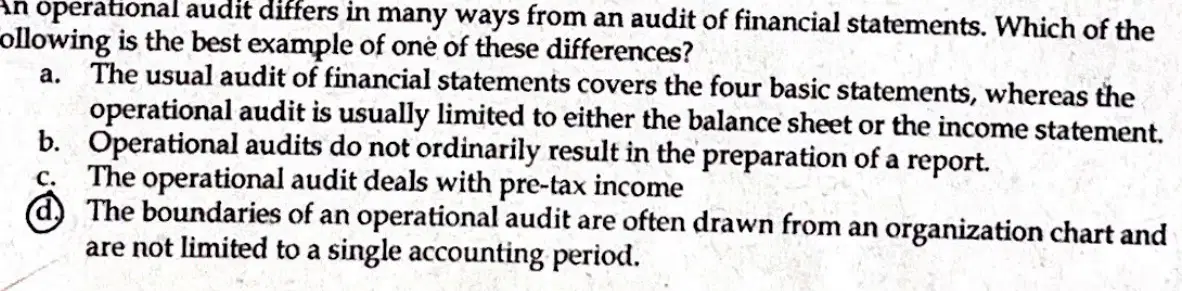
A
B
C
D
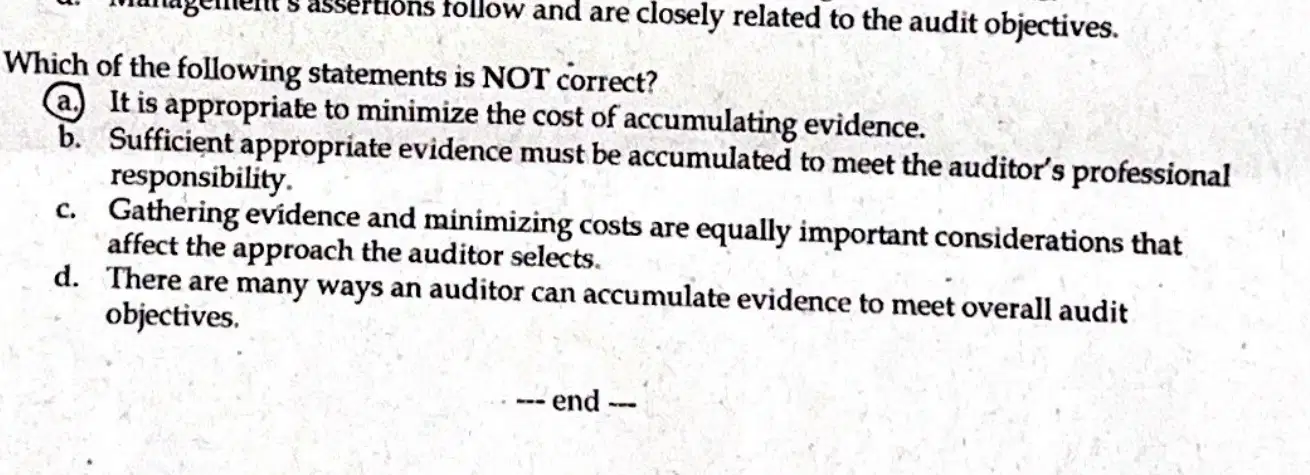
A
B
C
D
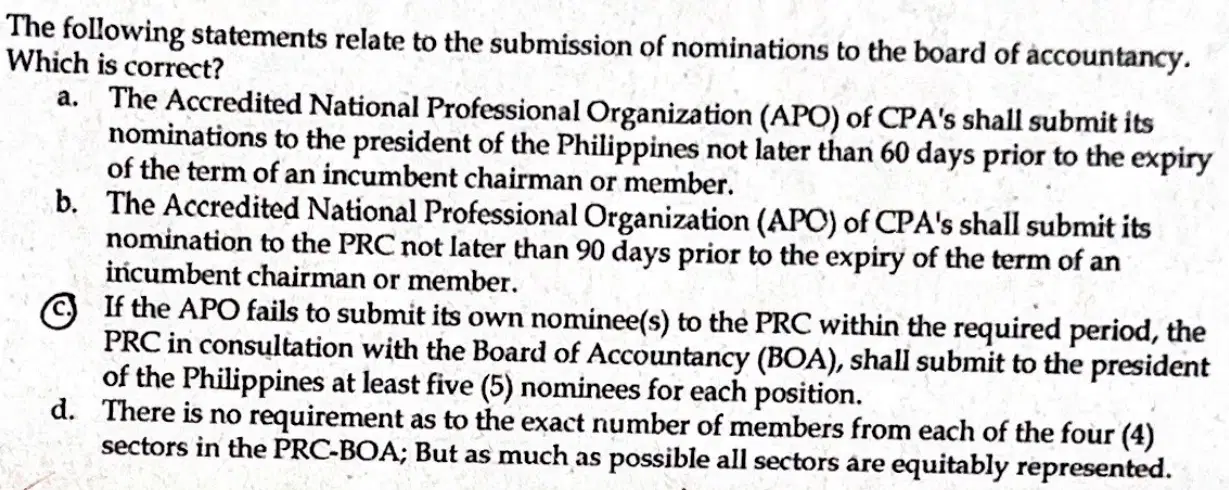
A
B
C
D

