wayground logo

Free Printable Worksheets

NEW

Font size

S
M
L
XL
Worksheets

Reflection in Lenses and the Eye Quiz

Total questions: 22

Worksheet time: 14mins

Name
Class
Date
1.

What type of lens is thicker at the center than at the edges?

a)

Diverging lens

b)

Concave lens

c)

Convex lens

d)

Flat lens

2.

What type of lens is thinner at the center than at the edges?

a)

Concave lens

b)

Bifocal lens

c)

Flat lens

d)

Convex lens

3.

What is the point where light rays parallel to the principal axis converge or appear to diverge after passing through a lens?

a)

vertex point

b)

center point

c)

focal point

d)

focal length

4.

What is the distance between the focal point and the optical center of a lens?

a)

ISO setting

b)

Aperture size

c)

Focal length

d)

Shutter speed

5.

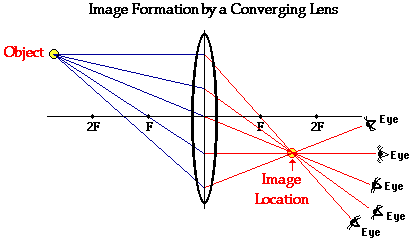
In which type of image does light actually converge to or appear to diverge from a specific point?

a)

Virtual image

b)

Enlarged image

c)

Inverted image

d)

Real image

6.

In which type of image does light not actually converge to or appear to diverge from a specific point?

a)

Converging lens

b)

Diverging lens

c)

Convex lens

d)

Plane mirror

7.

What is the transparent, biconvex structure in the front part of the eye that helps to focus light onto the retina?

a)

cornea

b)

iris

c)

lens

d)

retina

8.

What is the light-sensitive layer at the back of the eye that receives and processes images?

a)

Retina

b)

Iris

c)

Pupil

d)

Cornea

9.

What is the medical condition in which distant objects appear blurry while close objects can be seen clearly?

a)

Astigmatism

b)

Glaucoma

c)

Hyperopia

d)

Myopia

10.

What type of lenses are used to correct nearsightedness or myopia?

a)

Concave lenses

b)

Convex lenses

c)

Bifocal lenses

d)

Colored lenses

11.
The two parts of the eye that refract light are the ______________.
a)
eyelid and eyebrow
b)
eyelid and lens
c)
cornea and retina
d)
cornea and lens
12.
A person who is farsighted can be assisted by_________________.
a)
lenses that are tinted lenses
b)
concave lenses that make light rays focus on the cornea
c)
convex lenses that make light rays converge farther toward the retina
d)
surgery that enlarges the pupil
13.
For clear vision, an image must be focused exactly on the ________________.
a)
retina
b)
pupil
c)
optic nerve
d)
lens
14.

What type of lens do you have in your eye?

a)

Concave

b)

Prismatic

c)

Objective

d)

Convex

15.
The bending of light through a lens is called _____
a)
reflection
b)
refraction
c)
diffraction
d)
absorption
16.
The image, observed in a telescope, is _____
a)
bigger than the object
b)
the same size as the object
c)
slightly smaller than the object
d)
much smaller than the object
17.
What does the word "diverging" mean?
a)
to spread apart
b)
to come together
c)
parallel
d)
perpendicular
18.
What does the word "converging" mean?
a)
to separate
b)
to come together
c)
parallel 
d)
perpendicular
19.
This diagram best represents 
a)
reflection
b)
refraction
c)
absorption
d)
diffusion
20.
This image is.....
a)
inverted and smaller
b)
inverted and larger
c)
not inverted and smaller
d)
not inverted and larger
21.
What is letter B
a)
Optic nerve
b)
Lens
c)
Cornea
d)
Retina
22.
Can not see things far away without corrective lenses.
a)
Retina damaged
b)
Pupil damaged
c)
Farsightedness
d)
Nearsightedness