
NEW
Font size
 Worksheets
POP Quiz 01/17/2024
Total questions: 15
Worksheet time: 8mins

Which of the following answer best describes a long term effect of the Atlantic Slave Trade on Africa?
War between rival tribal nations grew as groups fought to acquire more captives to trade as slaves for European goods.
Individual and family groups fleed north to avoid capture and enslavement in southern colonies.
Mother countries benefited from the increased production of goods, including cash crops.
Women were removed from political and social opportunities reserved solely for men due to European patriarchy.

European states involved in the Atlantic Slave Trade, such as Portugal, benefitted from...
increasing the size and strength of their military by arming and training children forced into recruitment.
the increased production of raw materials grown or collected on colonial plantations by African slaves.
recieving more goods from Africa than simply slaves, such as gold and ivory.
advanced negotiation techniques with local tribal leaders such as Ana Nzinga.

Which of the following claims would most be supported by evidence found in the third paragraph of the excerpt provided?
African tribal elites were all in favor of supporting the capture and enslavement of fellow Africans, as it provided many the means to ensure their own succession.
Slavery was a relatively new idea presented to Africans after it was discovered by European colonists to be in practice by various southern mesoamerican groups such as the Incas.
Although slavery was not new to many African tribes, the means in which slaves were collected and treated was drastically different from how Europeans would use those taken to the Americas.
The Portuguese believed the slave trade to be esential to their own success as forced labor produced a great deal of wealth, even though some regarded slavery as an immoral practice.
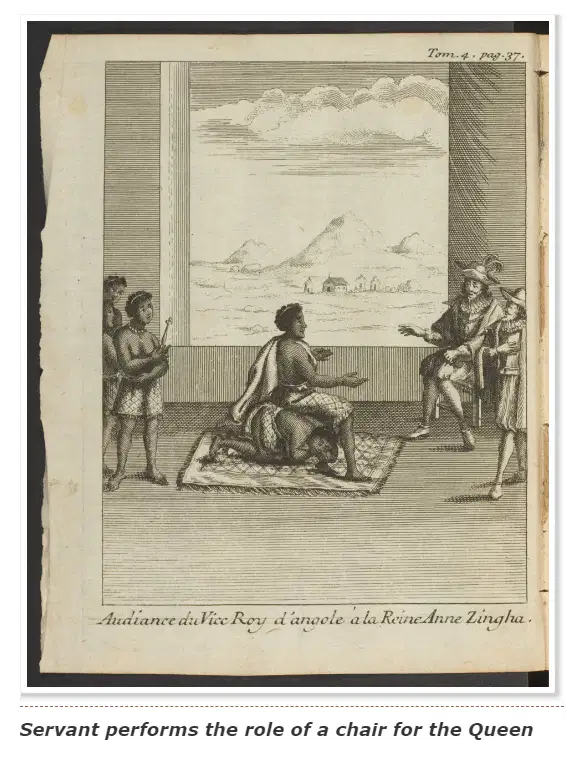
What can be inferred from African Queen Ana Nzinga's actions as depicted in the image provided?
Nzinga saw every African life to be of equal importance.
African leaders believed that no person deserved enslavement, even as punishment for a crime.
That she will be recognized by the Portuguese as a ruling authority of high status.
Like the Portuguese, Nzinga had no true sympathy for African people.

The actions taken by Nzinga and other tribal leaders symbolize what growing political movement
The empowerment of female leaders towards feminist ideals
To quell increasing slave resistance
Making alliances during Tribal Revolutions
Early Resistance against European Colonial Powers

In the meeting Nzinga argued with the Portuguese...
To provide arms and assist in conquering new lands in exchange for slaves.
To provide diplomatic immunity for her tribe in exchange for her own servitude.
to recognize the sovereignty of her people and end their enslavement.
To share their profit of the slave trade with the elder society of African leadership.
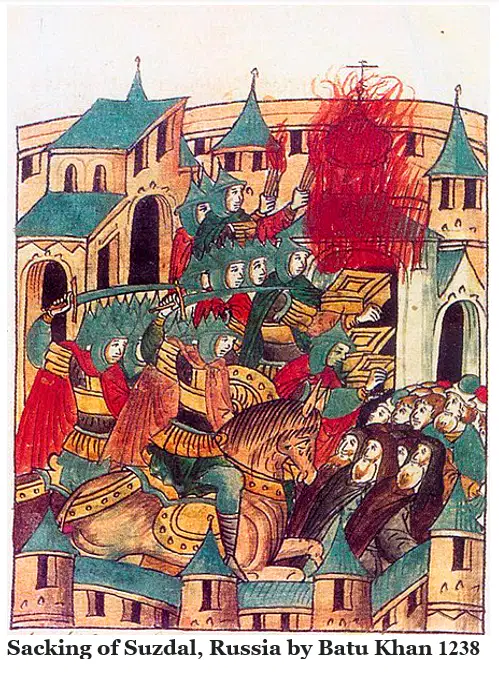
Which of the following historical arguments can be made about the impact of Mongol control over Russia?
Russia was held back (developmentally) from the rest of Western Europe.
Russia was integrated into the long distance Chinese trade.
Russia was not defeated due to its weather and size.
Serfdom in Russia was established on orders from the Mongols.
Which of the following best describes Kiev's (Russia) status after the historical event depicted in the image?
They became a colonial possession for Mongol settlers in Europe.
Kiev became an important trade hub along the Silk Road due to its large economy.
Kiev was destroyed along with important centers for study and instruction, and later abandoned.
The city and surrounding area became a Khan tributary state for the Golden Horde, but offered little.
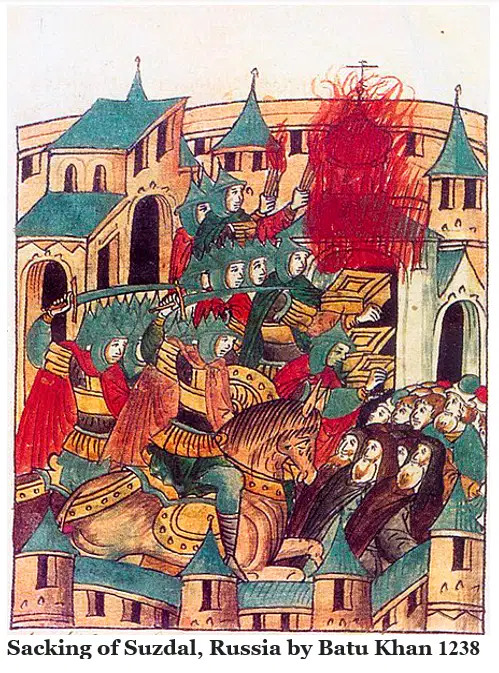
The events depicted in the image are most similar to what other event in Mongol history?
Defeat of Mongol forces by Mamluk slaves in Northern Egypt.
Mongol capture of Japanese islands following their journey across the Chinese sea.
Mongol sacking of Baghdad in response to the refusal of Caliphates to surrender.
Mongol transformation of the Song Dynasty in Kublai Khan's Yuan Kingdom.

The new approach described in the passage is most likely a reference to what belief system that emerged in the 14th century?
Humanism, which empowered many Europeans during the Renaissance Era to act for themselves and not follow traditional dogma.
Meritocracy, which developed during the Song Dynasty and advocated for the advancement of others based on skills and abilities.
Secularism, which argued for the separation of church and state activities for the public good.
Devshirme, a practice common in the Ottoman empire which identified specific individuals for service to the Sultan.

What actions, taken by Martin Luther in 1517, undermined the teachings of the Catholic church?
He proved the earth was not at the center of the solar system and instead that we orbit the sun.
His work refuted previous teachings by the church surrounding gravity and the weight of objects.
His letter argued shortcomings in the church's advocacy of its supreme power to control the destination of a person's soul.
He attempted to combine various faiths including Hinduism, Islam, and Christianity into a divine faith to be practiced by all.

Which answer specifically identifies an argument made by Martin Luther in his 95 Theses?
Salvation can only be granted by those who recant their sins and ask for forgiveness.
The Church could not forgive the sins of practitioners through the purchase of indulgences.
Only the Pope has the power to forgive, not his cardinals or priests.
The bible should only be written in Latin to avoid false ideas from being included.

Which of the following groups responded in the same manner as described by Dr. King, Jr. in the final paragraph?
The Chinese living under Mongolian rule.
Janissary soldiers not given advancement in the Ottoman ranks.
Jewish communities during the Bubonic Plague.
Protestants living in England under the rule of King Henry VIII.

Ultimately, what did Dr. Martin Luther King, Jr. advocate most for in response to violant acts by oppressive forces?
Violence in return as such actions were justifiable in the end.
To revolt against the wealthier ruling elites as the poorer classes deserved better treatment.
Non-violant resistance as such actions would quell the angry of some and create regret in others.
Following the laws and pushing for politicians to make the necessary changes.

Segregation supported by "Jim Crow" laws of the 1950s was the unconsciousable result of what ongoing historical development associated with the Atlantic Slave Trade?
Racist ideology supported by unorthodox biblical readings and political justifications.
Attempts to maintain smaller numbers for minorities in comparison to Eurocentric families.
Political allegiances to mercantile as opposed to social systems of government.
Alarmist response to the percieved threat of new ideas.

