
 Worksheets
Concept Quiz 7.1-7.5 (Work and Energy Conservation)
Total questions: 26
Worksheet time: 19mins
Two objects, one of mass m and the other of mass 2m, are dropped from the top of a building. If there is no air resistance, when they hit the ground _______.
the heavier one will have half the kinetic energy of the lighter one
the heavier one will have twice the kinetic energy of the lighter one
the heavier one will have one-fourth the kinetic energy of the lighter one
the heavier one will have four times the kinetic energy of the lighter one
Three cars (car A, car B, and car C) are moving with the same speed when the drivers slam on their brakes. The most massive car is car A, and the least massive is car C. If the tires of all three cars have identical coefficients of kinetic friction with the road surface, for which car is the amount of work done by friction in stopping it the greatest?
The amount of work done by friction is the same for all cars.
Car A
Car B
Car C
An iron ball and a marble are launched horizontally on a frictionless table by identical ideal springs. Both springs were initially compressed by the same amount. If the iron ball is heavier than the marble, which of the following statements about these objects are correct? (Select all that apply.)
Both move free of the spring with the same speed.
The iron ball has more initial elastic potential energy than the marble.
The marble leaves the spring moving faster than the iron ball.
The ball and marble both have the same kinetic energy just as they move free of the spring.
Both has the same initial elastic potential energy.
A heavy frog and a light frog jump straight up into the air. They push off in such away that they both have the same kinetic energy just as they leave the ground. Air resistance is negligible. Which of the following statements about these frogs are correct? (Select all that apply.)
Just as they leave the ground, the heavier frog is moving faster than the lighter frog.
The lighter frog goes higher than the heavier frog.
Just as they leave the ground, the lighter frog is moving faster than the heavier frog.
They both leave the ground with the same speed.
The heavier frog goes higher than the lighter frog.

A force acts on an object, causing it to move parallel to the force. The graph in the figure shows this force as a function of the position of the object. How much work does the force do as the object moves from 0 to 15m?
50 J
150 J
25 J
125 J

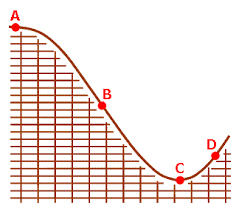
A cart is constrained to move along a straight line. A varying net force along the direction of motion is exerted on the cart. The cart’s velocity v as a function of time t is shown in the graph above. The five labeled points divide the graph into four sections.
During some part of the motion, the work done on the cart is negative. What feature of the motion indicates this?
The speed is decreasing.
The speed is increasing.
The acceleration is negative.
The acceleration is positive.

The Ug and K increase and decrease together
The Ug decreases while the K increases
Impossible to know without knowing the mass


What are the units of Potential Energy? Select all that apply.
N*m, Newtons*meters
kg, kilogram
J, Joules
m/s, meters/second

A graph of force vs. distance for an elastic material is:
A downward curve
An upward curve
A straight line from any point on the x and y axis
A straight line from the origin
The area under a force vs. displacement graph tells you the
mass of the object
momentum of the object
work done on the object
impulse of the object

An object is moving in the positive x-direction while a net force directed along the x-axis is exerted on the object. The figure above shows the force as a function of position. What is the net work done on the object over the distance shown?
F0d
3F0d/2
2F0d
4F0d

Which two forces do NO work on the gold block?
Fa
Fg
Ff
Fn
Which force(s) does/do negative work on the gold block? Select all that apply.
Fa
Fg
Ff
Fn

A 1000N force pulls a car for 300m to the left. What is the work done by the truck?
-300,000 J
-150,000 J
0 J
150,000 J

A block slides down a ramp at constant speed of 6 m/s. Which force does a negative value of work?
Fn
Fg
Ff
Fa
A block slides down a ramp at constant speed of 6 m/s. Which force does no work?
Fn
Fg
Ff
Fa

