wayground logo

Free Printable Worksheets

NEW

Font size

S
M
L
XL
Worksheets

Midterm Review

Total questions: 57

Worksheet time: 3hrs 51mins

Name
Class
Date
1.
diffusion is the movement of 
a)
water from low to high concentration
b)
particles from low to high concentration
c)
water from high to low concentration
d)
particles from high to lowconcentration
2.
Which structures are found in every living cell?
a)
cell membrane and cytoplasm
b)
chloroplasts and mitochondria
c)
a cell wall and nucleus
d)
chloroplasts and cell wall
3.
Which cell structure is found in plant and animals cells and controls what can come into or leave a cell?
a)
cell membrane
b)
cytoplasm
c)
nucleus
d)
vacuole
4.
Which of the following is not part of the cell theory?
a)
cells must contain DNA 
b)
all living things are made from cells
c)
cells can only come from other cells
d)
cells are the basic unit of life
5.
Almost all bacteria are...
a)
Unicellular
b)
Multicellular
6.
Every living organism is made up of one or more cells
a)
True
b)
False
7.
A cell is...
a)
the basic unit of structure and function in living organism
b)
an organism
c)
a basic part of everything that we see
d)
found only in animals, not plants
8.
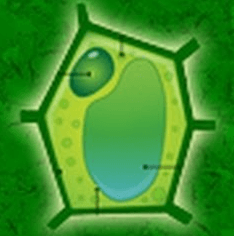
Which of the following are NOT found in animal cells
a)
chloroplasts and cytoplasm
b)
chloroplasts and cell wall
c)
cell wall and cell membrane
d)
mitochondria and nucleus
9.

What is NOT a part of cell theory:

a)

all cells come from existing cells

b)

all cells have a nucleus

c)

all living things are made of cells

d)

cells are basic unit of structure and function in living things

10.
Robert Hooke, Anton van Leeuwenhoek, Theodor Schwann, Rudolf Virchow, and Matthias Schliden were all responsible for what theory?
a)
The Theory of Gravity
b)
The Theory of Relativity
c)
The Cell Theory
d)
The Theory of Continental Drift
11.
All living things are made up of...
a)
cells
b)
cell tissues
c)
organ
d)
organ systems
12.

________ is the scientist who saw small chambers when looking at cork, and named them “cells”.

a)

Newton

b)

Hooke

c)

Carson

d)

Manning

13.
Which is true of prokaryotic and eukaryotic cells?
a)
Prokaryotic cells are larger than eukaryotic cells.
b)
Eukaryotic cells do not have nuclei, and prokaryotic cells do have nuclei.
c)
Prokaryotic cells lack membrane-bound organelles, and eukaryotic cells contain membrane-bound organelles.
d)
Eukaryotic cells are simpler than prokaryotic cells.
14.
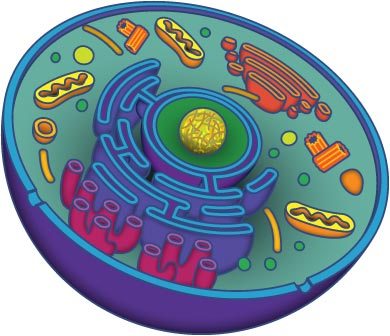
Which type of cell?
a)
Prokaryote
b)
Eukaryote
15.
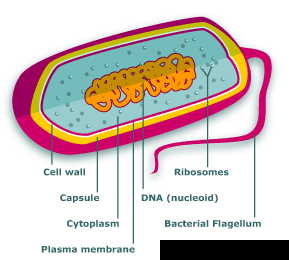
Which type of cell?
a)
Prokaryote
b)
Eukaryote
16.
A rigid layer that lies outside the cell's  membrane is...
a)
Cytoskeleton
b)
Cilia
c)
Cell Wall
d)
Flagella
17.

The chloroplast in plant cells are responsible for ______________.

a)

Cell respiration

b)

Metabolism

c)

Photosynthesis

d)

Carbon synthesis

18.
Find the total magnification: 
Eyepiece = 10X 
Objective lens = 55X
 
a)
10x
b)
55x
c)
65x
d)
550x
19.
The__________ sharpens the image under high magnification.
a)
the diaphragm
b)
fine adjustment knob
c)
coarse adjustment knob
d)
the ocular
20.
Never use this when on high power.
a)
Fine adjustment
b)
Diaphragm
c)
Course adjustment
d)
Stage clips
21.
What is the rate of reaction?
a)
How fast a reaction is 
b)
How big a reaction is
c)
How loud a reaction is
d)
How much gas a reaction produces
22.

The rate of a reaction is how _____________ a reaction occurs.

a)

Quickly

b)

Easily

c)

Unusually

d)

Differently

23.
Which factors increase the rate of a reaction.
a)
increasing temperature
b)
increasing concentration
c)
increasing surface area
d)
all of these
24.

The one and only factor that will change in an experiment. The person doing the experiment changes this.

a)

Dependent Variable

b)

Independent Variable

c)

Controlled variable

25.
The height of the bean plant depends on how much water they receive. What is the dependent variable? 
a)
Same amount of sunlight
b)
Same soil and water
c)
How much water they received
d)
The height of the bean plant 
26.
Ms. S set up an experiment to see how the mass of a ball affects the distance it rolls off a ramp. What is the dependent variable?
a)
Distance traveled by the ball
b)
Height of the ramp
c)
Mass of the ball
d)
Where the experiment took place.
27.
Tiffany was investing how fast it took Hayden to react to different sounds. Identify the independent variable.
a)
How fast Hayden reacted
b)
different sounds
c)
types of music
d)
Hayden
28.
Walker is testing which fertilizer will grow the tallest grass.  The height of the grown grass is the __ variable.
a)
constant (same)
b)
independent (changes)
c)
dependent (measured)
29.
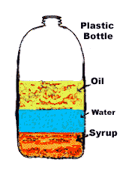
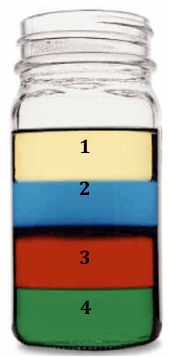
Which liquid is the least dense?
a)

oil

b)

water

c)

syrup 

30.
An object with which of the following densities will float on water?
a)
0.7 g/cm3
b)
1.2 g/cm3
c)
3.5 g/cm3
d)
11.4 g/cm3
31.
Put the liquids in order from most dense to least dense?
a)
4, 3, 2, 1
b)
1, 2, 3, 4
c)
3, 4, 2, 1, 
d)
4, 3, 1, 2
32.

Find the mass.

a)

285.3 g

b)

275.5 g

c)

275.3 g

33.

What is the value on the balance?

a)

240.0 g

b)

142.0 g

c)

100.4 g

34.
What is the volume of the liquid in this graduated cylinder?
a)
8.2 mL 
b)
8.02 mL 
c)
82 mL 
d)
9.8 mL
35.

What is adaptation?

a)

a characteristic of a living thing that helps it survive in its environment

b)

An environment includes everything living and non-living in the area that a plant or animal lives in

c)

made up of all the living. things and non-living things that function together in one place

d)

none of these

36.

What are the six kingdoms of living organisms?

a)

Archaebacteria, eubacteria, animalia, plantae, fungi, protista

b)

Archaea, plants, Krypton, Uranium, Protista, Animals

c)

Molecules, Cells, Tissues, Organs, Organ Systems, Organisms

d)

kingdom, phylum, class, order, family, genus, and species.​

37.

A mealworm is different from its parents because the parents are:

a)

Ant worms

b)

Redworms

c)

Adult worms

d)

Beetles

38.

The 1st stage in the Mealworm's life cycle is the...

a)

egg

b)

larva

c)

pupa

d)

beetle

39.

What is the correct order of the stages of a beetle's life cycle?

a)

egg, larva, adult, pupa

b)

egg, pupa, larva, adult

c)

egg, larva, pupa, adult

d)

egg, adult, pupa, larva

40.

What is the idea that life can arise form nonliving material?

a)

biogenesis

b)

evolution

c)

spontaneous combustion

d)

spontaneous generation

41.

Who finally disproved Spontaneous Generation?

a)

Redi

b)

Needham

c)

Spallanzani

d)

Pasteur

42.

What piece of equipment did Pasteur use in his experiment which allowed air to enter but trapped the dust particles in the air?

a)

microscope

b)

Erlynmeyer flask

c)

Swan-neck flask

d)

Wide mouth beaker

43.

What is a flagella?

a)

tiny hairs

b)

tail-like whip

c)

false foot

44.

A bacterium reproduces asexually by dividing to form two new bacterial cells. What is the name of the process by which bacteria reproduce?

a)

meiosis

b)

mitosis

c)

budding

d)

binary fission

45.

Bacterial moves around with this

a)

Flagellum

b)

Pili

c)

Capsid

d)

DNA

46.

Viruses are living organisms

a)

True

b)

False

47.

What is the field of view?

a)

2mm

b)

4mm

c)

5mm

d)

8mm

48.

The shape of a red blood cell helps it

a)

Flow through a blood vessel (vein) in your body

b)

Move messages quickly, from one area to another in your body

49.

The shape of a muscle cell helps it

a)

Get longer or shorter

b)

Move messages quickly

50.
What are the nucleotides made of?
a)
Sugar, Phosphate, nitrogen base
b)
Phosphate, Adenine, nitrogen base
c)
Thymine, Adenine, Cytomine
d)
Phosphate, Nitrogen, Adenine
51.
Adenine bonds with ______________.
a)
Guanine
b)
Thymine
c)
Cytosine
d)
Adenine
52.
Guanine bonds with ______________.
a)
Adenine
b)
Guanine
c)
Cytosine
d)
Thymine
53.
Which sequence of DNA bases would pair with this partial strand
ATG TGA CAG
a)
ATG TGA CAG
b)
TAC ACT GTC
c)
GTA AGT GAC
d)
CAT TCA CTG
54.
Which organelle is DNA usually found in?
a)
cell membrane
b)
vacuole
c)
chloroplast
d)
nucleus
55.
Which 2 molecules forms the sides (backbone) of the DNA ladder?
a)
deoxyribose and adenine
b)
deoxyribose and a hydrogen bond
c)
sugar and the nucleus
d)
deoxyribose (sugar) and phosphate
56.
What is the shape of DNA?
a)
double helix
b)
double heelies
c)
double trouble
d)
double staircase
57.

Little pieces of DNA that code for our traits are called

a)

cells

b)

chromosomes

c)

genes