
 Worksheets
Seminar 3 Consumer Journey and buying decision
Total questions: 18
Worksheet time: 2hrs 53mins
Consider how the couple made each decision. What issues arouse during their decision process?
What journey archetypes are evident in the story?
In your opinion, based on the story, explain what are the key implications for marketers that arise?
Imagine Grace, Harry, and Neha are running a clothing brand in the metaverse to promote sustainable consumption. They are using this virtual platform as part of their marketing strategy. How will this affect the consumer experience of their apparel products?
Can you map out the details of two journeys for the same product, one in the metaverse and one in a brick and mortar shop (in real life)? Use the figure in the board and use different colours to map out the differences for each journey. Start with the real life journey and then point out where you think the one in the metaverse would be different.
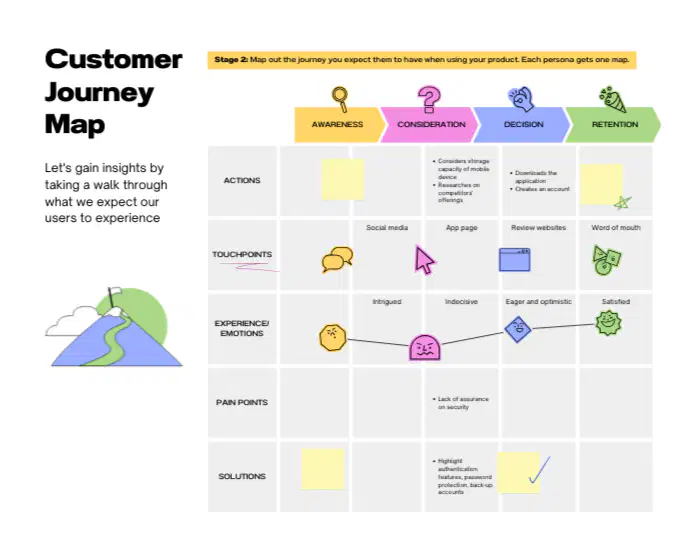
Discuss whether the customer journey varies across different types of products or for different needs (e.g., more functional versus hedonic).
Would the social aspects as discussed in the lecture be? More, less, or similarly relevant to virtual or tangible products? Why?
In the year 2050, John is a marketing manager for a leading intergalactic corporation. He is explaining the customer buying journey in the context of virtual reality shopping to his team. He mentioned that it consists of five stages which are (a) .
Attention, Evaluation, Acquisition,
Research, Comparison, Transaction,
Interest, Decision, Action, Satisfa
Awareness, Consideration, Purchase,
Imagine you are the owner of a futuristic tech company. Why would you want to use the customer buying journey model in your business strategy?
To increase the costs of your advertising campaigns
To limit the choices available to your customers
To better understand how your customers interact with your business at different stages
To confuse your customers with complex stages in the buying process
As a marketing strategist in a galactic retail conglomerate, what is a key challenge you might face when trying to understand the interstellar customer's purchasing journey?
Customers prefer traditional inter-galactic advertising methods
Customers do not use quantum devices for purchases
Customers do not seek reviews from friends and alien species
Customers expect personalized experiences across different planets
An intergalactic merchant wants to boost alien awareness about his cosmic goods during the trading process. He can achieve this by (a) .
ignoring interstellar surveys and galactic social media
limiting holographic advertising options
understanding alien demographics
avoiding any form of holographic advertising
You are the marketing director of a space tourism company in the year 2050. What strategy would you use to enhance your brand's visibility during a potential space traveler's booking process?
Ignore space traveler inquiries
Conceal space traveler testimonials
Avoid having an online presence on intergalactic platforms
Share space traveler success stories and valuable information about space travel
You are operating an intergalactic trade hub. What could potentially cause a space trader to abandon their cargo pod during the final transaction phase?
Requiring the space trader to register for a galactic pass and providing clear cost information
Requiring the space trader to register for a galactic pass and having a complex transaction process
Not revealing teleportation costs until the end and having a complex transaction process
Providing clear cost information and having a simple transaction process
A local spaceship supplies store owner, Zorgon, is trying to understand the importance of long-term customer loyalty for his intergalactic business. He believes it is (a) .
More likely to sell products to existing customers
More likely to sell products to new customers
Not having a significant impact on his sales
Not having any impact on customer retention
You are a brand manager for a cutting-edge tech company in the year 2050. Your brand often faces criticism on intergalactic social media platforms, while also receiving praise from satisfied customers across different planets. What would be a practical approach to handle this situation, especially during the advocacy stage of your brand?
Being proactive in resolving issues and seeking positive messages
Not engaging with customers on social channels
Avoiding social media monitoring
Ignoring negative reviews and not seeking positive messages
You are a brand manager in the year 2050 and you want to find out what people are saying about your brand during the advocacy stage in this digital era. What would be your first step?
Ignore any feedback from customers
Avoid any form of brand monitoring
Subscribe to a paid service for social media monitoring
Use a free service like Google Alerts
Imagine you are the owner of a futuristic tech company. What would be crucial for you to understand your customer's behavior during the time they are considering purchasing your advanced AI product?
Ignoring customer feedback
Performing market segmentation
Reducing marketing efforts
Using analytics and conducting surveys
How do distal social influences differ from proximal social influences in terms of their impact on the customer journey?
Customer journey models go back more than 100 years to the earliest days of marketing as a discipline. These models break down the customer’s path to purchase and beyond into discrete steps or stages and have proven remarkably useful to marketing academics and practitioners. These journey models vary a great deal in their specifics, but what nearly all previous incarnations of the customer journey have in common is the depiction of an individual journey.
A new article in the Journal of Marketing re-examines the classic customer journey model from a social perspective by emphasizing the social influences expected at each stage of the journey and across the journey stages. While previous customer journey models have acknowledged the possible influence of social others on customers, our approach was unique because it fully integrates social influences. This social approach is especially relevant given the ways technology has facilitated more and different social influences throughout the customer journey.
The nature and type of social influences are varied. This article grapples with this diversity by organizing social influences on the customer journey along a social distance continuum. We suggest that social distance is comprised primarily of five dimensions: number of social others, extent to which the other is known, temporal and physical presence, group membership, and strength of ties. We suggest that these dimensions converge to form a global sense of social distance, but that not all dimensions need to be on the extreme ends of the continuum for the social other to be interpreted as overall more proximal or distal. Rather, we suggest that a preponderance of the factors will determine how close the social other is perceived to be.
Distal social others can be larger groups or the whole of society, whose members might not be individuated, present, temporally proximal, or even known to the consumer. When a distal other is a single individual, it will tend to be someone the consumer does not know personally, such as a YouTube tutor or an anonymous review writer. For example, a vacation-planning consumer may be influenced by distal social others including the reviews on a travel website representing many, relatively unknown, non-physically present social others with only weak social ties and unlikely membership in a readily identifiable in-group.
Proximal social others are typically specific, individuated others who provide distinct, discrete, articulated inputs to the focal customer’s journey. They tend to be close, in terms of temporal and physical proximity, members of the customer’s in-group and have strong ties to the focal consumer. For example, the same vacation-planning consumer mentioned above may be influenced by inputs from a proximal social other, such as a single, close friend representing one, well-known, physically present, in-group member with strong social ties.
While technology and other societal forces have considerably broadened where and how traveling companions can influence the customer journey, perhaps the most fundamentally social journey is one wherein two or more consumers journey together. With respect to our social distance continuum, when a certain threshold is surpassed, social others may become incorporated into the decision-making unit (DMU) itself, creating a joint journey characterized by interdependence in most or all stages of the customer journey. This results in a pluralized DMU, where two or more people travel on a joint-decision, joint-consumption journey together. Decision making in such situations is qualitatively different because the members of the DMU have interdependent utilities and each member of the DMU may, at each stage of the journey, base his or her own responses on the responses of the other. Because of the relationship dynamics that must be managed, joint journeys are complex and distinct from individual journeys.
Key managerial issues across the entire social customer journey involve how and when to become involved in what might otherwise be consumer-to-consumer-only interactions. Considerations might include: when and how firms should respond to negative customer reviews or social media call-outs, when to highlight a social media influencer who is implicitly or explicitly endorsing one’s product, how to manage “sponsored” blog posts, and when to provide “corrective” information when consumers are being exposed to unfavorable product information by their peers. Of particular interest to marketers, social influence may be used to nudge consumers from evaluation to decision. Technology has increased the number of opinions that bear upon a customer’s journey and has even begun to insert itself as a decision support system wherein the customer and an artificial intelligence (AI)-enabled agent, such as a chatbot, together reach a final decision. Firms must carefully consider their usage of AI technologies, attending specifically to the social implications.
https://www.ama.org/2020/04/23/the-social-customer-journey-and-its-implications/
How do distal social influences differ from proximal social influences in terms of their impact on the customer journey?
In what ways might a proximal social influence be more persuasive than a distal one, and vice versa?
How can businesses effectively measure the impact of distal and proximal social influences on consumer behavior?
How has technology, particularly social media, redefined the concept of social distance in customer journey models?
In what ways have AI and decision support systems become a social influence in the customer journey?
How does a joint journey change the dynamics of decision-making in a customer journey model?
What are some potential advantages and challenges of addressing a pluralized decision-making unit (DMU) for businesses?
What are some of the ethical considerations for a company when intervening in consumer-to-consumer discussions?
How should companies balance the use of AI in the customer journey to enhance the social experience without replacing human interaction?
What strategies can managers employ to leverage social influences at different stages of the customer journey to drive conversions?
What types of messages are most persuasive? For example, would you be more likely to buy a TiVo if an ad described it as offering you freedom or if it explained how you could replay sports events? A new study in the Journal of Consumer Research says the key to an effective message is finding the fit between the consumers' goals and the level of abstraction.
"Informing people that TiVo promotes freedom of expression is an abstract, high-level benefit of the brand, whereas the replay and slow motion features represent concrete, low-level benefits," write authors Angela Y. Lee (Northwestern University), Punam Anand Keller (Dartmouth College), and Brian Sternthal (Northwestern University). "Our research indicates that whether consumers are more persuaded by abstract or concrete benefit information depends on their goals."
For example, the researchers found that when consumers aimed to fulfill aspirations and satisfy achievement goals, more abstract messages (like highlighting the TiVo's freedom aspects) stimulated favorable brand evaluations.
On the other hand, consumers who sought to fulfill their responsibilities and satisfy their security goals, concrete messages (such as the replay and slow-motion features of TiVo) were more persuasive.
People experience a heightened sense of engagement when they process information that fits with their goals, the authors explain. When the level of abstraction fits the goal, people understand messages better and are more easily persuaded.
And, it seems, this message fit can benefit people in tasks beyond choosing products. "Our research shows that not only do people become more engrossed in fit information, they are also energized by fit messages to perform better in a subsequent task (e.g., solving anagrams), even if the task is unrelated to the message."
Angela Y. Lee, Punam Anand Keller, and Brian Sternthal. alue from Regulatory Construal Fit: The Persuasive Impact of Fit between Consumer Goals and Message Concreteness. Journal of Consumer Research, February 2010 (published online July 21, 2009)
https://www.sciencedaily.com/releases/2009/08/090824182451.htm
How do consumer goals influence the effectiveness of abstract versus concrete advertising messages?
What are some examples of consumer goals that might be better served by abstract advertising messages?
Conversely, when might concrete advertising messages be more effective based on consumer goals?
According to the study in the Journal of Consumer Research, how does message abstraction align with consumer goals?
Can you provide an example of how a high-level benefit can be more persuasive for certain consumer goals?
What are examples of consumer goals that align with concrete messages, and how do these messages influence decision-making?
How does the concept of 'fit' between message abstraction and consumer goals play out with other products besides TiVo?
How does the 'fit' between the advertisement's message and the consumer's goals affect their engagement with the product?
In what way can the right message fit impact consumer behavior beyond the immediate decision-making process?

