
Font size
 Worksheets
Physiology MOD 1
Total questions: 28
Worksheet time: 30mins

What is homeostasis?
A dynamic steady state at equilibrium
Maintenance of a relatively constant environment
A state of constant change
A disruption of physiological variables

How are homeostasis and disease related?
Reorder the following: the components of a homeostatic system
Stimulus/perturbation: Change in the internal environment.
Sensor/receptor: Detects changes in the regulated variable.
Control center: Processes information and sends signals.
Effector: Produces responses to bring the regulated variable back to the set point.
Effector response: Action taken by effectors.

What is the main characteristic of negative feedback control?
Increases the effect of the perturbation
Reverses change and decreases the effect of the perturbation
Anticipates a physiological perturbation
Drives the system to extreme until something outside of the system shuts it off
Match the following components of a homeostatic system.
Set Point:
100mgHG
Sensor:
Baroreceptor
Control Center
Medulla
Effector
Blood vessels and the heart
Effector Response
Vasodilation/constriction, HR change

What is the force that would need to be applied to a pure solvent to prevent it from passing into a given solution by osmosis?
Osmotic gradient
Osmolarity
Osmotic pressure
Tonicity

Match the following examples with the suitable mechanism of action.
Milk Ejection Reflex, Blood clotting, action potentials in neurons
Positive Feedback Loop
Salivation for food, anticipatory thermogenesis before exercise
Feedforward
Body temperature regulation, Thyroid hormone regulation, Blood glucose regulation
Negative Feedback
What is the primary energy source for primary active transport?
Energy of electrochemical gradient
Potential energy stored as an ionic electrochemical gradient
Energy of ion gradient
ATP hydrolysis
What is the process by which materials move out of the cell by fusion with the plasma membrane of vesicles formed inside the cell?
Bulk-phase endocytosis
Phagocytosis
Exocytosis
Endocytosis

Match the following: the red outline is the cell and the outside of it is the solution.

Hypotonic Solution

Isotonic Solution

Hypertonic Solution

If I place a RBC into a (a) solution, the RBC would shrivel up.

Match the following homeostasis variable/set points.
Blood Glucose
100
Arterial pH
7.38
Core Body Temp
37
Cell Membrane Potential
-90 to -55
Plasma Osmolality
282

Adipose tissue contains more water than lean muscle.
True
False

Responsive
Predictive
Error-driven
Can be error free
Simple controller
Complex controller

Of the 50-60% body composition of fluid, 67% is intracellular.
True
False
Higher concentrations of polyunsaturated fatty acids, such as omega-3, increase membrane fluidity and the number of gaps in the phospholipid bilayer...
increase the rate of simple diffusion
decrease the rate of simple diffusion
does not affect the rate of simple diffusion
stops simple diffusion
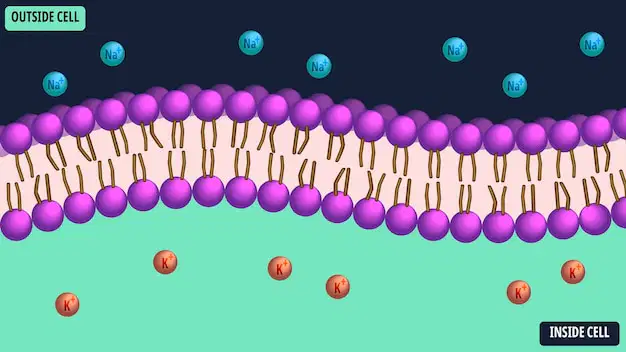
If the solute concentration is greater outside the cell than inside the cell, water will move by osmosis...
into the cell
out of the cell
in equal amounts into and out of the cell
toward lower concentrations of solute
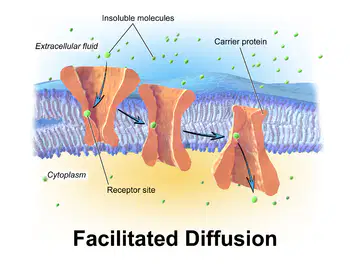
What is a property of carrier-mediated facilitated diffusion that distinguishes it from simple diffusion?
Saturation of transport
Direction of molecule movement
Use of ATP
Reversibility

A function of Na+/K+ ATPase is to...
maintain high extracellular concentration of K+
maintain low intracellular concentration of Na+
remove K+ from cytocol
bring the Na+ into the cell

If the volume of the cell increases when placed into a solution, that solution is said to be ___ to the cell
Hypertonic: Hypoosmotic
Hypertonic: Hyperosmotic
Hypotonic: Isotonic
Hypotonic: Hypoosmotic

Osmolarity is the number of osmoles (a) of solution while Osmolality is the osmoles of solutes (b) of water.

Organize these options into the right categories.
Reflexes that control local blood vessels
Arterial pressure control
Walking movements
Respiration control
Salivation
Licking lips
Memory storage
Thought process
Precision of other areas of brain fxns
Amplitude varies with size of initiating event
All-or-none
Has no threshhold
Has no refractory period
Can be summed
Cannot be summed
Has threshold
Duration is constant
Duration varies
Initiated by environmental stimulus
Depends on ligand-gated ion channels
Depends on voltage-gated ion channels
Is only a depolarization
Can be depolarization or a hyperpolarization
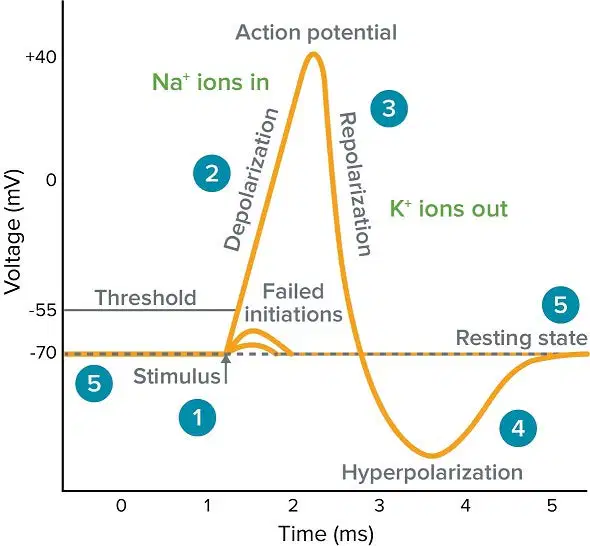
Label the following picture.
Failed initiations
Threshold
Resting state
Stimulus
Hyperpolarization
Depolarization
Repolarization
What variable has the largest influence on the resting membrane potential?
(a)

In a 90kg man, what percentage of water makes up the ECF?
17.8
16.3
33.2
36.2

In Nernst's equation, there is a calculation for the equilibrium potential of ions. K+ is considered (a) and Na+ is (b) .

A semipermeable membrane separates two solutions. Solution 1 has an osmotic pressure of 2800 mmHg, and Solution 2 has an osmotic pressure of 3800 mmHg. Water will move by osmosis in what direction?
There will not be any movement.
The water will flow towards solution 1.
The water will flow towards solution 2.

