

wayground logo

Free Printable Worksheets

NEW

Font size

S
M
L
XL
Worksheets

Earth Science - Meteorology Basics

Total questions: 52

Worksheet time: 37mins

Name
Class
Date
1.
What is the name of the atmospheric layer we live in?
a)
troposphere
b)
mesosphere
c)
stratosphere
d)
thermosphere
2.
Which layer of the atmosphere contains the ozone layer, which protects us from the sun's harmful rays?
a)
troposphere
b)
mesosphere
c)
stratosphere
d)
thermosphere
3.
What is the term for the conditions in the atmosphere over a long period of time?
a)
 Stratosphere
b)
 Climate
c)
 Weather
d)
 Wind
4.
Which global wind pattern is responsible for moving weather fronts across the Unites States?
a)
Polar Easterlies
b)
Trade Winds
c)
Prevailing Westerlies
d)
Doldrums
5.
Distinct weather patterns on Earth's surface are created by __________ and the Coriolis Effect.
a)
unequal heating
b)
magnetic fields
c)
increased temperature
d)
increased air pressure
6.
What increases air's ability to hold more water vapor?
a)
increased wind speed
b)
decreased temperature
c)
increased temperature
d)
increased air pressure
7.
What is dew point?
a)
Temperature when gas become a liquid
b)
water vapor
c)
relative humidity
d)
humidity
8.
What is the cause of Earth's change of seasons throughout the year?
a)
Rotation of the Earth
b)
Revolution of the Earth
c)
Tilt of the Earth's axis
d)
Earth's temperature & weather
9.

As you go higher in the atmosphere the molecules

a)

Are closer together

b)

Are farther apart

c)

Stop moving

10.

As you go higher in the troposphere (the layer of the atmosphere that is closest to Earth) the temperature

a)

Increases

b)

Decreases

c)

Stays the same

d)

first decreases then increases

11.

Climate is different than weather because

a)

Weather is short term, climate is over long periods of time

b)

Weather deals with precipitations, climate with temperature

c)

Climate deals with precipitations, weather with temperature

d)

Weather and climate are the same

12.

The amount of water vapor in the air is known as:

a)

Cloud

b)

Temperature

c)

Humidity

d)

Dew Point

13.

What change causes water vapor in the air to form clouds?

a)

as air rises in the atmosphere, it becomes warmer and cannot hold as much water

b)

as air rises in the atmosphere, it cools and water vapor in the air condenses to a liquid or solid state

c)

as air rises in the atmosphere, the air becomes heavier and changes forms

14.
If the air is "saturated", that means:
a)
the air is full of water
b)
the air is partially full of water
c)
it's amount of water vapor in the atmosphere right now
d)
how much liquid water it potentially can hold
15.
As the air temperature increases, the air's capacity for water vapor: 
a)
increases
b)
decreases
c)
remains the same
d)
is unrelated to air temperature and can either increase or decrease
16.
What is the Dew Point Temperature if the dry-bulb temperature on your sling psychrometer is 20ºC and the wet-bulb temperature is 15ºC?
a)
14ºC
b)
12ºC
c)
10ºC
d)
-18ºC
17.
What do we call a collection of millions of tiny water droplets or ice crystals? 
a)
Fog
b)
Humidity
c)
Clouds
d)
Weather
18.
The sun heats up surface water, causing evaporation (turning a liquid into a gas).  The water vapor then rises into the air creating....
a)
rain
b)
pollution
c)
fog
d)
humidity
19.
Water droplets that condense from the air onto cool surfaces near the ground are called....
a)
fog
b)
precipitation
c)
dew
d)
icicles
20.
What is relative humidity?
a)
humidity that is related to other humidity
b)
condensation
c)
clouds
d)
the amount of water in the air compared to the amount of water the air can hold - a ratio
21.
If the air is only holding one-third as much moisture as it can possibly hold, what is the relative humidity?
a)
50%
b)
25%
c)
33%
d)
67%
22.
What will happen if the relative humidity is 100%, and the temperature begins falling?
a)
The air will be sticky and uncomfortable
b)
Dew will form
c)
The temperature will rise
d)
The atmospheric pressure will fall
23.

Which layer of the atmosphere contains clouds and weather? (click to enlarge picture)

a)

Therosphere

b)

Mesosphere

c)

Stratosphere

d)

Troposphere

24.

Which gas is most abundant in the atmosphere? (click to enlarge picture)

a)

oxygen

b)

nitrogen

c)

water vapor

d)

argon

25.
Which pie chart correctly shows the percentages of elements in the air?
a)
a
b)
b
c)
c
d)
d
26.
The hottest layer.
a)
troposphere
b)
thermosphere
c)
exosphere
d)
mesosphere
27.
What two gases are found throughout all layers of the atmosphere?
a)
Nitrogen and carbon dioxide
b)
Nitrogen and oxygen
c)
Oxygen and carbon dioxide
d)
Trace gases and water vapor
28.
As you go higher in the troposphere, the temperature _______________.
a)
decreases
b)
increases
c)
stays the same
d)
gets very hot
29.
What is the function of the ozone layer?
a)
to allow UV rays to get to Earth
b)
to block UV rays from getting to Earth
c)
To keep oxygen in
d)
to allow meteors to get to Earth
30.
This is the layer where most commercial jet airliners fly.
a)
Troposphere
b)
Stratosphere
c)
Mesosphere
d)
Thermosphere
31.
This is the layer where meteors, or shooting stars, burn up.
a)
Troposphere
b)
Stratosphere
c)
Mesosphere
d)
Thermosphere
32.
What happens to the density (thickness)/air pressure of the air as you increase in altitude?
a)
density increases
b)
density decreases
c)
density stays the same
d)
density disappears
33.
Air in the atmosphere is 78%
a)
Einsteinium
b)
nitrogen
c)
oxygen
d)
carbon dioxide
34.
The atmosphere is a mixture of gases.
a)
True
b)
False
c)
True and False
d)
Neither True nor False
35.

The stratosphere is located between

a)

thermosphere and mesosphere

b)

core and mantle

c)

troposphere and mesosphere

d)

exosphere and mesosphere

e)

your head and Uranus

36.
Water is found in the atmosphere.
a)
True
b)
False
c)
True and False
d)
None of the above
37.
How are the layers of the atmosphere classified?
a)
Density
b)
Gases
c)
Humidity
d)
Temperature
38.
The order of the layers of the atmosphere from space to the earth's surface.
a)
stratosphere, troposphere, mesosphere, thermosphere
b)
troposphere, thermosphere, stratotosphere, mesosphere
c)
troposphere, stratosphere, mesosphere, thermosphere
d)
troposphere, stratosphere, thermosphere, mesosphere
39.
Why does air pressure differ around the earth?
a)
Cold air rises at the equator and warm air sinks at the poles.
b)
Cold air sinks at the equator and warm air rises at the poles.
c)
Warm air  air sinks at the equator and cold air rises at the poles.
d)
Warm air rises at the equator and cold air sinks at the poles.
40.
What causes GLOBAL winds to move in all directions?
a)
breezes
b)
coriolis effect
c)
westerlies
d)
easterlies
41.
Global winds over the United States blow in which direction?
a)
east to west
b)
north to south
c)
south to west
d)
west to east
42.
What causes wind?
a)
differences in pressure
b)
conduction currents
c)
density
d)
tropical currents
43.
This type of wind helped blow trader's ships from Europe to the Americas. It blows winds from EAST to WEST. 
a)
Polar Easterlies
b)
Trade Winds
c)
Prevailing Westerlies
d)
Horse Latitudes
44.
This type of wind comes from the POLES. It blows from east to west and brings freezing weather. 
a)
Prevailing Westerlies
b)
Polar Easterlies
c)
Polar Westerlies
d)
Horse Latitudes
45.

The Equator receives the most direct sunlight and therefore has the warmest air. What type of air pressure would be found there?

a)

High Pressure

b)

Low Pressure

46.

The Poles receives the least direct sunlight and therefore have the coldest air. What type of air pressure would be found there?

a)

High Pressure

b)

Low Pressure

47.

What causes the Coriolis Effect?

a)

Rotation of the Earth

b)

Rotation of the Moon

c)

Earth tilt

d)

Rotation of the Sun

48.
What is the instrument called that measures air pressure?
a)
thermometer
b)
ruler
c)
yard stick
d)
barometer
49.

A high pressure area at 30 degrees North or South that contains calm to no wind.
a)
Trade Winds
b)
Doldrums
c)
Horse Latitudes
d)
Westerlies
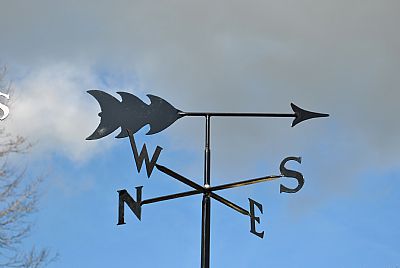
50.
This tool is used by meteorologists to  ___________.
a)
find north, south, west, and east.
b)
show where the rain is coming from.
c)
the direction of the wind.
d)
find wind speed.
51.
This instrument is used to measure
a)
temperature
b)
air pressure
c)
relative humidity
d)
rain
52.
This instrument is a 
a)
barometer
b)
thermometer
c)
rain gauge
d)
sling psychrometer
