
 Worksheets
Energy (Heat Transfer) Quiz 6P3.1
Total questions: 12
Worksheet time: 6mins
Name
Class
Date
1.
A frying pan is touching the flame of a gas stove. The bacon in the pan begins to cook as it heats up. Which of the following BEST describes the heat transfer through the bottom of the pan?
a)
conduction
b)
convection
c)
radiation
d)
vaporization
2.
Jake poured water into a pot. He put the pot on a stove and turned the stove on low. After a few minutes, the water in the pot began to boil. Which statement BEST describes why the water boiled?
a)
The stove transferred light to the pot of water.
b)
The stove transferred electricity to the pot of water.
c)
The stove transferred heat energy to the pot of water.
d)
The stove transferred mechanical energy to the pot of water
3.
Isabella filled a glass with warm water. She measured the temperature, and it was 30°C. She left the glass on a table in a room that was 20°C. A few hours later, she measured the water temperature again, and it was 24°C. Which BEST explains why the water temperature changed?
a)
Energy in the air removed heat from the water.
b)
Heat energy in the water was destroyed by the glass.
c)
Heat energy in the water was transferred to the cooler air.
d)
Energy used by evaporation caused the water temperature to decrease
4.
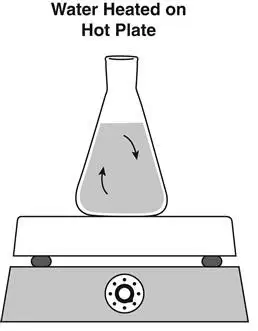
In an investigation, water in an Erlenmeyer flask is placed on a hot plate. As the water is heated, the cooler, denser water at the surface sinks and pushes the warmer water to the top. What do the arrows in the drawing MOST likely represent?
a)
phase changes
b)
convection currents
c)
electromagnetic radiation
d)
energy transfer by conduction
5.
The BEST example of heat transfer by convection is when
a)
sunlight warms soil.
b)
feeling the heat from a campfire
c)
flames heat up a pan
d)
heat rises in a chimney
6.
Which of the following will absorb heat energy?
a)
two sticks being rubbed together
b)
a piece of wood burning
c)
steel wool rusting
d)
ice cubes melting
7.
Why is covering up with a thick, fluffy blanket a good way to stay warm on a cold night?
a)
The blanket produces heat that warms your body.
b)
The blanket transfers thermal energy from the room to your body.
c)
The blanket decreases the transfer of thermal energy from your body to the air.
d)
The blanket increases the amount of thermal energy that your body produces.
8.
A student standing near a campfire feels warmer as the fire grows. Which process MOST likely transfers heat from the campfire to the student?
a)
conduction
b)
convection
c)
radiation
d)
transmission
9.
Which picture shows the transfer of heat by conduction?
a)
Option 1
b)
Option 2
c)
Option 3
d)
Option 4
10.
Molly was making iced tea by putting tea bags in boiling water. She needed to cool the hot tea quickly, so she poured it into a pitcher full of ice. Which BEST describes the flow of thermal energy?
a)
from the ice to the tea
b)
from the tea to the ice
c)
from the pitcher to the tea
d)
from the ice to the pitcher
11.
A black brick exposed to sunlight becomes warm. How is energy from the Sun transferred to the brick?
a)
convection
b)
conduction
c)
radiation
d)
reflection
12.
After playing outside on a cold day, Jaime went inside to wash his hands. Although the water was normal temperature, he noticed that it felt warmer than usual. What would explain this phenomenon?
a)
His body had more kinetic energy than the water.
b)
Heat flowed from a cooler substance to a warmer substance.
c)
The water from the faucet had a higher temperature than his skin.
d)
The thermal energy in the room was higher than the thermal energy outside.
100 %

