
 Worksheets
APES Mini Geology Chapter 11 Review
Total questions: 12
Worksheet time: 24mins
Which of the following is false?
Most earthquakes occur near the center of a tectonic plate.
Minerals are considered non-renewable resources.
Rocks can change from one type to another over time.
Tsunamis (tidal waves) have nothing to do with the tides.
Which type of rock forms from sediment becoming compressed?
Igneous
Metamorphic
Sedimentary
Organic
This type of rock is formed from magma cooling.
Igneous
Metamorphic
Sedimentary
Organic
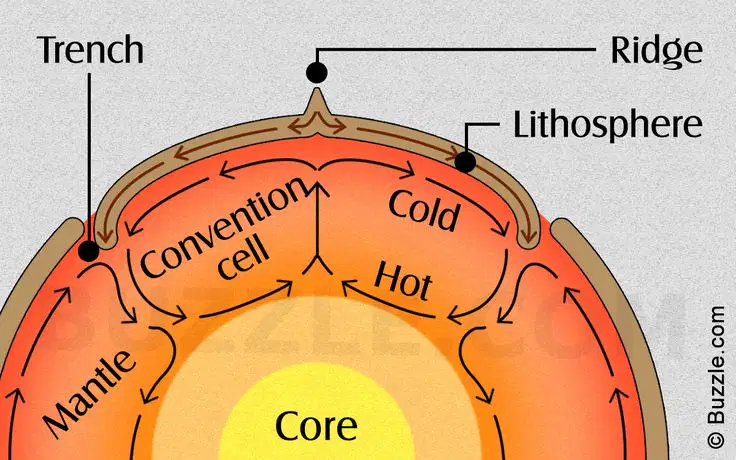
What do convection cells do?
Which of the following is involved in sedimentary rock formation?
Stress
Pressure
Weathering
Burial
Heat
Subduction occurs when a continental plate slides up and over an oceanic plate. Why is the oceanic plate pushed down?
Because the continental plate is thicker
Because the oceanic plate is more dense
Because the continental plate is more dense
Because the oceanic plate is thinner
Which of the following describes the lithosphere?
Light, solid rock that covers about 41% of the Earth's surface (although some is under the ocean)
Hot, partly melted rock that flows and can be deformed.
Solid outer part of the earth, consisting of the crust and the upper mantle.
Solid metallic ball made up of mostly iron and nickel
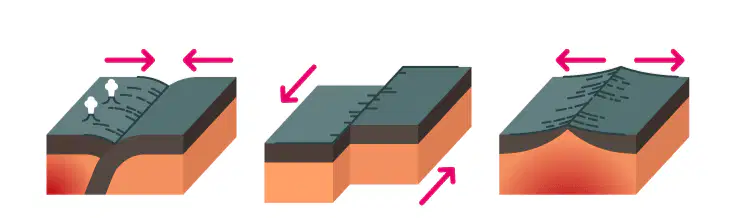
Label each plate boundary in the image provided. Use these labels over the top: Convergenet, Divergent, and Transform. Use these labels for underneath: 'subduction zones occur here', 'lots of volcanic activity', 'lots of earthquakes', 'new plate growth', 'sea floor spreading', and 'creates igneous rock and metamorphic rock'.
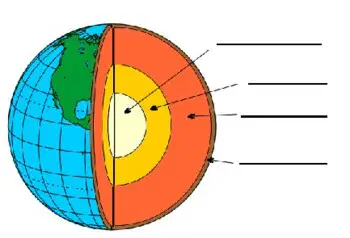
Complete the labeling for this image. Major labels: Core, Inner Core, Crust, Mantle. Minor labels: 'thin rocky shell', 'thick layer of hot rock', 'molten metal, mostly iron', 'solid metal, mostly iron'.
Which of the following is the definition of seismic waves?
Vibrations caused when energy accumulated over time is released
The place where an earthquake begins
The interaction of physical and chemical processes that change rocks from one type to another
What is the difference between the mantle, crust, asthenosphere, and lithosphere. Be very specific.
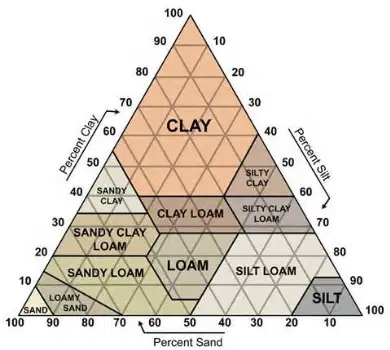
What type of soil is represented by 50% sand, 30% clay, and 20% silt?
silt loam
sandy clay loam
sandy clay
loam

