
NEW
Font size
 Worksheets
CHE 029 P2 Review Quiz
Total questions: 20
Worksheet time: 10mins
Correct sequence for spectrophotometer mechanism
Source - Detector - Sample - Wavelength selector - Signal Processor
Source - Wavelength selector - Detector - Sample - Signal Processor
Source - Wavelength selector - Sample - Detector - Signal Processor
Source - Wavelength selector - Sample- Signal Processor - Detector
Which of the following functional groups has an absorption peak wave number of 2260 – 2100 cm-1?
Aliphatic
Alkene
Alkyne
Amide
What is the general term given to types of chromatography which are more effective in the separation of macromolecules?
Partition
affinity
gel permeation
column
The stationary phase is always composed of a solid phase.
The mobile phase is always composed of a liquid phase.
Only the 1st statement is correct.
Both statements are correct.
Only the 2nd statement is correct.
Both statements are incorrect.
Which is NOT a principle of chromatography
determination of strength of solutions
indication of molecular structure
determination of homogeneity
segregation from complex mixtures
What type of quantum change would the Microwave possess?
Change of spin
Change of configuration
Change of orientation
Change of nuclear configuration
In the analysis of the absorption spectra for colored samples, if the complementary color transmitted of a sample is Blue, the color of the light absorbed is:
Green-blue
Red
Blue-green
Yellow
If the wavelength region is at 595-650nm, the color of light absorbed is
Orange
Yellow
Red
Yellow-green
In a spectrophotometric cell of 1.0 cm path length, the solution of a substance shows the absorbance value of 1.60. If the molar absorptivity of the compound is 2.2 x 10^4 L mol cm, calculate the concentration of the sub-stance in solution. What is the concentration of the substance in that solution?
7.28x10^-5 mol L-1
2.84x10^-5 mol L-1
2.78x10^-5 mol L-1
7.82x10^-5 mol L-1
Which of the following sources utilizes wavelengths: 160 – 380nm
H2 and D2 lamps
Xenon arc lamp
Nernst glower
Nichrome wire
In the analysis of the absorption spectra for colored samples, if the complementary color transmitted of a sample is ORANGE, the color of the light absorbed is BLUE-GREEN, at which wavelength range should it be detected:
400 – 435 nm
435 – 480 nm
480 – 490 nm
490 – 500 nm
Calculate the Sodium carbonate content of 1.12g sample requiring 24.8ml of 0.1947N HCL on titration with phenolphthalein (Na2CO3: 53g/mol)
22.8494 %
25.6448 %
3.9481%
15.7647%
A light ray travels from air (n = 1.0) into a medium with a refractive index of 1.5. Calculate the refractive index of the medium.
0.67
1.5
0.75
1
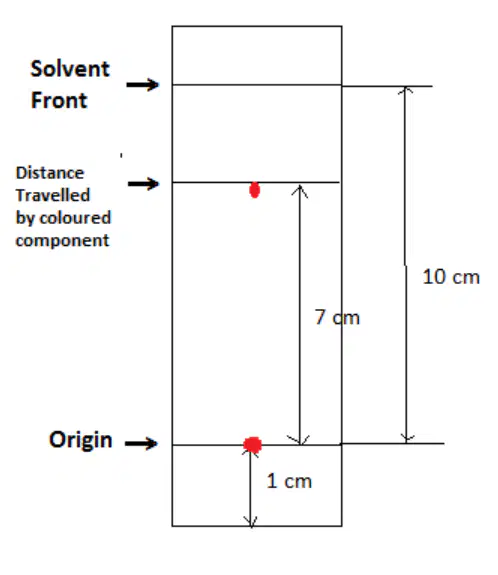
Find the retention factor for the red-colored component with the help of the given figure.
0.7
0.8
0.9
0.1
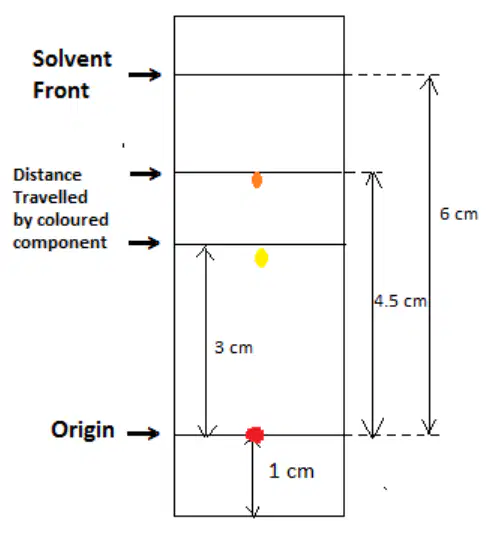
Determine the retention factor of the yellow-colored component of the dye using the given diagram.
2
0.75
0.4
0.5
What is the principle behind gas chromatography?
Partition
Affinity
Gel permeation
Column
What is the purpose of a spectrophotometer's wavelength selector?
To select the color of light to be absorbed
To select the wavelength of light to be absorbed
To select the intensity of light to be absorbed
To select the duration of light to be absorbed
What is the function of the mobile phase in chromatography?
To carry the sample through the stationary phase
To separate the components of the sample
To absorb the components of the sample
To analyze the components of the sample
What is the purpose of a chromatography's stationary phase?
To carry the sample through the mobile phase
To separate the components of the sample
To absorb the components of the sample
To analyze the components of the sample
Which of the following functional groups has an absorption peak wave number of 1800 – 1650 cm-1?
Aliphatic
Alkene
Alkyne
Amide

