
 Worksheets
Midterm 1 Spring 2024
Total questions: 50
Worksheet time: 1hrs 12mins
What is the best explanation for why a person shivers when their body temperature is “too cold”?
The shivering is caused by increased water reabsorption by the kidneys that raises the body’s temperature.
The shivering is caused by an increase in muscle contractions that release energy maintaining homeostasis.
The shivering is caused by an increase in insulin production that raises the body’s temperature.
The shivering is caused by a decrease in the blood’s pH level that raises the body’s temperature.
A contractile vacuole helps protists eliminate excess liquid. This is a “pumping" process which reduces pressure inside the cell and prevents the cell from bursting. What is most likely the source of energy for this process?
DNA
Lipids
ATP
Ribosomes
Cells in your intestinal lining have a higher concentration of sodium than your food. How do they acquire the additional sodium they need?
Osmosis
Diffusion
Active Transport
Passive Transport
Enter: Oxygen Exit: Carbon dioxide
Enter: Water vapor Exit: Glucose
Enter: Carbon dioxide Exit: Oxygen
Enter: Light Exit: Water vapor
Which of these is the correct equation for photosynthesis?
6O2 + C6H12O6 --> 6CO2 + 6H2O
6O2 + 6CO2 --> C6H12O6 + 6H2O
6CO2 + 12H2O --> C6H12O6 + 6H2O + 6O2
6CO2 + 6H2O --> 6O2 + C6H12O6
Which of these are limiting factors for photosynthesis? Choose 3 answers.
Light intensity
CO2 concentration
Temperature
O2 levels
The ___ is the cell part (organelle) inside cells where cellular respiration happens.
mitochondria
chloroplast
nucleus
ribosome
Which of the following is the chemical equation for cellular respiration?
C₆H₁₂O₆ + 6O₂ → ATP + 6CO₂ + 6H₂O
CO₂ + H₂O → ATP + C₆H₁₂O₆ + O₂
C₆H₁₂O₆ + H₂O → ATP + CO₂ + O₂
C₆H₁₂O₆ + CO₂ → ATP + H₂O + O₂

Photosynthesis (a) energy as (b) . Whereas cellular respiration (c) energy as (d)
Organize these options into the types of cellular respiration.
Oxgyen
Without Oxygen
Mitochondia
2 ATP
36-38 ATP
Cytoplasm

This diagram shows a Paramecium, a unicellular protist. When a chemical is added to the pond water in which the Paramecium lives, the Paramecium stops moving. Which structure is most likely affected?
1
2
3
4
How are flagella and cilia similar?
They both aid in movement.
They are both used for reproducing.
They are both hair-like projections that are used for digestion.
They are both used to shoot out trichocysts that paralyze potential prey.
Match the following Unicellular image to its name

flagella

cilia

Pseduopod

A contractile vacuole helps a protist remove excess water. This helps the cell
maintain homeostasis.
excrete food waste.
obtain nutrition.
grow and develop.

Which structure is an adaptation for movement?
Structure A
Structure B
Structure C
Structure D
Structure E
Which statement best explains how sweating during exercise maintains homeostasis?
It regulates mineral concentrations in cells.
It regulates body temperature.
It maintains water balance.
It maintains sugar balance in cells.
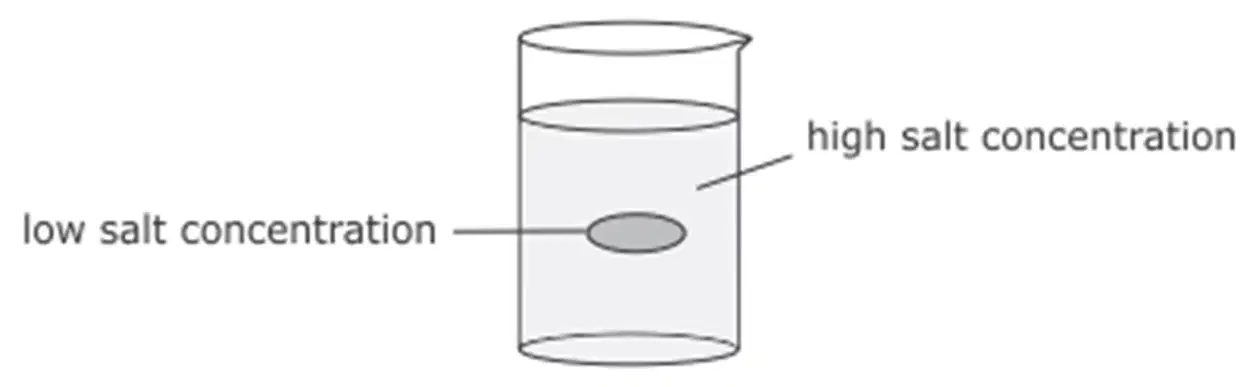
This diagram shows a red blood cell in a beaker that contains a solution with a higher salt concentration than that inside the red blood cell. What will happen to the red blood cell in this environment?
The size of the red blood cell will remain constant.
The red blood cell will swell at first and then shrink.
The red blood cell will swell from absorbing salt molecules.
The red blood cell will shrink from losing water molecules.
Which process best represents a balance of glucose in the bloodstream maintained by insulin?
Osmosis
Adaptation
Metabolism
Homeostasis
Which best illustrates active transport?
Water molecules move into red blood cells placed in pure water causing them to swell and burst.
Glucose molecules move into animal cells through membrane proteins from a region of higher concentration to a region of lower concentration.
Sodium ions are pumped from a region of lower concentration to a region of higher concentration in the nerve cells of humans.
Food coloring molecules spread out in a cup of water when a drop of dye is added to the solution.
Match the following types of passive transport with the correct diagram.

Simple diffusion

Facilitated Diffusion

Osmosis
Which purpose does a cell membrane play in eukaryotic cells?
It digests waste.
It maintains homeostasis.
It translates cellular proteins.
It creates energy to fuel cell processes.
Group the following into the correct type of transport.
Endocytosis and exocytosis
Requires Energy

Osmosis

Does not require energy
Sort the following statements based on if the statement is talking about prokaryotes or eukaryotes
more complex structure
DNA is found in the nucleus
DNA is found in the cell
Unicellular organisms
Ribosomes are found in the cell
Determine where the following organelles can be found (if the organelle can be found in more than one, place in the middle of the two columns).
Cell Wall
Chloroplast
Golgi Body
ER (endoplasmic reticulum)
Nucleoid
Which cell structure identifies a cell as a eukaryotic cell.
nucleoid
mitochondria
nucleus
cell membrane

All cells have the a cell membrane, cytoplasm, DNA, and _______
Mitochondria
Nucleus
Ribosomes
Cell Wall
Which is true of prokaryotic and eukaryotic cells?
Prokaryotic cells are larger than eukaryotic cells.
Eukaryotic cells do not have nuclei, and prokaryotic cells do have nuclei.
Prokaryotic cells lack membrane-bound organelles, and eukaryotic cells contain membrane-bound organelles.
Eukaryotic cells are simpler than prokaryotic cells.
Which statement about the genes of specialized cells is true?
Each specialized cell in an organism contains a different set of genes.
All the specialized cells of an organism contain the exact same genes.
The specialized cells of an organism contain half as many genes as its unspecialized cells.
The specialized cells of an organism contain twice as many genes as its unspecialized cells.
Liver and skin cells are specialized cells that are descended from the same set of stem cells. Why do these specialized cells vary in structure and function?
Liver cells and skin cells receive different amounts of DNA. The additional DNA allows skin cells to develop pigment.
Liver cells and skin cells receive different DNA. The DNA determines the structure and function of each cell.
Liver cells and skin cells receive the same DNA. However, different sets of genes are activated in each cell.
Liver cells and skin cells receive the same DNA. However, liver cells receive more DNA over time.
Match the following organelles
Nucleus
Contains the codes & information for protein synthesis
Rough ER
Transports the proteins
Golgi
Packages the proteins
Mitochodrion
Supplies ATP to all organelles
Ribosomes
Synthesizes the proteins
Which of the images below represents a chloroplast?


Which of the images below represents the site of cellular respiration?
What is one goal of cellular differentiation?
To create many identical copies of cells.
To make stem cells for use in the future.
To make single-celled organisms.
To make specialized cells to maintain homeostasis.
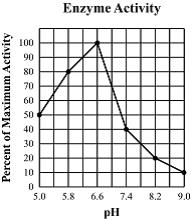

Using the diagram, match the following.
A
Substrate
B
Enzyme
C
Active Site
D
Product
E
Enzyme Substrate Complex

Which enzyme would you expect to find in bacteria growing in a hot environment?
Enzyme X
Enzyme Y
When an amoeba eats, it does so by the process of endocytosis. What type of transport is this?
Passive
Active
Facilitated
Diffusion
How does a cell use energy to maintain homeostasis?
Energy is used to make carbohydrates.
Energy is used to make ATP which can be used for diffusion of molecules across the cell membrane.
Energy is used for active transport of molecules that drive specific cellular actions.
Energy is used to repair the cell membrane.

Match the following monomer to its biomolecule.
Carbohydrates
Monosaccharide
Proteins
Amino acid
Nucleic Acids
Nucleotide
Lipids
Fatty acid
This biomolecule can form many highly complex structures. Some of the many functions include structural support, speed up chemical reactions, and cell membrane channels.
carbohydrates
proteins
nucleic acids
lipids
All of the following are functions of proteins EXCEPT
catalyze/speed up chemical reactions
provide quick energy
make up muscles, hair, and bones
support the immune system
Match the following would be a monomer structure to its biomolecule?

Protein

Carbohydrate

Lipid

Nucleic acid
Match the following functions to the biomolecule
Makes up cell membranes
Lipid
Build muscle
Protein
Carry genetic information
Nucleic acid
Energy source (cellular respiration)
Carbohydrate


