
 Worksheets
Introduction to G9 History
Total questions: 26
Worksheet time: 14mins
A primary source is described as...
A firsthand account or original material that provides direct evidence on a historical topic
A personal opinion or interpretation of a historical topic based on examination of the key details
A detailed account of the past that interprets the original material to help people in the present understand the past
A secondary source is best described as...
Which item is NOT a Secondary Source?
Journal article on the Egyptians
New York Times article on Genghis Khan
Congressional Bill
Thesaurus
Which item is NOT a Primary Source?
National Geographic magazine article
Personal Diary
100 yuan note from 1970
Live video footage
Which of these items is a Secondary Source?
A Drawing of the troop movements in the Battle of Gettysburg
A Photocopy of the US Constitution
Letter from US President Abraham Lincoln to his wife
Atlas of the Earth
The US President's Diary
Which of these items is a Primary Source?
News article explaining the impact of WWII on Shanghai
A Blog about the US constitution
The US Declaration of Independence
A Bilingual Dictionary
1937 News article reporting on the bombing of Shanghai South Station
The Medieval Period lasted...
from the beginning of the Tang Dynasty to the end of the Yuan Dynasty
from roughly AD 500 to AD 1500
from roughly 500 BC to 1500 BC
a few centuries
Which social system best describes most societies in Medieval Europe?
Democracy
Feudalism
Monarchy
Theocracy (rule by religious leaders)
Which political system best describes society in most places in Medieval Europe?
Democracy
Feudalism
Monarchy
Theocracy (rule by religious leaders)
Which groups made up society in Medieval Europe?
Priests, kings & knights
Nobles, knights, priests & merchants
Peasants, politicians, priests & pets
Nobles, priests, knights & peasants
Kings, merchants & traders
Which of these did NOT occur during the Medieval Period?
The Crusades
The Rise of Islam in the Middle East
The end of the Eastern Roman/Byzantine Empire
Emperor Constantine moved the Roman capital to Byzantium (and renamed it Constantinople)
The Hundred Years War was fought between the kingdoms of England and France
The Reconquista was the reconquest of Spain from...
The peasants
Heretic (holding different beliefs) Christian kings
The Muslims
The Africans
The French

Who is widely considered to be the first European to reach North America?
Christopher Columbus (sailed for the Spanish crown)
Leif Erikson (Norse explorer)
Asterix the Gaul (explorer & member of last village to hold out against the Romans)
Marco Polo (Venetian merchant who also visited China)
When did Christopher Columbus, leading an expedition for the Spanish crown in to find a western route to Asia, 'discover' the Americas?
1500
1453
1095
1492
Why did the Spanish want to find a western route to Asia?
They wanted to control all the trade routes in the Atlantic Ocean
They needed to fund their wars against the Muslims, and the trade opportunities presented a way to do this
All the other European countries were sending explorers to find a western route, and they wanted to get there first
They could no longer get goods from Asia via eastern trade routes
Why did the Spanish want to conquer central America?
They didn't think the local rulers were very good
To expand their empire
To gain new trade routes and wealth
To convert the locals to Christianity
To increase the cultural diversity of the Kingdom
The Aztec Empire was located in what is now...
New Mexico
Mexico City
Mexico
The Gulf of Mexico
When the Spanish arrived, the Aztec capital city was...
Montezuma
Tenochtitlan
Tlaxcala
Teotitlan
When the Spanish arrived, the Aztec ruler was...
Montezuma
Quetzalcoatl
Tlaxcalan
Teotitlan
When the Spanish arrived, the Aztec Empire was...
a unified state
a coalition of small states sharing a similar culture
a strong alliance of city-states
a central power controlling surrounding vassal states
The Aztecs...
were probably the native peoples of the Mexican Plateau
probably migrated to the Mexican Plateau because it was rich in gold
probably evolved from a previous civilisation on the Mexican Plateau
probably migrated to the Mexican Plateau due to changes in the climate in their original lands
When the Spanish first arrived in Tenochtitlan, it was...
a large village
a large temple precinct dominated by priests
one of the largest cities in the world
a huge palace from which Montezuma and his court ruled the Aztec Empire
The Aztecs came to dominate Mexico because...
they were always the largest, most fearsome military force in the region
they formed an alliance to overthrow the previous most-dominant city state
they were a warrior culture that could on flourish by waging war against others and forcing them to work for them
there were no other powers in Mexico
The Aztecs...
built pyramids to their gods
built Tenochtitlan on the best land on the Mexican Plateau
trained as warriors from a young age
created innovative (new) ways to practise agriculture
sacrificed themselves to their gods when they started to get old
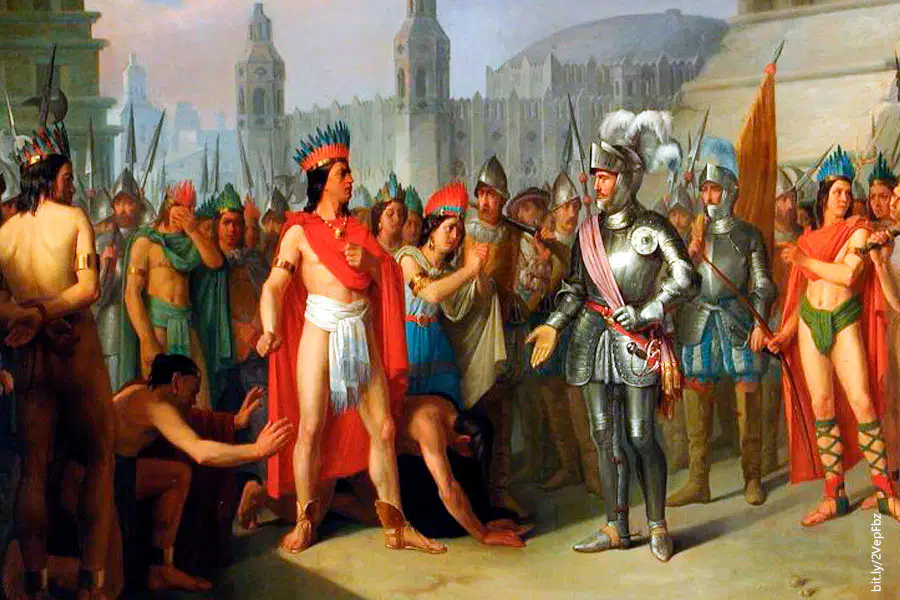
What does this image show?
the surrender of Montezuma to the Spanish conquistador Cortes
the defeat of the Spanish conquistador Cortes by the Aztecs
The Spanish conquistador Cortes presenting Montezuma to the Spanish court
The first meeting of the Spanish conquistador Cortes and Montezuma
What does the Columbian Exchange refer to?
The goods exchanged with the locals by Columbus on his voyages to the Americas
The broad exchange of people, new goods & diseases between the Americas and Europe & Africa
The replacement of Mesoamerican governors with Spanish governors
The mutual exchange of Aztec peoples and Spanish peoples so they could learn about each other's cultures

