
 Worksheets
Unit 6 Bellringer Quiz Review: Reproduction
Total questions: 11
Worksheet time: 6mins
What is a function of genes found in an organism?
Genes code for traits present in an organism and can be passed on to the organism’s offspring.
Genes code for traits present in an organism and cannot be passed on to the organism’s offspring.
Genes code for traits that can be inherited by organisms that reproduce asexually but not those that reproduce sexually.
Genes code for traits that can be inherited by organisms that reproduce sexually but not those that reproduce asexually.
What is an advantage that asexual reproduction has over sexual reproduction?
Asexual reproduction creates offspring at a faster rate.
Asexual reproduction results in genetic diversity among offspring.
Asexual reproduction results in offspring that are larger in size than the parent.
Asexual reproduction allows offspring to be more adaptable to the environment.
James has blue eyes like his father and a widow's peak like his mother. What explains James having similar traits as his parents?
living together with his parents
performing similar activities like his parents
observing and learning from his parents
inheritance of genes from his parents
A particular mountain stream is home to a population of salamanders that are red in color. In the past year, a second population of salamanders that are dark blue in color moved into the same stream. Scientists researching the stream have recently discovered young salamanders that are red with dark blue patches on their bodies. What can the scientists conclude from this evidence?
The salamanders are suffering from a bacterial disease.
The salamanders are on the verge of becoming extinct.
The salamanders undergo asexual reproduction.
The salamanders undergo sexual reproduction.
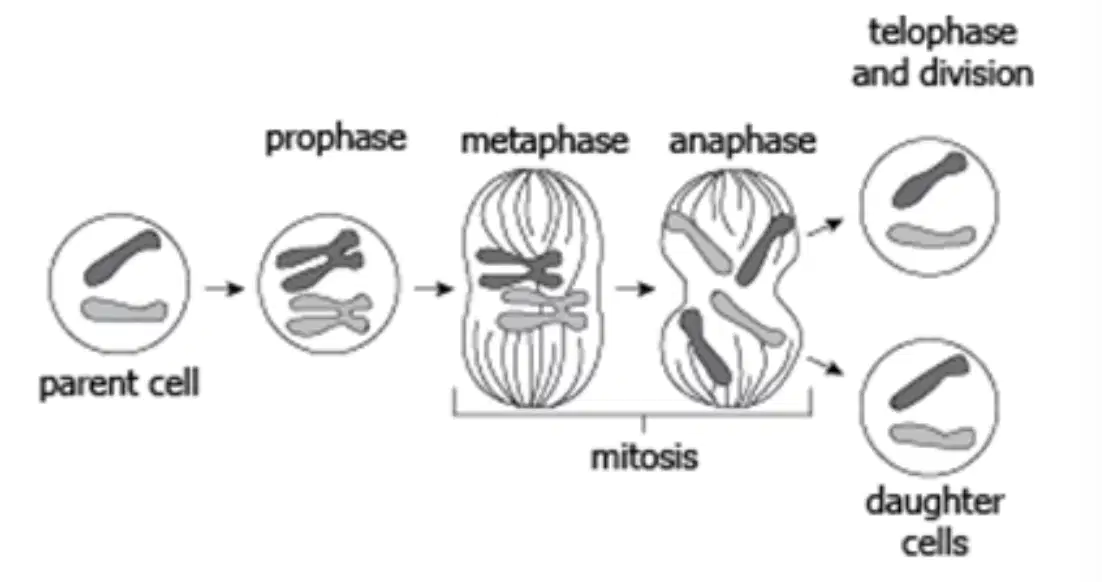
The diagram shows a parent cell undergoing the process of mitosis.
A student claims that mitosis can be a form of asexual reproduction and writes several statements.
1. Daughter cells inherit genes from only one parent cell.
2. Daughter cells are identical copies of the parent cell.
3. Daughter cells have more genetic content than the parent cell.
Which statement(s) can the student provide to support the claim?
1 only
2 only
1 and 2
1 and 3
Which statement accurately describes how genetic information is transferred during meiosis?
Meiosis creates four daughter cells that have half the number of chromosomes that are present in the parent cells.
Meiosis creates two daughter cells that have half the number of chromosomes that are present in the parent cells.
Meiosis creates four daughter cells that have identical genetic information to the parent cells.
Meiosis creates two daughter cells that have identical genetic information to the parent cells.
What relationship exists between genes and chromosomes?
Genes are located on chromosomes which are found in the nucleus of cells.
Genes produce chromosomes which transmit traits from one generation to another.
Genes are made up of chromosomes which move from the nucleus to the cytoplasm.
Genes and chromosomes produce alleles which determine the phenotype of offspring.

A female parent snail with a striped shell and a male parent with no stripes produce five offspring, as shown.
In sexual reproduction, only the male parent passes genes to the offspring.
In sexual reproduction, only the female parent passes genes to the offspring.
In sexual reproduction, offspring inherit genes from both parents, and each offspring has a new combination of traits.
In sexual reproduction, the male parent passes its genes to male offspring, and the female parent passes its genes to female offspring.

A student lists some characteristics of asexual reproduction in plants. Which characteristics did the student list correctly?
2 and 3
1 and 2
1 and 4
2 and 4
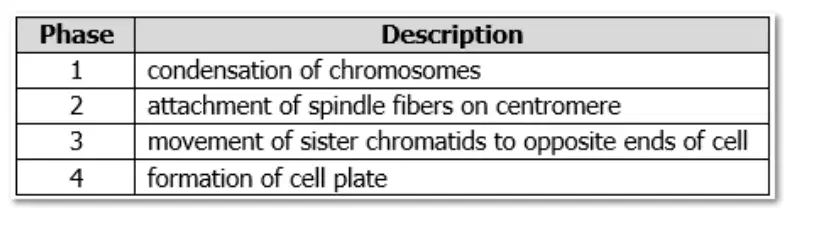
The table shows the sequential description of the phases of cell division in plants. Based on the information, a student draws a diagram of the phases. Which diagram correctly sequences the phases outlined in the table?

Diagram set 1

Diagram set 2

Diagram set 3


The image shows two modes of reproduction. Which statement is correct about the modes of reproduction shown in the image?
Mode 1 can produce offspring more rapidly than Mode 2.
Mode 1 produces offspring identical to their parents.
Mode 2 produces offspring identical to their parents.
Mode 2 produces a zygote through the process of fertilization.

