
 Worksheets
Mughals
Total questions: 120
Worksheet time: 1hrs 5mins
Who was the founder of the Mughal Empire
Akbar
Shah Abbas
Babur
Osman
Who was the founder of the Mughal Empire
Akbar
Shah Abbas
Babur
Osman
A tax paid by non-Muslim populations to their Muslim rulers.
Tariff
poll tax
sales tax
Jizya
A faith established by Akbar, which combined elements of many religions including Islam, Hinduism and Zoroastrianism
Sunni
Sikhism
Divine Faith
Mughal Faith
Muslim kingdom established in northern India by Central Asian Turkish warlords at the turn of the 13th century and continuing to rule N. India until its conquest by Babur.
Tokugawa Shogunate
Delhi Sultanate
Ottoman Empire
Holy Roman Empire
Small, highly detailed, and colorful book illustrations that were prevalent in the Mughal Empire were called
Miniatures
Abstract art
Impressionism Art
Realism
He is considered the greatest of the Mughal emperors of India. He reigned from 1556 to 1605 and extended Mughal power over most of the Indian subcontinent. In order to preserve the unity of his empire, he adopted programs that won the loyalty of the non-Muslim populations of his realm.
Gandhi
Nur Jahan
Akbar
Peter the Great
Local officials in the Mughal Empire that were given plots of farmland which they rented out. They kept part of the local taxes as their salaries and forwarded the remainder to the central govt.
Sikhs
Zamindars
pasha
ultimus
Who was most powerful woman in 17th Century India. She played an unprecedented role in running the vast Mughal empire. Her husband, Jahangir, left the affairs of the state for her to run. She ruled with an "iron hand".
Nur Jahan
Jahangir
Akbaella
Aurangzeb
This dynasty ruled most of India and Pakistan in the 16th and 17th centuries. It consolidated Islam in South Asia, and spread Muslim arts and culture as well as the faith. They were Muslims who ruled a country with a large Hindu majority
Ottomans
Romans
Byzantines
Mughals
He was known for building gardens, monuments, and forts as the country was suffering. He ordered the construction of the Taj Mahal in memory of his wife.
Akbar
Shah Jahan
Suleiman
Ismael
A monotheistic religion that originated in the Punjab region of the Indian subcontinent around the end of the 15th century. They are a nonviolent group.
Muslims
Hindus
Christians
Sikhs
A historical practice found chiefly among Hindus in the northern and pre-modern regions of South Asia, in which a widow sacrifices herself by sitting atop her deceased husband's funeral pyre.
Sikhs
Jizya
Sati
Sikri
It is an enormous mausoleum complex commissioned in 1632 by the Mughal emperor Shah Jahan to house the remains of his beloved wife. The mausoleum is built of shimmering white marble that seems to change color depending on the daylight
Colosseum
Burj Khalifa
Taj Mahl
Eiffel Tower
An Indian prince; a ruler of one of the principal native states of India
Maharaja
Shah
Sultan
Janissary
He is known as being the emperor of India from 1658 to 1707. He was the last of the great Mughal emperors. Under him the Mughal Empire reached its greatest extent, although his policies helped lead to its dissolution.
Babar
Akbar
Shah Jahangir
Aurangzeb
This warrior destroyed Delhi. The city was so completely devastated that according to one witness, "for months, not a bird moved in the city"
Timur the Lame
Attila the Hun
William the conqueror
Slavic the Brave
Akbar the Great improved his empire in all these areas EXCEPT:
tax system
religious tolerance
economic improvements
world wide exploration
Fatehpur Sikri was built by:
Shah Jahan
Babur
Akbar
Jahangir
The Mughal Empire was situated in what modern nation?
Iran
India
Saudi Arabia
Turkey
In 1857, ____________ replaced the Mughal dynasty.
Marathas
Sikhs
British Raj
Afghans
Who founded the Mughal Empire?
Akbar
Suleiman
Babur
Jahangir
A tax paid by non-Muslim populations to their Muslim rulers.
Tariff
poll tax
sales tax
Jizya
Shah Jahan laid the foundation of a new city called?
Lahore
Shah Jahanabad
Fatehpur
Daulatabad
What is sulh-i kul ?
Delhi
Universal War
Universal Peace
Mughal Dynasty
What was the salary given to Zamindars?
Zabt
Iqta
Jagirs
Coins
The second battle of Panipat was fought between _________ and ________
Akbar and Rana Pratap
Akbar and Hemu
The word 'Jahangir' means
Ruler of the world
Conqueror of the world
Fatehpur Sikri was built by:
Shah Jahan
Babur
Akbar
Jahangir
Shah Jahan built was building as a tomb for his wife?
Hagia Sophia
Globe Theater
Palace of Versailles
Taj Majal
Who is considered the greatest Mughal ruler?
Babur
Akbar
Aurangzeb
Jahangir
A tax paid by non-Muslim populations to their Muslim rulers.
Tariff
poll tax
sales tax
Jizya
He is known as being the emperor of India from 1658 to 1707. He was the last of the great Mughal emperors. Under him the Mughal Empire reached its greatest extent, although his policies helped lead to its dissolution.
Babar
Akbar
Shah Jahangir
Aurangzeb
What were the first six Mughals known as
Great Mughals
Poor Mughals
Rich and able Mughals
both (a) and (b)
The history of Akbar's rule was written by
Ishwar Das
Abul Fazl
Bhimsen
Muhammed Kazim
Travels in the Mughal Empire was written by
Wazir
Manucci
Tavernier
Bernier
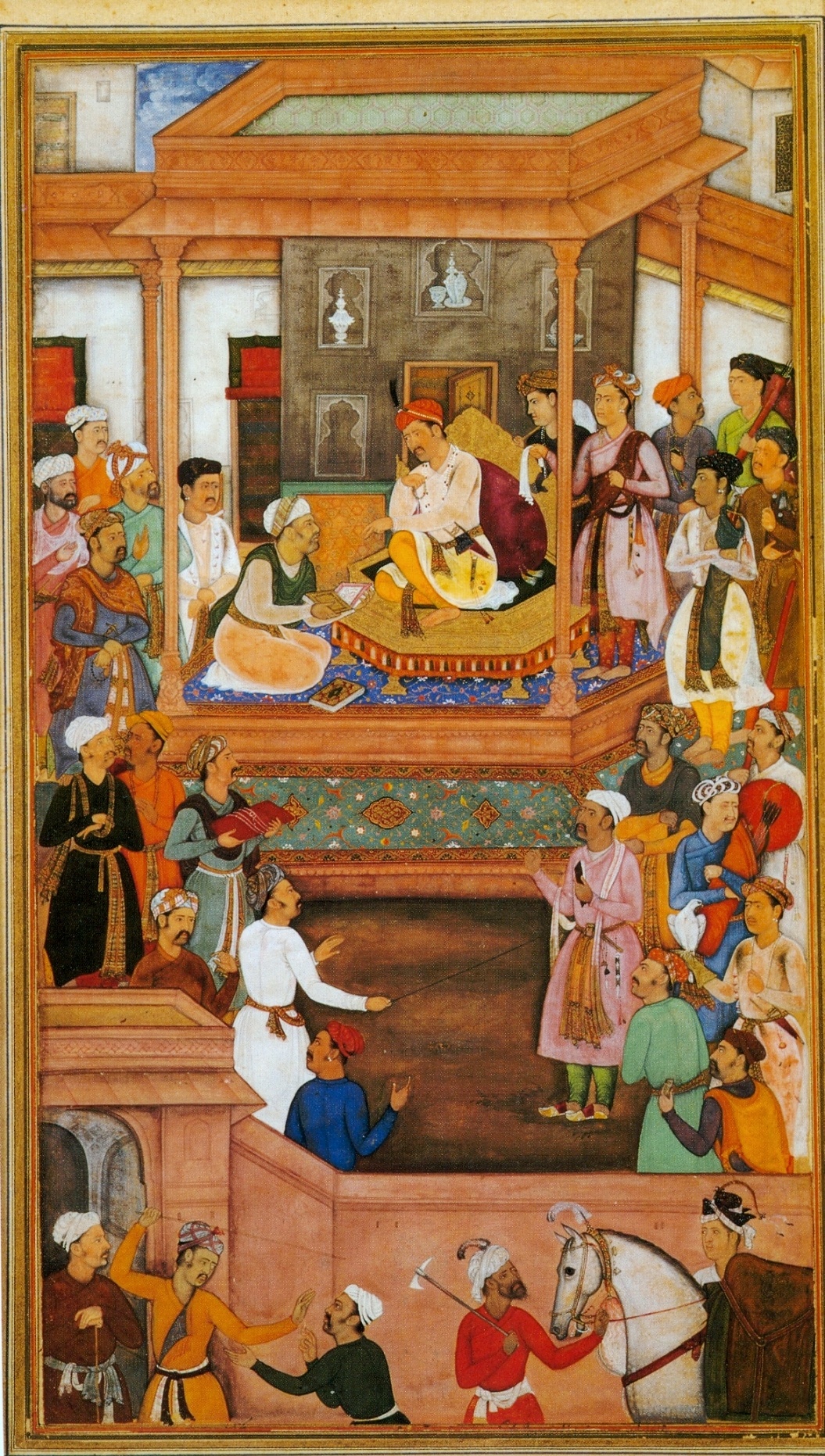
This ruler imprisoned his father, killed his brothers, and took the throne for himself.
Babur
Shah Jahan
Akbar
Aurangzeb
Who was Jahangir's wife ?
Nur Jahan
Raziya Sultan
Rani Lakshmibai
A faith established by Akbar, which combined elements of many religions including Islam, Hinduism and Zoroastrianism
Sunni
Sikhism
Divine Faith
Mughal Faith
A historical practice found chiefly among Hindus in the northern and pre-modern regions of South Asia, in which a widow sacrifices herself by sitting atop her deceased husband's funeral pyre.
Sikhs
Jizya
Sati
Sikri
Who founded the Mughal Empire?
Akbar
Suleiman
Babur
Jahangir
The battle that established the Mughal Empire was:
Caldiran
Mesopotamia
Panipat
Gettysburg
What is the ruler of a sultanate called?
sultan
king
shah
leader
Who is considered the greatest Mughal ruler?
Babur
Akbar
Aurangzeb
Jahangir
This ruler was a religious conservative who did not allow freedom of religion.
Akbar
Aurangzeb
Shah Jahan
Babur
This sultan lost to Babur at the Battle of Panipat in 1526.
Ibrahim Lodi
Henry VIII
Suleiman the Magnificent
New Delhi
A tax paid by non-Muslim populations to their Muslim rulers.
Tariff
poll tax
sales tax
Jizya
Whom did babur defeated , which war and which date
Ibrahim lodi , first battle of panipat , 1539
Ibrahim lodi , first battle of panipat ,1526
Sikandar lodi , first battle of panipat ,1526
Ghias - ud - din tughlaq , first battle of panipat ,1526
First six mughals are called
Greater Mughals
Great Mughals
Less Mughals
Grand Mughals
Sher Shah was most famous ruler of this dynasty
Sher
Mughal
Sur
Lodi Dynasty
The Mughals practiced what religion
Hinduism
Buddhism
Islam
Christianity
What is the name of the capital of the Ottoman Empire
Constantinople
Rome
Istanbul
Ceylon
What type(s) of goods were exported from India
Textiles
Silks
Spices
Precious stones
Eventually, which major European country will colonize in India
Germany
Great Britain
Spain
Italy
Who is considered the greatest Mughal ruler?
Babur
Akbar
Aurangzeb
Jahangir
The Mughals were descendants of whom?
Ottomans
Turks
Mongols
Mauryians
Who was famous in Akbar's court?
Mian Tansen
Abul Fazl
Raja Birbal
Raja Todar Mal
All of the above
SUCCESSORS OF AKBAR WERE _____________
STRONG
WEAK
SMART
THEY COULD NOT KEEP THE WORK OF AKBAR SO WERE NOT SO STRONG.
WHO WAS THE FAMOUS RULER OF SUR DYNASTY?
AKBAR
HUMAYUN
SHER SHAH
WRITE AKBAR'S RAJPUT POLICIES ? ANY 2
NAME ANY ONE OF AKBAR'S TRUSTED GENERAL'S
(a)
Who is considered the greatest Mughal ruler?
Babur
Akbar
Aurangzeb
Jahangir
Which sultan lost to Babur at the Battle of Panipat in 1526.
Henry VIII
Ibrahim Lodi
Suleiman the Magnificent
New Delhi
Which of the following is not a mughal emperor
Aurangzeb
Bahadur Shah Zafar
Sher Shah Suri
None of these
Why did Shah Jahan build Taj Mahal?
In memory of his wife
For his sons
For his people
In memory of Mumtaz
The ______________ was a very important position as he was in charge of army's postings, salaries and supplies.
Chief Justice
Mir-bakhshi
Minister
Laws of Akbar's government were ______________________.
people friendly
not people friendly
______________ came to be known for its fabulous riches and wealth which attracted people from far-off lands.
China
Persia
India
____________ language became the official language of Mughal Empire.
Urdu
Persian
English
Humayun was defeated by Sher Shah and fled away to
Kabul
India
Farghana
Persia
Father of jahangir
Babur
Aurangzeb
Akbar
The head of the Delhi Sultanate government is called the ____________________.
emperor
sultan
king
Genghis
Aurangzeb is a kind ruler
True
False
The Mughal Empire originated in the region of ___________________
Delhi
Deccan
Punjab
Kerala
When did Humayun ascend the throne?
1510 CE
1556 CE
1414 CE
1530 CE
Who defeated Humayun?
(a)
How did Humayun die?
Falling from stairs
Playing horse polo
Poisoning
When was the first battle of Panipat fought?
1526
1504
1525
1426
How long did the Mughals rule over India?
16th to 20th century
15th to 18th century
16th to 18th century
At what age did Babur conquer Samarkhand?
15
16
14
Babur was the king of Farghana in Central Asia.
True
False
What is the meaning of the word "Babur"?
Tiger
Lion
Cheetah
At what age did Babur die?
47
50
49
When was Babur born?
23rd February,1483
23rd November,1484
20th January,1483
Shivaji was forced to sign the Treaty of (a) and surrender to Aurangzeb.
(a) was the founder of Sikh religion.
(a) was the King of Persia who invaded India in 1739 CE.
Banda Bahadur was the last Mughal ruler of India.
False
True
Shah Jahan spent his last days imprisoned at the Agra Fort.
True
False
__ reversed the Rajput policy followed by the earlier Mughals
Jahangir
Aurangzeb
Shah Jahan
Bahadur Shah Zafar
___ succeeded Akbar to the Mughal Throne.
Bahadur Shah
Shah Jahan
Jahangir
Aurangzeb
Chattrapati was the title given to ____
Guru Gobind Singh
Raja Jai Singh
Shivaji
Ahmed Shah
Guru Arjan Dev was killed under _____ ‘s order
Akbar
Jahangir
Shah Jahan
Aurangzeb
___ was the name of Shivaji's mother.
Jaya Bai
Jija Bai
Jiji Bai
Durga Bai
(a) meant pure
Aurangzeb’s conflict with Mewar began with the death of Raja Jai Singh
True
False
The Rajput commander who defeated Shivaji at Purandar was ___
Raja Bhar Mal
Raja Todal Mal
Raja Jaswant Singh
Raja Jai Singh
Aurangzeb re-imposed (a) on non muslims
__ looted India and took away the Peacock Throne.
Ahmed Shah Abdali
Nadir Shah
Sher Shah
Ajmal Shah
Aurangzeb authorised the chroniclers to document his rule & times.
False
True
___ had a Chain of Justice put up outside his palace.
Shivaji
Jahangir
Guru Nanak
Shah Jahan
Jahangir's real name was ___
Salim
Khurram
Dilawar
Nusrat
____ meant "Lord of the World"
Jahangir
Shah Jahan
Bahadur Shah
Aurangzeb
___ was a widow of a Persian noble who later married the Mughal Emperor
Mumtaz Mahal
Nur Jahan
Jija Bai
Jahan Ara
Who was 1st Mughal Emperor?
🙄🙄🙄
Aurangzeb
Sher Shah Suri
Babur
Sachin Tendulkar
Who was Shah Jahan's favorite wife?
😌
(a)
When did Akbar became king? (AGE)
🙄
24
67
16
13

Built by Shah Jahan:
🤴🏻⚒
Agra Fort
Gangai Konda Cholapuram
Agra
Jama Masjid
Red Fort
Mughals were descendants of:
Alexander the Great , Julius Caesar
Timur , Genghis Khan
Suleiman I , Genghis Khan
Ashoka Maurya , Illtutmish
Who was Babur's regent?
Chaitanya
Bairam Khan
Birbal
Tenali Raman
Virat Kohli
Whom did Aurangzeb insulted when the ruler accepted Mughal's authority?
(a)
Where was Jami Masjid constructed?
Delhi-i-Kuhna
Shahjahanabad
Agra
Orissa

The throne above ⬆ in the Diwan-i am is referred as-
Throne Balcony
Peacock Throne
Marble Throne
Throne of Sun

Nur Jahan was Akbar's Wife...
True
False

Shah Jahan's favorite son:
(a)

How emperors ruled the Mughal Empire?
18
20
67
6