
 Worksheets
Homeostasis and Cell Transport Quiz
Total questions: 24
Worksheet time: 43mins
Passive transport is the movement of molecules across the cell membrane without the use of energy. True or False?
False
True
Maybe
Not sure
Give an example of passive transport in cells.
Diffusion
Exocytosis
Endocytosis
Active transport
Active transport requires energy to move molecules across the cell membrane. True or False?
False
Only on weekends
Maybe
True
What is the main difference between active and passive transport?
Active transport requires more cells, while passive transport requires fewer cells.
Active transport only occurs in plant cells, while passive transport only occurs in animal cells.
Active transport requires energy, while passive transport does not.
Active transport moves substances from a lower to a higher concentration, while passive transport moves substances from a higher to a lower concentration.
Explain the process of osmosis with an example.
Osmosis only occurs in animal cells, not plant cells.
When a plant cell is placed in a hypertonic solution, water will move out of the cell, causing it to shrink and wilt.
When a plant cell is placed in a hypotonic solution, water will move into the cell, causing it to shrink and wilt.
Osmosis is the movement of water from an area of low concentration to an area of high concentration.
Diffusion is the movement of molecules from an area of low concentration to an area of high concentration. True or False?
True
Depends on the type of molecules
False
Sometimes true, sometimes false
How does temperature affect the rate of diffusion?
Temperature decreases the rate of diffusion.
Temperature only affects the color of the substance, not the rate of diffusion.
Temperature increases the rate of diffusion.
Temperature has no effect on the rate of diffusion.
Facilitated diffusion uses transport proteins to move molecules across the cell membrane. True or False?
False
Not sure
Maybe
True
What are the similarities and differences between facilitated diffusion and active transport?
Facilitated diffusion does not require energy, while active transport does.
Facilitated diffusion and active transport both involve the movement of water molecules
Facilitated diffusion and active transport both move substances against the concentration gradient
Facilitated diffusion and active transport both require energy
What happens to a cell in a hypotonic solution?
The cell shrinks as water moves out of the cell.
The cell swells as water moves into the cell.
The cell remains the same as water does not move.
The cell divides as water moves in and out of the cell.
What is the difference between osmosis and diffusion?
Osmosis involves the movement of water, while diffusion involves the movement of other molecules.
Osmosis requires energy, while diffusion does not.
Osmosis and diffusion are the same.
Osmosis involves the movement of other molecules, while diffusion involves the movement of water.
What is the role of transport proteins in facilitated diffusion?
They provide energy for the process.
They move molecules against the concentration gradient.
They provide a pathway for certain molecules to cross the membrane.
They have no role in facilitated diffusion.
What happens to a cell in a hypertonic solution?
The cell swells as water moves into the cell.
The cell shrinks as water moves out of the cell.
The cell remains the same as water does not move.
The cell divides as water moves in and out of the cell.
What is the difference between endocytosis and exocytosis?
Endocytosis involves the movement of molecules into the cell, while exocytosis involves the movement of molecules out of the cell.
Endocytosis requires energy, while exocytosis does not.
Endocytosis and exocytosis are the same.
Endocytosis involves the movement of molecules out of the cell, while exocytosis involves the movement of molecules into the cell.
What is the role of ATP in active transport?
ATP provides the energy required for active transport.
ATP has no role in active transport.
ATP is the molecule being transported.
ATP inhibits active transport.
What is the difference between simple diffusion and facilitated diffusion?
Simple diffusion requires energy, while facilitated diffusion does not.
Simple diffusion and facilitated diffusion are the same.
Simple diffusion involves the movement of molecules without the help of transport proteins, while facilitated diffusion involves the movement of molecules with the help of transport proteins.
Simple diffusion involves the movement of molecules with the help of transport proteins, while facilitated diffusion involves the movement of molecules without the help of transport proteins.
What happens to a cell in an isotonic solution?
The cell swells as water moves into the cell.
The cell shrinks as water moves out of the cell.
The cell remains the same as water moves neither in nor out of the cell.
The cell divides as water moves in and out of the cell.
What is the effect of a hypertonic solution on a plant cell?
The plant cell will shrink as water moves out of the cell.
The plant cell will remain the same as water does not move.
The plant cell will swell as water moves into the cell.
The plant cell will burst as water moves into the cell.
Which of the following is an example of active transport?
Osmosis
Facilitated diffusion
Endocytosis
Simple diffusion
Select the box that shows facilitated diffusion.
Tap on all the pictures of ACTIVE transport.
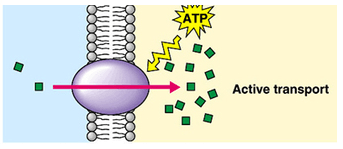
In her biology class, Aria learned that ATP is a form of (a) .
Passive Transport
Active Transport
If we need a protein and ATP to move molecules through ACTIVE TRANSPORT in this diagram which side are the molecules moving to?
Select the box that shows osmosis.

