Worksheets
Ionic Bonding Quiz
Total questions: 20
Worksheet time: 18mins
In ionic bonding, metals tend to:
A. Gain electrons and become anions
B. Lose electrons and become cations
C. Share electrons with nonmetals
D. Neither gain nor lose electrons
Which type of elements generally form ionic bonds?
A. Metals with nonmetals
B. Nonmetals with nonmetals
C. Metals with metals
D. All of the above
What is the charge on the magnesium ion in magnesium chloride (MgCl2)?
A. 1+
B. 2+
C. 1-
D. 2-
What is formed when an atom loses an electron?
A. A negative ion
B. A positive ion
C. A covalent bond
D. A molecule
What is the formula of the ionic compound formed between sodium (Na) and oxygen (O)?
A. NaO
B. Na2O
C. NaO2
D. Na2O2
What is the name given to the force that holds ions together in an ionic compound?
A. Covalent bond
B. Ionic bond
C. Metallic bond
D. Van der Waals force
Which of the following is a property of ionic compounds?
A. High melting and boiling points
B. Low melting and boiling points
C. Poor conductor of electricity in solid state
D. Both A and C
What is the electron configuration of a chloride ion (Cl-) if the atomic number of chlorine is 17?
A. 2, 8, 7
B. 2, 8, 8
C. 2, 8, 6
D. 2, 8, 1
What is the correct formula for the ionic compound formed between calcium (Ca) and sulfur (S)?
A. CaS
B. Ca2S
C. CaS2
D. Ca2S3
Ionic compounds are typically:
A. Gases at room temperature
B. Liquids at room temperature
C. Solids at room temperature
D. Plasma at room temperature
Which of the following is NOT a characteristic of ionic bonds?
A. They involve the transfer of electrons.
B. They form between atoms with low melting and boiling points
C. They produce a crystal lattice structure.
D. They result in the formation of ions.
Why do ionic compounds tend to dissolve in water?
A. Ions break apart forming an electrolyte.
B. Metals and non-metals are all soluble in water.
C. Molecules of water separate the molecules in crystalline lattices.
D. Water dissolves all substances.
A three-dimensional arrangement of ions in a crystal is...
A. A Macromolecule
B. Lattice structure
C. Giant Covalent Structure
D. An arrangement of molecules
Which of the following will most likely form an ionic bond?
A. Lithium and fluorine
B. Carbon and hydrogen
C. Sulfur and oxygen
D. Nitrogen and hydrogen
Which of the following statements about ionic compounds is true?
A. They have high volatility.
B. They are usually soluble in non-polar solvents.
C. They have high melting and boiling points.
D. They conduct electricity well in the gaseous state.
What is the electron configuration of a sodium ion (Na+) if the atomic number of sodium is 11?
A. 2, 8
B. 2, 8, 7
C. 2, 8, 1
D. 2, 8, 6
What is the charge on the oxygen ion in magnesium oxide (MgO)?
A. 1-
B. 2-
C. 1+
D. 2+
Draw the electron structure of a sodium atom

Complete the dot-and-cross diagram to show the electron arrangement in a molecule
of chlorine.
Show outer shell electrons only.

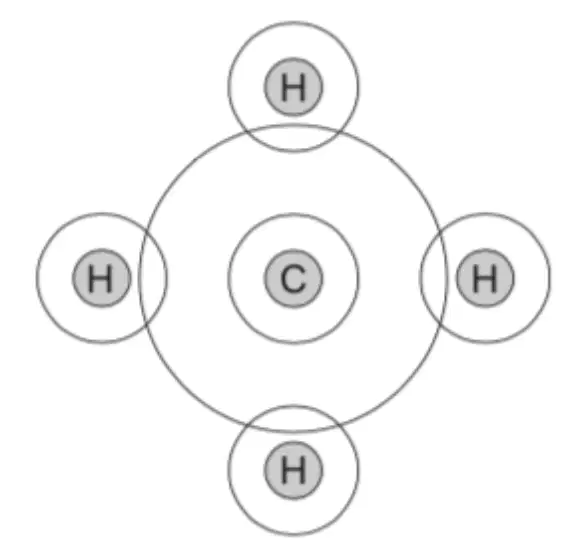
Complete the dot and cross diagram of methane to show all the electrons.