
Font size
 Worksheets
Unit 5 Review - Earth's History, Dating and Fossils
Total questions: 53
Worksheet time: 4hrs 25mins

Layer B on side #1 (left) is a match to which layer on side #2 (right)?
z
y
w
there is no match
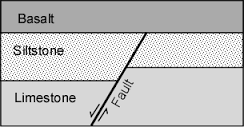

Which layer is OLDER? Fault E or Intrusion D?
Fault E
Intrusion D

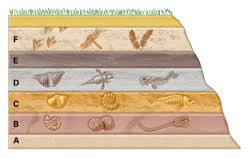
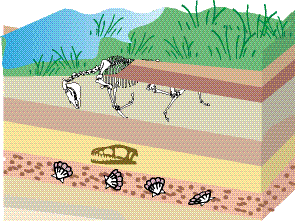


What is the best reason that fossil #4 is NOT a good index fossil?
It is not widespread
it is not short-lived (in numerous layers)
It is in half of the outcrops
Which of the follow is INCORRECT about an index fossil?
The fossil must have lived only during a short part of the Earth's history.
Many fossils of the organism must be found in the rock layers.
The fossil must be found over a wide area of the Earth and be unique.
The fossil must only be found in one area.


How old do Paleontologists believe the Earth is? Is this an example of absolute or relative dating?
Relative
Absolute

Which fossil makes the best index fossil?
ammonite
brachiopod
trilobite
shark
all four are good index fossils

What letter would be the best example of an index fossil?
X
Z
Y
W

What is the correct age order of the rocks from OLDEST to YOUNGEST
A,B,C,D,E
B,C,D,E,A
All are the same age
A,E,D,B,C

What fossil would make a good index fossil?


What are fossils that are abundant, easily recognizable, short lived, and widespread called?
Preserved fossils
Index fossils
Imprints
Radioactive dating

Use relative age dating to put the rock layers in correct order from oldest to youngest.
B, D, A, E, C
C, E, D, A, B
A, C, E, D, B
C, E, D, B, A


Scientists use radiometric dating (radioactive decay) to measure...
relative time (dating)
absolute time (dating)
half-lives
time of day
By saying "my dad is 48 and I am 13", it would be...
relative dating (time)
absolute dating (time)
law of superposition

living things die, their remains are quickly buried by sediments, the sediments compress and harden into sedimentary rock over time

Rock layers can often help scientists compare and date fossils across a geological timeline. These layers can be affected by different Earth processes. The diagram shows a section of rock layers affected by both erosion and tectonic plate movement. Which timeline of events best explains the formation of the rock layers in the diagram?
1) Layer T then R were deposited
2) Layer R was eroded at the surface
3) Fault Gf cross cut across Layers T and R
4) Layers M then J then V were deposited
1) Layer T then R were deposited
2) Fault Gf cross cut across Layers T and R
3) Layer R was eroded at the surface
4) Layers M then V then J were deposited
1) Layer R then T were deposited
2) Fault Gf cross cut across Layers T and R
3) Layer R was eroded at the surface
4) Layers J then M then V were deposited
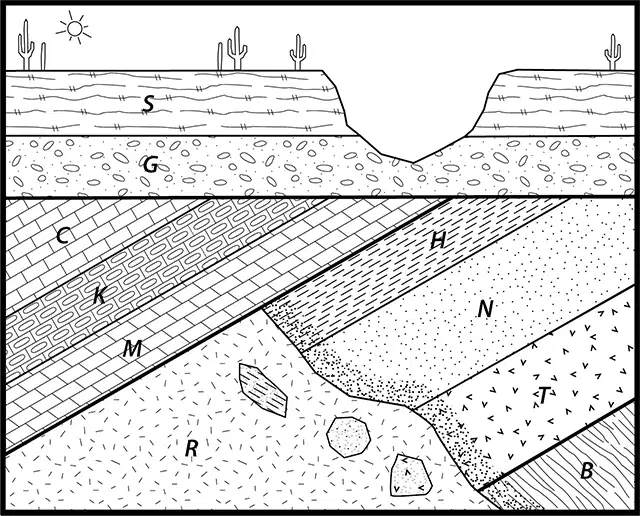
Rock layers can often help scientists compare and date fossils across a geological timeline. These layers can be affected by different Earth processes. The diagram shows a section of rock layers affected by both erosion and tectonic plate movement. Which timeline of events best explains the formation of the rock layers in the diagram?
1) Layers B,T,N,H,M,K,C were deposited at an angle
2) Igneous formation R intruded into layers B,T,N,H
3) Layers S and Then G were deposited
1) Layers B,T,N,H,M,K,C were deposited horizontally
2) Tectonic forces tilted layers B,T,N,H,M,K,C
3) Layers G then S formed
4) Igneous formation R intruded into layers B,T,N,H
1) Layers B,T,N,H,M,K,C were deposited horizontally
2) Tectonic forces tilted layers B,T,N,H,M,K,C
3) Igneous formation R intruded into layers B,T,N,H
4) Layers G then S formed
1) Layers B,T,N,H formed horizontally
2) Igneous formation R intruded into layers B,T,N,H
3) Layers C,K,M were deposited
4) Tectonic forces tilted layers B,T,N,H,R,M,K,C
5) Layers G then S were deposited

List from youngest to oldest
BAECD
DCEAB
CEABD
ACEDB
The principle that states that geologic processes that occurred in the past can be explained by current geologic processes.
The present is the key to the past.
Unconformity
Uniformitarianism
Superposition
Catastrophism

Place the layers in order from oldest to youngest.
1, 2, 3, 4, 5, 6, 7
7, 6, 5, 4, 3, 2, 1
1, 2, 3, 4, 7, 5, 6
1, 2, 4, 3, 7, 5, 6

Place the layers in order from oldest to youngest.
E, B, C, D, A
A, B, C, D, E
E, D, C, B, A
B, D, E, C, A

Which layer is an intrusion?
A
B
C
D

Which letter is a fault?
E
F
G
H

What is the oldest feature?
A
Fault
L
Q
D
Place the layers in order from oldest to youngest.
E, B, C, D, A
A, B, C, D, E
E, D, C, B, A
B, D, E, C, A
Place the layers in order from oldest to youngest.
1, 2, 3, 4, 5, 6, 7
7, 6, 5, 4, 3, 2, 1
1, 2, 3, 4, 7, 5, 6
1, 2, 4, 3, 7, 5, 6

a model scientists use to describe the timing of events and the relationships between those events in earth’s history.
geologic time scale
era
period
epoch

What is the correct order of the rock layers from oldest to youngest?
F, E, C, B, A, D
F, E, D, C, B, A
A, B, C, D, E, F
D, F, E, C, B, A
Absolute age is defined as:
The age of rock determined by radiometric dating.
The age of rock based on living animals.
The age of rock based on its location.
The age of rock determined by relative dating.
What is the best reason that fossil #4 is NOT a good index fossil?
It is not widespread
it is not short-lived (in numerous layers)
It is in half of the outcrops
What letter would be the best example of an index fossil?
X
Z
Y
W

