
Font size
 Worksheets
Overview Fed/Fast (slides provided only) - Corso - GI Exam 2
Total questions: 30
Worksheet time: 21mins
Catabolism is
The breakdown of molecules to release energy, usually in the form of ATP
The synthesis of molecules, usually costing energy, usually in the form of ATP
Anabolism is
The breakdown of molecules to release energy, usually in the form of ATP
The synthesis of molecules, usually costing energy, usually in the form of ATP
Which catabolic processes result in 4 Kcal/g after metabolism (SATA)
Proteins to amino acids
Complex carbs to simple sugars
DNA/RNA to nucleotide bases
Triglycerides to FA and glycerol
Ethanol breakdown
Which catabolic processes result in 9 Kcal/g after metabolism
Proteins to amino acids
Complex carbs to simple sugars
DNA/RNA to nucleotide bases
Triglycerides to FA and glycerol
Ethanol breakdown
Which catabolic processes result in 7 Kcal/g after metabolism
Proteins to amino acids
Complex carbs to simple sugars
DNA/RNA to nucleotide bases
Triglycerides to FA and glycerol
Ethanol breakdown
Sucrose is a essential sugar in our diet
True
False
Select all of the following essential amino acids
α-linoleic acid (C18:2Δ9,12)
α-linoleic acid (C18:3Δ9,12,15)
Eicosapentaenoic acid (EPA) (C20:5Δ5,8,11,14,17)
Docosahexenoic acid (DHA) (C22:6Δ7,1,13,16,19)
Oleic acid (C18:1Δ9)
All of the following are essential amino acids we need in our diet EXCEPT
Phenylalanine
Valine
Methionine
Isoleucine
Cystine
Match the following different parts of digestion in the mouth with their descriptions
Tears apart fibrous molecules such as cellulose and fibrous protein
Chewing
Breakdown of glucose alpha 1-4 bonds found in amylose, amylopectin, and glycogen
Salivary amylase
Breaks ester bonds of FA from TGs -> DGs. This is an acidic enzyme that works in stomach and duodenum
Salivary lipase
Select all of the following fragments that are made from digestion in mouth during starch breakdown
Maltose
Isomaltose
Glucose
Limit dextrins
Maltotriose
Digestion of triglycerides in the mouth by lingual lipase leads to formation of monoglycerides and free fatty acids
True
False
Which of the following is NOT true about digestion in the stomach
Pepsin fragments proteins on nitrogen side of aromatic amino acids
Carbohydrate digestion occurs due to activation of amylase
Salivary lipase is still active in acid
Gastric lipase is active in stomach
Hydrogen/Potassium ATPase pumps make stomach acidic.
Protein digestion begins in which of the following
Mouth
Stomach
Intestine
pancreas
(a) is released from cheif cells and interacts with (b) secreted from parietal cells to form the active enzyme (c) which cuts proteins on the nitrogen side of amino acids
The final digestion of carbohydrates occurs in which of the following
Mouth
Stomach
Small intestine
Gall bladder
Pancreas
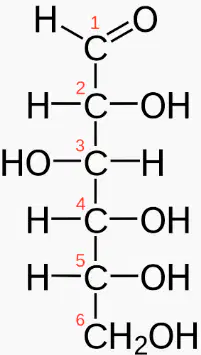
D-glucose is shown in the image attached which of the following would be different for galactose
Flipped carbon #4
Flipped carbon 2 and 4
Aldose sugar vs a keytose sugar
Flip at carbon one
D-glucose is shown in the image attached which of the following would best describe fructose compared to glucose
Flipped carbon #4
Flipped carbon 2 and 4
Aldose sugar vs a keytose sugar
Flip at carbon one
Bile is made in which of the following
Gall bladder
Stomach
Liver
pancreas
Bile is stored in which of the following
Gall bladder
Stomach
Liver
pancreas
Bile is derived from which of the followin
Chlosterol
DNA
Carbohydrates
Amino acids
Pepsinogen is activated by (a) to form pepsin
Trypsinogen is activated by (b) (initial activation needed) to Trypsin
Chymotrypsinogen is activated by (c) to chymotrypsin
Proelastase is activated by (d) to elastase
Procarboxypeptidase is activated by (e) to carboxypeptidase
Bile helps in the digestion of which of the following
Carbohydrates
Nucleic acids
Proteins
Fats
Triglycerides and cholesterol are found on the outside of the chylomicrons
True
False
Glucose and galactose is absorbed by which of the following
GLUT 5 via passive transport
Glucose/sodium symporter
Glucose ATPase
Glucose/Calcium symporter
Fructose is absorbed by which of the following
GLUT 5 via passive transport
Glucose ATPase
Glucose/Calcium symporter
Glucose/Sodium symporter
Which of the following enzymes are absorbed by one the 6 types of amino acid symporters with which of the following
K+
Na+
Cl-
Ca2+
Match the following descriptions during the fed state to the proper part of the body
Takes in and uses glucose almost exclusively and burns it all the way down to water and CO2
Brain
Uses glucose but doesn't have mitocondria and burns it to pyruvate before converting it to lactate
Red blood cells
Uses glucose only after insulin stimulation and GLUT 4 activation. Burns all the way down to CO2 aerobically or lactate anerobically
Muscles
Uses glucose only after insulin stimulation and GLUT 4 activation. Glucose is turned into glycerol and then TGs
Adipose
Glucose can an enter and leave freely and only used when insulin is high. Stores excess glucose as glycogen
Liver
Which of the following store glycogen (SATA)
Muscles
Liver
Red blood cells
brain
Adipose
Match the following descriptions during the fasting state to the proper part of the body
Release glycerol and FA
Adipose
Use glucose making lactate which is sent to liver
Red blood cells
Primary consumer of glucose and breaks it down to CO2 and ATP
Brain
Uses keytone bodies from the liver and releases proteins via amino acids back to the liver
Muscle
Provides glucose to the brain and turns FAs into keytone bodies
Liver
During the starvation state keytone bodies can be taken up by the brain; however, it is not preferred due to being highly basic
True
False

