
 Worksheets
Movement Neuroscience 1
Total questions: 29
Worksheet time: 15mins
What is the basic structural and contractile unit of a muscle fiber?
Myofibril
sarcomere
myoglobin
endomysium
According to the sliding filament theory, which proteins slide past each other during muscle contraction?
Actin and Myosin
Troponin and Tropomyosin
Myoglobin and Myosin
Sarcomere and Sarcoplasm
What is the term for the force generated by a contracting muscle?
Elasticity
Tension
Isometric
Relaxation
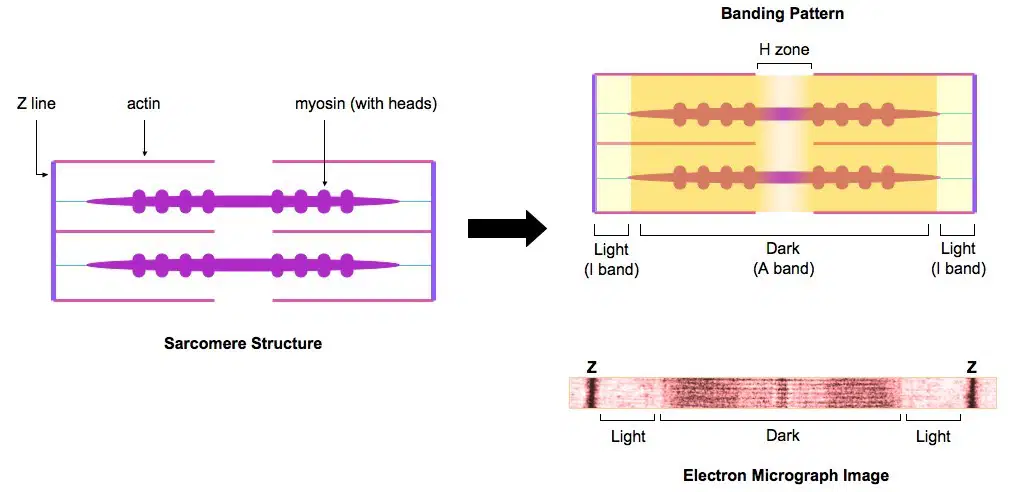
In a sarcomere, what happens to the length of the H-zone during muscle contraction?
It shortens
It disappears
It lengthens
It remains constant
During muscle contraction, what is the role of myosin heads?
Anchor the sarcomere
Bind to actin and form cross-bridges
Inhibit tropomyosin movement
Store calcium ions
What structure anchors the thin filaments in a sarcomere?
H-zone
Z-disk
M-line
A-band
What triggers the movement of tropomyosin, exposing the binding sites on actin?
Calcium ions
ATP
Myoglobin
Creatine phosphate
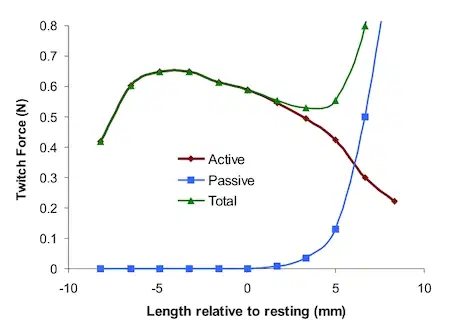
What happens to tension development when a muscle fiber is stretched beyond its optimal length?
Tension increases
Tension decreases
Tension remains constant
Tension becomes isometric
What is the primary energy source for muscle contraction at the molecular level?
Glucose
ATP
Oxygen
Lactic acid
What is responsible for the force generated during active muscle contraction?
Passive tension
Myosin cross-bridges
Elastic recoil
Sarcomere length
What contributes to the force in a muscle during passive stretching, mainly due to the elastic elements?
Active tension
Myosin heads
Passive tension
Z-disk contraction
According to the force-length relationship, what happens to active force as sarcomere length deviates from the optimal length?
Active force always increases
Active force remains constant
Active force varies, reaching a maximum at optimal length
Active force decreases linearly
What component of the muscle is primarily responsible for passive force during sarcomere lengthening?
Myosin filaments
Z-disk proteins
Elastic elements (titin)
Troponin and tropomyosin
In a muscle at rest, what contributes to passive force even when there is no active contraction?
Calcium ions
Myosin cross-bridges
Elastic recoil
ATP hydrolysis
Which of the following factors influence the force generated by muscle fibers?
Blood circulation
Sarcomere length
Glycogen content
Number of fibers recruited
Fiber length
What is a motor unit composed of?
Muscle fibers and tendons
Motor neurons and sensory neurons
Motor neurons and the muscle fibers they innervate
Myosin and actin filaments
What is the role of a motor nucleus in the spinal cord?
Processing sensory information
Controlling voluntary muscle movements
Regulating heart rate
Maintaining balance and coordination
What happens when a motor unit is activated?
Muscle contraction occurs in a single muscle fiber
Contraction occurs in all muscle fibers of the muscle
Contraction occurs in the muscle fibers innervated by the motorneuron in that motor unit
Only the motor neuron is activated
Muscle relaxation occurs
What does the recruitment threshold represent in the context of motor units?
The maximum force a motor unit can generate
The minimum stimulation required to activate a motor unit
The speed of muscle contraction
The endurance of a muscle during prolonged contraction
When are low-threshold motor units typically recruited?
A)
During high-intensity contractions
During low-intensity contractions
When the recruitment threshold is reached
When the demand for force or power increases
What does the Henneman size principle state?
Larger motor units are recruited first during low-intensity contractions.
Smaller motor units are recruited first during low-intensity contractions.
Motor unit recruitment is random and not governed by any principle.
The size of motor units has no impact on force production.
What is rate coding in the context of motor units?
The modulation of force through the recruitment of motor units.
The process of adjusting the firing rate of action potentials within motor neurons.
The random firing pattern of motor neurons.
The coordination of motor units in a synchronized manner.
What does recruitment refer to in the context of motor units?
The process of adjusting the firing rate of action potentials within motor neurons.
Coordinating the firing pattern of motor units.
The process of activating additional motor units to generate more force.
The size of muscle fibers within a motor unit.
How does innervation number vary within a population of motor units?
Innervation number is consistent across all motor units.
Innervation number increases linearly within the population.
Innervation number increases exponentially within the population.
Innervation number decreases as motor unit size increases.
What characterizes the innervation pattern of most fibers within a population of motor units?
Most fibers have high innervation numbers.
Most fibers have medium innervation numbers.
Most 50% of the fibers have relatively low innervation numbers.
All fibers within the population have the same innervation number.
Which of the following characteristics is associated with action potentials in fast-twitch motor units?
Slow propagation speed
Gradual and sustained contraction
Short contraction time
Well-suited for endurance activities
What distinguishes action potentials in slow-twitch motor units from fast-twitch motor units?
Slow-twitch fibers have a longer contraction time.
Fast-twitch fibers propagate action potentials more slowly.
Fast-twitch fibers are well-suited for endurance activities.
Slow-twitch fibers have a shorter contraction time.
How is the absolute force of fast-twitch and slow-twitch motor units at all frequencies of stimulation?
Absolute force is greater for slow-twitch motor units.
Absolute force is greater for fast-twitch motor units.
Absolute force is equal for both fast- and slow-twitch motor units.
Absolute force is unrelated to motor unit type.
How does the contraction time differ between fast-twitch and slow-twitch motor units at lower stimulus rates?
Slow-twitch motor units have a briefer contraction time.
Fast-twitch motor units have a longer contraction time.
Slow-twitch motor units have a longer contraction time.
Contraction time is unrelated to motor unit type.

