
 Worksheets
Ch 8: Protists + Fungi - Ch 10 CR + PS
Total questions: 19
Worksheet time: 10mins
Name
Class
Date
1.
What part of the visible light spectrum creates the color for the chlorophyll pigmented plant in photosynthesis?
a)
green light reflected
b)
all light other than green light that is reflected
c)
green light absorbed
2.
What of the visible light spectrum is used as light energy during photosynthesis?
a)
green light only
b)
all light other than green light
c)
green and red lights
d)
the entire spectrum of light
3.
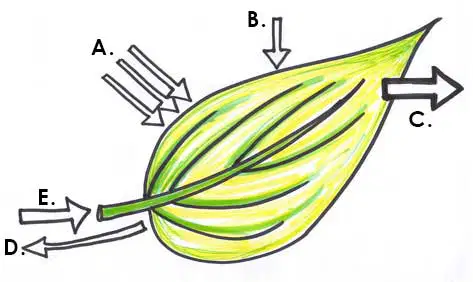
What of the following items listed is produced by photosynthesis?
a)
glucose
b)
fructose
c)
sucrose
d)
a mix of sugars
4.
How are the reactions in cellular respiration and photosynthesis related?
a)
Photosynthesis produces water and carbon dioxide, which are needed for cellular respiration.
b)
Cellular respiration produces glucose, which is used for fuel in photosynthesis.
c)
Photosynthesis produces glucose, which is used for fuel in cellular respiration.
d)
Cellular respiration produces energy in the form of ATP, which is used for fuel in photosynthesis.
5.
Cellular respiration takes place in what 2 areas of a cell (Select 2)
a)
cytoplasm
b)
mitochondria
c)
nucleus
d)
chloroplast
6.
What does Cellular Respiration produce/release into the upon completion? (Select all that apply)
a)
water
b)
carbon dioxide
c)
ATP
d)
glucose
e)
oxygen
7.
What is required to start the Photosynthesis cycle? (Select all that apply)
a)
water
b)
carbon dioxide
c)
light energy
d)
glucose
e)
oxygen
8.
T/F: Protists and Fungi are prokaryotic cells.
a)
True
b)
False
9.
T/F: Protozoans are a type of protist that looks like tiny animals.
a)
True
b)
False
10.
T/F: The world of protists is very unique and diverse, making them hard to classify.
a)
True
b)
False
11.
The main trait that makes plant-like protists "plant-like" is their _______________________________.
a)
number of cells in their organisms.
b)
how they rerpoduce.
c)
ability to make their own food.
12.
The network of threadlike structures underground of fungi that absorbs mineral, nutrients and water is called the ________.
a)
heterotroph
b)
hypae
c)
mycellium
d)
mycorrhiza
13.
The structure formed of roots of plants and hyphae that weave together and create a partnership of exchanging molecules is called ________.
a)
lichen
b)
hypae
c)
mycellium
d)
mycorrhiza
14.
The structure formed when fungi and other photosynthetic organisms that grow together and create a mutualistic relationship in exchange of water, minerals, sugar and oxygen is called ________.
a)
lichen
b)
hypae
c)
mycellium
d)
mycorrhiza
15.
T/F: The types of fungi are named based on how they look and reproduce.
a)
True
b)
False
16.
Fungi create partnerships by providing nutrients and water to plants. In payment, plants provide ________.
a)
carbon dioxide
b)
organic matter
c)
minerals
d)
sugar
17.
An amoeba (animal-like protist) has a unique adaption for movement. It is called a(n) ______________.
a)
flagella
b)
paramecium
c)
volvox
d)
pseudopod
18.
Based on the video we watched in class, this particular fungus-like protist is intelligent enough to solve mazes and has been used in real-life planning for a Japanese train rail system.
a)
algae
b)
slime mold
c)
water mold
d)
sarcodines
19.
What organelle is to Cellular Respiration, as the chloroplast is to Photosynthesis?
a)
Nucleus
b)
Cell Membrane
c)
Mitochondria
d)
Vacuole
100 %

