
 Worksheets
3rd Unit 3 - Ch.1&2
Total questions: 13
Worksheet time: 14mins
Which statement describes a trait that earthworms have that help them to survive in their environment.
Living above ground protects earthworms from predators that might eat them.
An earthworm can't grow back its tail if it is eaten by a bird.
Living underground allows an earthworm to feel the soil shaking when a predator is near.
An earthworm uses its eyesight to find a mate to reproduce.

What comparison does the graph represent? What inference can we make? Select TWO responses
The graph shows an increase in yellow shell snail population and a decrease in striped snail population.
The graph shows a decrease in yellow shell snail population and an increase in striped snail population.
Scientists can count less striped snails now probably due to a change in the environment that is forcing the number of the striped snails to get smaller.
Scientists can count more striped snails now likely due to a change in the environment that is allowing the striped snail to flourish.
How do most adaptations happen?
Plants and animals carefully plan their adaptations.
Plants and animals are forced to adapt by other organisms.
Competition for limited resources eventually lead to adaptations.
Organisms do not develop adaptations because they are created perfect.
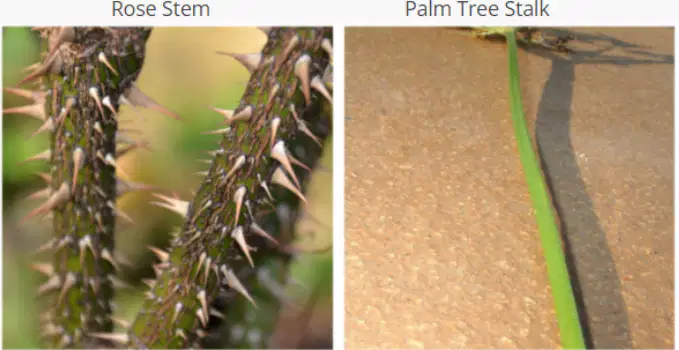
Look carefully at the rose stem and the palm tree stalk below. Both of these plants are in an area that animals eat the trunks of small trees and bushes.
Select two adaptations that make the rose stem more likely to survive in its environment that the palm tree stalk.
It has a narrower trunk.
It has a wider trunk.
It has thorns.
It is slick.
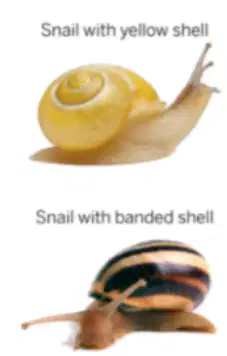
Which of the following is an adaptive trait for snails? Select the two that apply.
Banded shell color
Antenna Length
Sleeping during the day
High shell strength
Larger shells
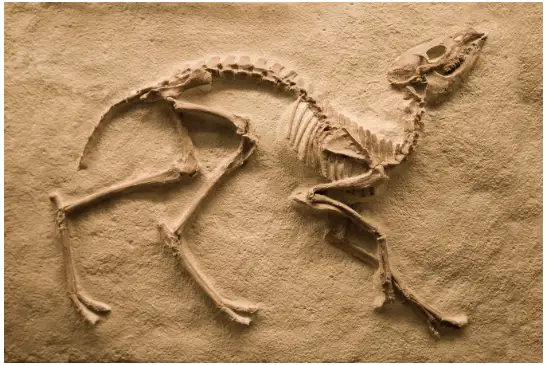
Below is an image of a fossil. What inference can be made about the organism found in this fossil?
The organism most likely swam in water.
The organism most likely walked on land.
The organism most likely ate plants.
The organism most likely ate meat.

Using the chart, Which plant will most likely survive if there is no rain fall for a month?
Plant A
Plant B
Plant C
Plant D
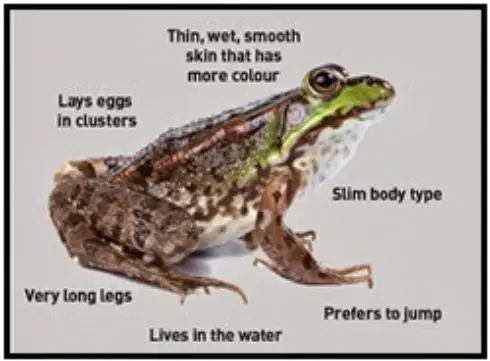
Tommy is playing in the yard and sees a frog. He runs up to catch it, but it jump, jumps, jumps away from him. Tommy tries again to catch the frog and almost catches it but he couldn't hold on to it. Which two statements are true about why the frog was able to get away from Tommy?
The frog jumped quickly and far with its long legs each time it jumped. Tommy was not fast enough to catch up with the jumping frog.
The frog hid in the water so Tommy couldn't see him.
The frog was the color of the grass and dirt so Tommy couldn't find it.
The frog has a slick body that Tommy couldn't hold on to.
A mother Louisiana black bear who can find more food will likely _______________ than a mother Louisiana black bear that cannot find enough food.
eat people food
have cubs with stunted growth
have more healthy cubs
move away from where she lives
An alligator that can stay still longer to catch food will likely have __________________.
more problems with people
more offspring who survive
a northern habitat
time to hibernate
What can scientists learn about long ago by study fossils?
Select the two correct answers.
behaviors of organisms
colors of organisms
how organisms sound
past environments
traits of organisms
Trey is doing a science experiment and records the amount of times that it rains at his house over 3 months. In April, it rained 10 days. In May, it rained 8 days. In June, it rained 4 days. Which of these bar graphs correctly shows the data?


Read the list below and answer the question. The prehistoric, extinct Megalodon and the Great White Shark share the traits listed in the image.
These traits show that the Megalodon and the Great White Shark at some point shared _______________________.
a past family ancestor
a meal
the same ocean
species

