
 Worksheets
SLO # 13.5.1, 13.5.2, 13.5.4
Total questions: 10
Worksheet time: 3hrs 30mins
Which one of the following type galvanometers is a moving magnet and fixed coil type?
Moving Coil Galvanometer
Moving Magnet Galvanometer
Ballistic Galvanometer
Tangent Galvanometer
The galvanometer used for estimating the quantity of charge flow through it is called
Mirror Galvanometer
Moving Coil Galvanometer
Ballistic Galvanometer
Astactic Galvanometer
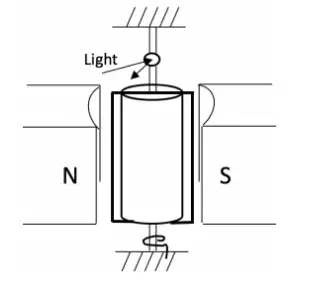
The figure shown below is a block diagram of ___________ galvanometer?
Mirror Galvanometer
Ballistic Galvanometer
Moving Coil Galvanometer
All of these
What is the key difference between an analog multimeter and a digital multimeter?
Analog multimeters use complex components, while digital multimeters use a moving pointer.
Analog multimeters display numerical values, while digital multimeters use a printed scale.
Analog multimeters use a moving pointer and magnetic field, while digital multimeters use complex components and display numerical values
In case of reverse polarity, how does an analog multimeter respond?
Displays negative values.
Moves the pointer to the right.
May suffer damage.
Requires automatic calibration.
Q: What is a key advantage of digital multimeters over analog multimeters in terms of accuracy?
Digital multimeters are less reliable.
Analog multimeters use complex components
Digital multimeters use a magnetic field for measurements.
Digital multimeters can achieve ±0.5% accuracy, providing higher precision than analog multimeters.
Which of the following statements best describes the working of a digital multimeter (DMM)?
A DMM measures electrical current by converting it into digital signals for display.
A DMM measures electrical current by converting it into digital signals for display.
A DMM measures resistance by applying a known voltage and measuring the resulting current.
A DMM combines analog-to-digital conversion to measure voltage, current, and resistance accurately.
Which of the following statements best describes the working principle of a digital multimeter (DMM)?
A) Digital multimeters measure voltage, current, and resistance by converting analog signals into digital data.
B) Digital multimeters use mechanical components to measure electrical quantities accurately.
C) Digital multimeters employ electronic circuits to sample and convert electrical signals into numerical values.
D) Digital multimeters rely solely on visual inspections to determine electrical parameters.
What principle does an analog multimeter operate on?
Piezoelectric effect
d'Arsonval galvanometer
Hall effect
Photoelectric effect
What moves in a magnetic field when current passes through it in an analog multimeter?
Resistor
Scale
Coil
Diode

