
 Worksheets
Mitosis - Meiosis Review Honors Biology 2024
Total questions: 23
Worksheet time: 31mins

What phase of Meiosis is in this picture?
Prophase I
Metaphase I
Anaphase I
Telophase I
In which phase of Meiosis does crossing-over happen?
Prophase I
Metaphase I
Anaphase I
Telophase I

Which phase of meiosis is shown in the picture?
Prophase I
Metaphase I
Anaphase I
Telophase I

Which phase of meiosis is shown in the picture?
Prophase II
Metaphase II
Telophase I
Telophase II

Which phase of meiosis does the picture on the left happen?
prophase I
prophase II
metaphase I
telophase II

Which phase of meiosis is shown in the picture?
prophase I
metaphase I
anaphase I
telophase I
After meiosis II, which of the following is true about the cells that are produced?
Four cells are produced. They are identical to each other and each contains half the number of chromosomes that the parent cell has.
Four cells are produced. Each is unique and contains half the number of chromosomes that the parent cell has.
Four cells are produced. Each is unique and contains the same number of chromosomes that the parent cell has.
Two cells are produced. Each is unique and contains the same number of chromosomes that the parent cell has.
True or False: Crossing-over also happens in Meiosis II.
True
False
What effect does crossing over has in terms of traits of offspring?
Results in identical traits of offsprings.
Causes variation in the traits of offsprings.
It really does nothing to the traits of offspring.
After meiosis I, which of the following is true about the cells that are produced?
Two cells are produced. They are identical to each other and each contains half the number of chromosomes that the parent cell has.
Two cells are produced. They are unique to each other and each contains half the number of chromosomes that the parent cell has.
Four cells are produced. They are unique to each other and contain the same number of chromosomes that the parent cell has.
Only one cell is produced. It is identical to the parent cell and contains the same number of chromosomes.
The four cells that are produced after Meiosis are _______.
haploid because they contain just half the number of chromosomes as the parent cell.
diploid because they contain as many chromosomes as the parent cell.
diploid because they contain twice as many chromosomes as the parent cell.
The end of mitosis results in ____ to each other.
2 cells that are identical
4 cells that are identical
2 cells that are not identical
4 cells that are not identical

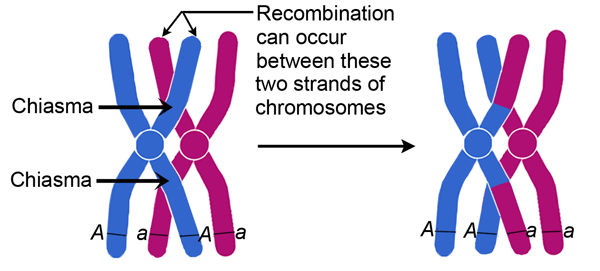
segregation of sister chromatids
condensation and segregation of alleles
mutationin which the DNA content of the gene is altered
crossing - over in which genes are exchanged
A chromosome is composed of two identical sister
centromeres
chromatids
autosomes
somatic cells
During meiosis, if an organism has 10 chromosomes, how many will the new daughter cells have?
10
8
5
2
During mitosis, if an organism has 10 chromosomes, how many will the new daughter cells have?
10
8
5
2
Which of the following does NOT happen during Telophase II?
the nuclei reform
each cell begins to split evenly in two
the chromosomes duplicate
the nuclei contain a haploid number of chromosomes
Which of the following are CORRECT observations about the differences between MITOSIS and MEIOSIS? (Check all that apply.)
Mitosis produces cells that identical to the parent cell.
Meiosis produces cells that have half the number of chromosomes as the parent cell.
All cells go through INTERPHASE as part of the cell cycle, whether it goes to mitosis or meiosis next.
In both types of cell division, the chromosomes are only duplicated once.
Only in Mitosis, do you see chromosomes pair up to form a tetrad.
These cells are sex cells like sperm and egg
Somatic Cells
Germ Cells
Intestinal Cells
Stomach Cells
The end result of mitosis is _______________
2 identical diploid cells
2 genetically unique diploid cells
4 identical haploid cells
4 different haploid cells
The end result of meiosis is ______________
2 identical diploid cells
2 unique diploid cells
4 identical haploid cells
4 unique haploid cells

A
B
C
D

