
 Worksheets
Waves in Action Test Review
Total questions: 30
Worksheet time: 16mins
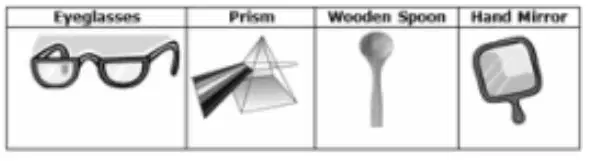
Which object in the chart would Mariah use to help her as she put on her lipstick?
insulator (wooden spoon)
prism
mirror
lens (eyeglasses)
What occurs when sunlight hits metal and blinds the driver of a car?
absorption
reflection
conduction
refraction
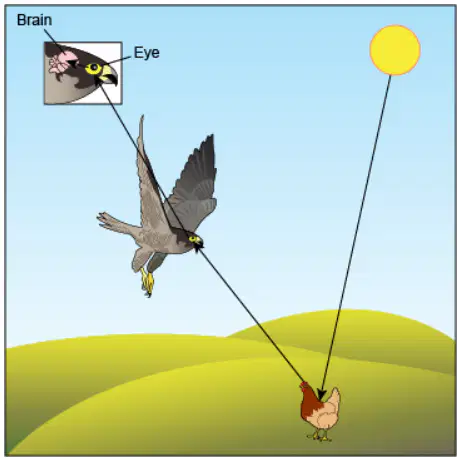
Falcons hunt during the day. They search for food from high in the sky. When they spot food, they swoop down at up to 180 kilometers per hour to capture it. Owls are different from falcons because they hunt at night. Even though they hunt at different times of the day, owls and falcons both use their eyes to find food. Falcons and owls take in and process visual images the same way. The picture shows how a falcon sees a chicken that it is trying to capture. Miguel recently bought some chickens that lay eggs. He keeps the chickens in his backyard. Miguel noticed a falcon circling over his yard during the day. When it got dark, Miguel noticed the falcon left. Instead, he saw an owl flying over the yard at night. Miguel is afraid the falcon or the owl will see his chickens and take them. Miguel begins brainstorming ideas to keep the larger birds from seeing the chickens in the backyard. If the hunting birds cannot see the chickens, they will not take them. Why does the falcon hunt during the day?
It is easier for the falcon to see.
It is easier for the falcon to hide from prey.
The falcon relies on its sense of hearing to hunt.
The falcon prefers to hunt when it is warm outside.
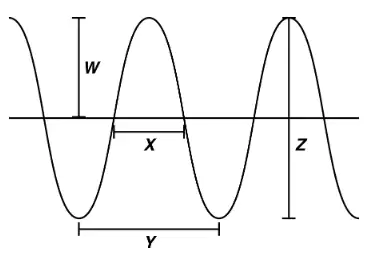
This illustration shows a transverse wave. Which bar measures the wavelength of the wave?
bar W
bar X
bar Y
bar Z
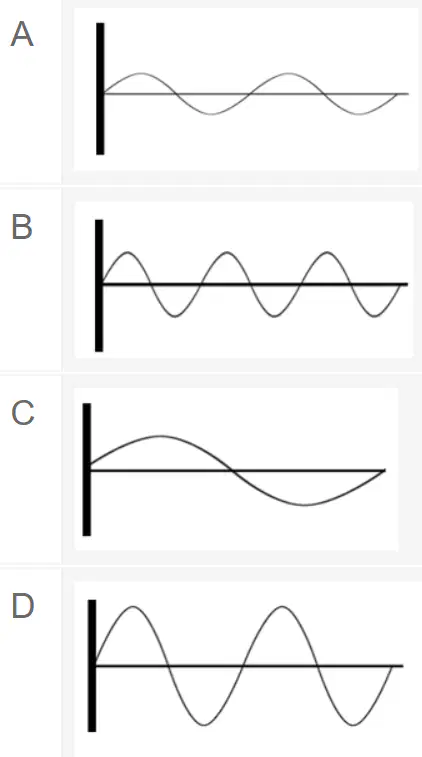
Light travels in waves. As the amplitude of a wave increases, light gets brighter. Which image shows the brightest light wave?
A
B
C
D
Falcons hunt during the day. They search for food from high in the sky. When they spot food, they swoop down at up to 180 kilometers per hour to capture it. Owls are different from falcons because they hunt at night. Even though they hunt at different times of the day, owls and falcons both use their eyes to find food. Falcons and owls take in and process visual images the same way. The picture shows how a falcon sees a chicken that it is trying to capture. Miguel recently bought some chickens that lay eggs. He keeps the chickens in his backyard. Miguel noticed a falcon circling over his yard during the day. When it got dark, Miguel noticed the falcon left. Instead, he saw an owl flying over the yard at night. Miguel is afraid the falcon or the owl will see his chickens and take them. Miguel begins brainstorming ideas to keep the larger birds from seeing the chickens in the backyard. If the hunting birds cannot see the chickens, they will not take them. The falcon is able to see and respond to the chickens from high in the sky. Place the phrases in the correct order to show how this happens.
Light reflects off the chickens; The falcon swoops down to try to capture the chicken; Information is sent to the falcon's brain; Light enters the falcon's eyes.
Information is sent to the falcon's brain; Light enters the falcon's eyes; Light reflects off of the chicken; The falcon swoops down to try to capture the chicken.
Light reflects off of the chickens; Light enters the falcon's eyes; Information is sent to the falcon's brain; The falcon swoops down to try to capture the chicken
The falcon swoops down to try to capture the chicken; Light enters the falcon's eyes; Light reflects off of the chickens; Information is sent to the falcon's brain
When a mirror is placed by a fish bowl with a beta fish swimming inside, the beta fish sees what appears to be another fish. This occurs because of
absorption
refraction
reflection
diffraction
How is a telephone able to transmit sound?
It conducts vibrations from speaker to receiver.
It magnifies a person’s voice.
It carries the sounds through wires.
It converts vibrations to electrical signals.

What number is represented by the sequence? 0111 0011 0010 0110
1123
2917
7326
4309
Which of these objects is visible because it reflects light toward the eye?
burning candle
flashlight bulb
glowing campfire log
shiny metallic balloon
Which of the following best describes what happens when a student looks in a mirror?
The mirror acts as a light source that lights the student’s face.
Light waves bouncing off the student’s face reflect off the mirror.
Matter from the student’s face is transformed into light waves in the mirror.
The student’s eyes see light waves reflecting off the mirror as solid matter.
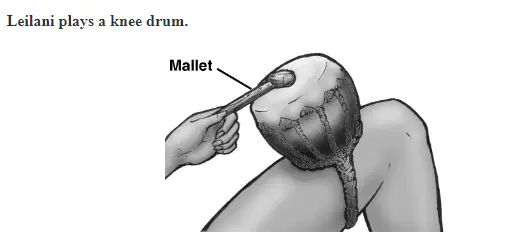
When she strikes the drum with the mallet, it makes a sound. Why does the drum make a sound?
because her knee moves
because the drum head is round
because the top of the drum vibrates
because the mallet is made of wood
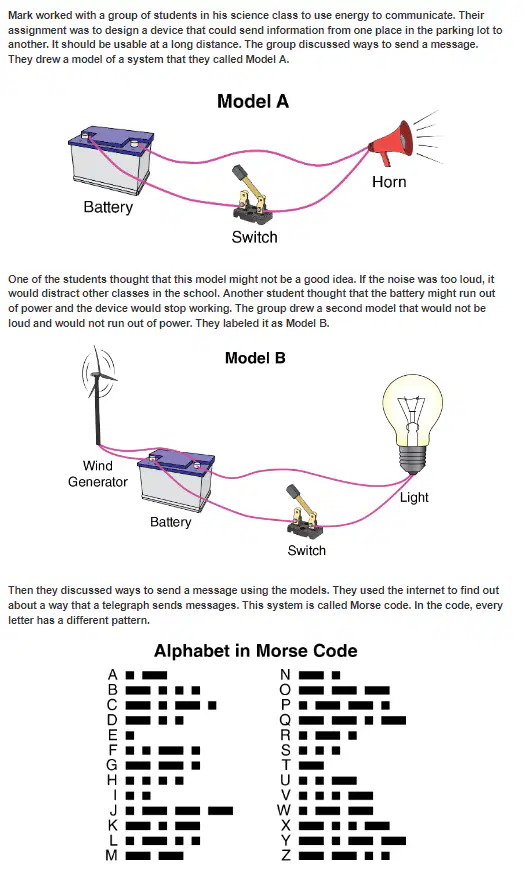
Mark decided to send the letter "X" as a message using one of the model devices. Which combination of model and set of signals could he use so that a person on the other side of the parking lot could understand his message?
Model A: one long sound and three short sounds
Model A: one loud sound, two soft sounds, then one loud sound
Model B: one long flash of light, two short flashes, then another long flash
Model B: one bright flash of light, two dim flashes, then another bright flash
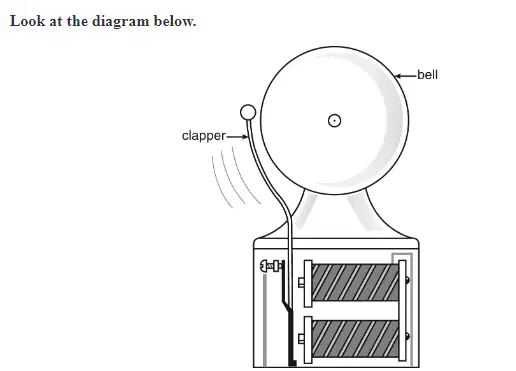
The bell makes a sound when it is hit by the clapper because the bell
rotates
vibrates
releases heat
produces electricity

Which statement most accurately compares wave 1 to wave 4?
Wave 1 has a taller amplitude than wave 4.
Wave 4 has a shorter wavelength than wave 1.
Wave 4 has a higher frequency and amplitude than wave 1.
Wave 1 has more energy than wave 4.

What is true about these waves?
The red wave has the longest wavelength , and lowest frequency. Therefore it has the lowest energy.
The purple wave has the highest frequency, therefore it has the lowest energy.
The green wave has the lowest amplitude and the highest energy.
The orange wave has the shortest wavelength and highest energy.
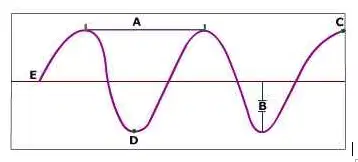
The wave crest is represented by which letter?
A
B
C
E

Which wave has the highest frequency?
1
2
3
4

These waves have the same _____.
amplitude
frequency
period
wavelength
The highest point on a wave is:
the crest
the trough
the top
the coast
The lowest point on a wave is the:
Amplitude
Crest
Trough
Wavelength

The crest of a wave is...
the distance between 2 crests
the highest point of the wave
the number of repetitions in a wave
the lowest point of a wave
A(n) __________ material allows some light to pass through it.
transparent
translucent
opaque
A(n) ______ material allows no light to pass through it.
transparent
translucent
opaque
________ is to bounce off a surface.
refract
reflect
transparent
translucent
We see objects when light waves reflect off an object and enters our __________.
ears
eyes
nose
mouth
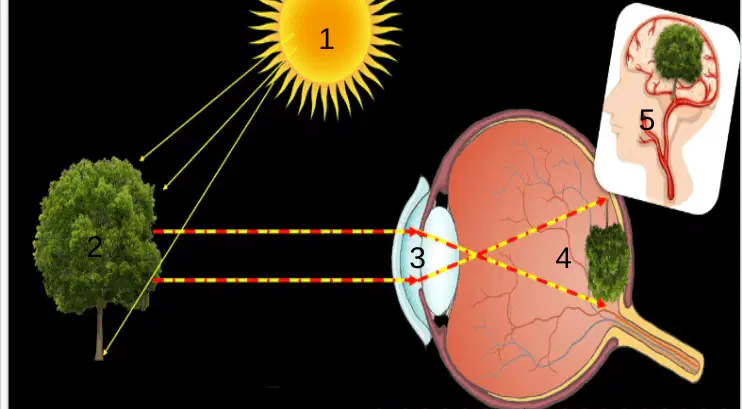
Which description below describes what is happening in box 2?
The light waves hit the object and reflect off.
The light waves enter our eyes through the pupil.
Light waves travel in straight lines from the light source to an object.
After the light waves enter the eye the light is refracted and the image is now upside down on the back of our eye (retina).
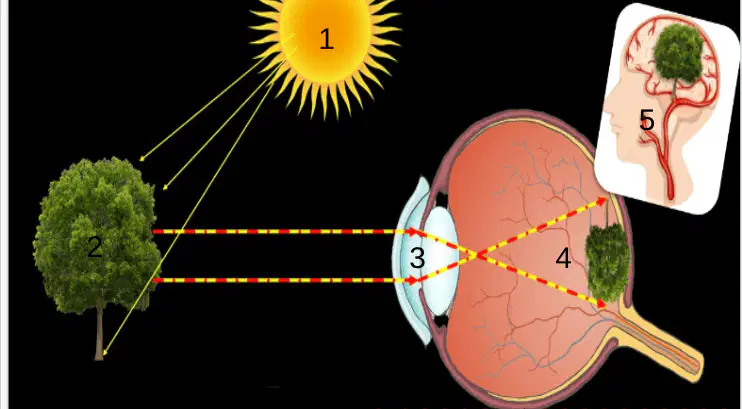
Which description below describes what is happening in box 5?
The light waves hit the object and reflect off.
The brain makes sense of the image and tells us the object we are seeing.
Light waves travel in straight lines from the light source to an object.
After the light waves enter the eye the light is refracted and the image is now upside down on the back of our eye (retina).
Which of the following is an example of using patterns to transfer information?
Writing a letter with a pen
Using Morse code to send a message
Painting a picture
Speaking in a foreign language
A student wants to send the word “YES” using a pattern so the message can be understood from far away.<br>Which option shows a pattern that could correctly transfer information?
Morse Code
Y E S
– · – – · · · ·
Random shapes with no pattern
One symbol repeated with no meaning
XXXX XXXX XXXX
Different colors with no repeating rule

