
NEW
Font size
 Worksheets
Air Masses & Fronts Quick Check Review
Total questions: 36
Worksheet time: 36mins
An air mass classified as mT usually forms over what type of Earth surface?
Warm water
Warm land
Cool land
Cool water
Which type of weather is usually associated with a cP air mass?
moist and cool
dry and warm
moist and warm
dry and cool
Compared to a maritime tropical air mass, a maritime polar air mass has a
higher temperature and less water vapor
lower temperature and more water vapor
higher temperature and more water vapor
lower temperature and less water vapor
An air mass classified as mP usually forms over which type of Earth surface?
warm ocean
cool ocean
warm land
cool land
An Earth Science student observed the following weather conditions in Albany, New York, for 2 days. The first day was warm and humid with southerly winds. the second day, the temperature was 15 degrees cooler, the relative humidity had decreased, and wind direction was northwest. Which type of air mass most likely had moved into the area on the second day?
continental tropical
maritime polar
continental polar
maritime tropical
In New York State, dry, cool air masses (cP) often interact with moist, warm air masses (mT). Which statement correctly matches each air mass with its usual geographic source region?
cP is from northern Canada and mT is from the Gulf of Mexico
cP is from northern Canada and mT is from the deserts of the southwestern United States
cP is from the North Atlantic Ocean and mT is from the Gulf of Mexico
cP is from the North Atlantic Ocean and mT is from the deserts of the southwestern United States
Which air mass is normally associated with the formation of hurricanes?
maritime tropical
maritime polar
continental polar
continental tropical
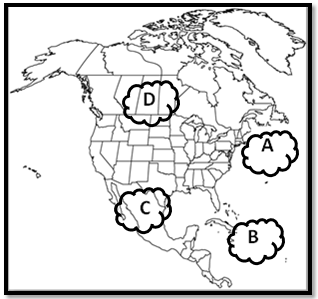
Which type of air would you find at air mass C?
mT
mP
cT
cP
What's the humidity and temperature of a continental tropical (cT) air mass?
Wet and cold
Dry and warm
Wet and warm
Dry and cold
What's the humidity and temperature of a maritime tropical (mT) air mass?
Wet and cold
Dry and warm
Wet and warm
Dry and cold
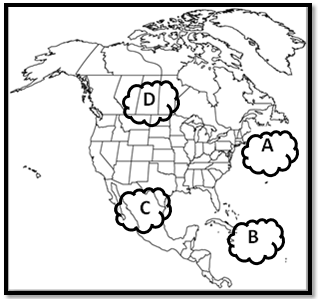
Which type of air would you find at air mass D?
mT
mP
cP
cT

Look at the incoming front and tell me what type of weather PA is currently having.
warm and sunny
cold and sunny
warm with rain
cold with rain
If there was a low pressure system coming in what type of weather would we experience.
happy, sunny weather
happy, rainy weather
lousy, sunny weather
lousy, rainy weather
If there was a high pressure coming in, what type of weather would we experience?
happy, sunny weather
happy, rainy weather
lousy, sunny weather
lousy, rainy weather
This front is represented by triangles and semi-circles on the same side when approaching a location.
warm front
cold front
stationary front
occluded front
This front is represented by semi-circles on one side and triangles on the other side when approaching a location.
warm front
cold front
stationary front
occluded front
This front is represented by triangles when approaching a location.
warm front
cold front
stationary front
occluded front

Look at this front coming in and tell me what weather is currently happening in MO.
warm and sunny
cold and sunny
warm with rain
cold with rain
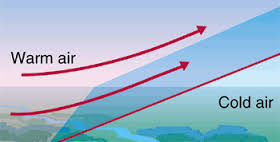


What type of front is shown?
Warm Front
Cold Front
Occluded Front
Stationary Front


This is the symbol for a _____________ weather front.
Cold
Warm
Stationary
Occluded

A _____________ weather front occurs when a cold air mass moves forward, pushing the warm air mass up.
Cold
Warm
Stationary
Occluded

A _____________ weather front occurs two cold air masses meet and push/force the warm air in the middle upwards.
Cold
Warm
Stationary
Occluded

