
 Worksheets
13 REVIEW 4 DNA TEST
Total questions: 20
Worksheet time: 10mins
Name
Class
Date
1.
Used heat-killed bacteria and harmless bacteria injected into mice to conclude the transforming factor had to be a gene
a)
Griffith
b)
Avery
c)
Hershey & Chase
d)
Watson & Crick
2.
Experimented to identify the molecule in the heat-killed bacteria that caused transformation by using enzymes
a)
Griffith
b)
Avery
c)
Hershey & Chase
d)
Watson & Crick
3.
Used radioactive markers of phosphorus and sulfur to label DNA and proteins of bacteriophages
a)
Griffith
b)
Avery
c)
Hershey & Chase
d)
Watson & Crick
4.
The process by which one type of bacteria is changes into another type is called
a)
transcription
b)
transformation
c)
duplication
d)
replication
5.
Bacteriophages are
a)
a form of bacteria
b)
enzymes
c)
coils of DNA
d)
viruses
6.
Before DNA could definitively be shown to be the genetic material in cells, scientists had to show it could
a)
tolerate high temperatures
b)
carry and make copies of information
c)
be modified in response to environmental factors
d)
be broken down into subunits
7.
A nucleotide DOES NOT contain
a)
a 5-carbon sugar
b)
an amino acid
c)
a nitrogen base
d)
a phosphate group
8.
According to Chargaff's rule of base-pairing, which of the following is true about DNA?
a)
[A]=[T] and [C]=[G]
b)
[A]=[G] and [C]=[T]
c)
[A]=[C] and [T]=[G]
d)
[A]=[T]= [C]=[G]
9.
The bonds that hold the two strands of DNA together come from
a)
the attraction of phosphate groups for each other
b)
strong bonds between nitrogenous bases and deoxyribose
c)
weak hydrogen bonds between the nitrogenous bases
d)
carbon-to-carbon bonds in the sugar portion of the nucleotides
10.
In prokaryotes, DNA molecules are located in the
a)
nucleus
b)
ribosomes
c)
cytoplasm
d)
histones
11.
In eukaryotes, nearly all the DNA is found in the
a)
nucleus
b)
ribosomes
c)
cytoplasm
d)
histones
12.
The main enzyme involved in linking individual nucleotides into DNA molecules is
a)
DNA protease
b)
ribose
c)
carbohydrates
d)
DNA polymerase
13.
Which of the following events occurs in DNA replication in prokaryotes?
a)
Regulatory proteins bind to all of the nucleotides on the DNA molecule.
b)
Enzymes “unzip” the DNA molecule by breaking ionic bonds between base pairs.
c)
Replication starts from a single point and proceeds in two directions until the entire chromosome is copied.
d)
Replication starts from multiple points and proceeds in two directions until the entire chromosome is copied.
14.
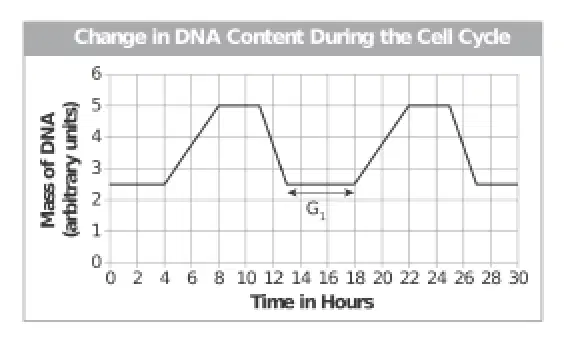
Which conclusion about DNA replication is supported by the graph?
a)
DNA replication occurs during all phases of the cell cycle.
b)
DNA replication occurs only during the G1 phase of the cell cycle.
c)
DNA replication occurs only during the S phase of the cell cycle.
d)
DNA replication occurs randomly, and is unrelated to the cell cycle.
15.
How does the double-helical structure of DNA explain how the molecules can be copied or replicated?
a)
Because of base pairing, each strand has all the information to serve as a template for the other strand.
b)
Each strand receives the information from the DNA polymerase attached to the replication fork.
c)
The nitrogenous bases on one strand are copied to the other strand.
d)
The nitrogenous bases line up on each strand and are attached to each other.
16.
Which pair of nitrogenous bases will form a bond in a DNA molecule?
a)
cytosine and adenine
b)
adenine and thymine
c)
guanine and thymine
d)
thymine and cytosine
17.
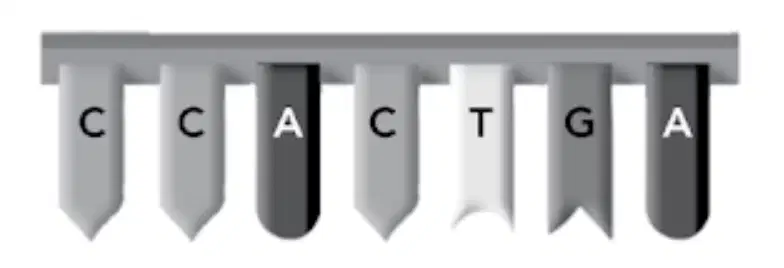
The diagram represents a portion of one strand of a DNA molecule. Match the strand in the diagram by base pairing
a)
GGTGACT
b)
TTGTCAG
c)
GGTCGAT
d)
CCTAGTG
18.
The x-ray diffraction picture was taken by
a)
Rosalind Franklin
b)
Rosa Parks
c)
James Watson
d)
Erwin Chargaff
19.
Telomeres are located near the tips of eukaryotic DNA. During DNA replication, what is the role of enzymes called telomerases?
a)
removing damaged telomeres from the DNA molecules
b)
attaching telomeres onto newly-synthesized DNA molecules
c)
preventing telomeres from migrating elsewhere in a DNA molecule
d)
preventing loss or damage of genes near telomeres
20.
In eukaryotes, replication begins
a)
in several places
b)
at one point and continues in both directions
c)
during the G2 phase
100 %

