
 Worksheets
Metamorphosis Section 1-3 Quizizz
Total questions: 49
Worksheet time: 33mins
Which of the following statements is an example of what Rushdie calls “human truth”?
Anna Karenina was a real person.
Salman Rushdie included a flying carpet in his novel.
Fiction contains elements that are universal to all humans.
Fiction is sometimes based on true events.
Which one of the following examples would fit the criteria of “magical realism”?
a cat that wears a hat, eats pasta, and plays the violin
a beam of light that transports a man to another planet
a flying house that comes with a detailed technical manual
a supernatural being that resembles a large bowl of pudding
Pallas personates an old woman; she both places false gray hair on her temples, and supports as well her infirm limbs by a staff.
What is the meaning of personates as it is used in the excerpt?
to punish someone in order to injure them
to give someone a personality
to compliment someone
to assume the identity of someone else
Which of the following best describes a “human truth” revealed in Ovid’s story "The Transformation of Arachne into a Spider?
Arachne acquires a reputation for fine workmanship.
Pallas transforms Arachne into a spider.
Arachne displays a haughty superiority.
Pallas uses her embroidery to celebrate the gods.
Read the sentence from paragraph 6 of Kafka’s story.
His boss would certainly come round with the doctor from the medical insurance company, accuse his parents of having a lazy son, and accept the doctor’s recommendation not to make any claim as the doctor believed that no-one was ever ill but that many were workshy.
What does the word workshy mean as it is used in the sentence?
unemployed
bashful
idle
injured
Write a paragraph to summarize the text, The Metamorphosis (Section I). Be sure to include key details in your objective summary.
Personates
pretend to be
humble plea
humble request
monarch
Entreaty
humble request
humble plea
intimidates
soveriegn
Suppliant
humble request
humble plea
woeful
difficult
Daunted
woeful
miserable
intimidated
poisonous
Monarch
personates
rustic
to attach
sovereign
Wretched
rodents
miserable
noxious
thrash
Bereft
scoundrel
Deprived
moan
daunted
Delineates
difficult
pretend to be
portrays
simple
Rustic
unsophisticated country person
to attach
plaintively
louts
Censure
monarch
disapproval
sovereign
louts
Noxious
thrash
venom
poisonous
rodent
Cleave
to attach
pretend to be
portrays
woeful
Vermin
austere
louts
rodent
scoundrel
Floundering
narrow bladed saw
thrash
running
intimidated
Strenuous
moan
laborious
difficult
simple
Plaintively
censure
woeful
suppress
soughing
Suppress
daunted
put down
miserable
austere
louts
moan
scoundrel
vermin
rodent
Fretsaw
arduous
suppress
soughing
narrow-bladed saw
soughing
moan
woeful
floundering
cleave
austere
personates
simple
difficult
daunted
arduous
simple
difficult
fretsaw
louts
Which two of the following events are most important in determining why the chief clerk left the Samsa household?
The chief clerk hears something fall inside Gregor’s room.
The chief clerk catches a glimpse of Gregor as he leaves his room.
The chief clerk is told that Gregor might be ill.
Mr. Samsa begins to weep.
Gregor makes a run toward the chief clerk.
Does this quote reveal Gregor as calm or self-sacrificing?
"Gregor was still there and had not the slightest intention of abandoning his family."
calm
self-sacrificing
Does this quote reveal Gregor as calm or self-sacrificing?
"He did not have the slightest doubt that the change in his voice was nothing more than the first sign of a serious cold, which was an occupational hazard for travelling salesmen."
calm
self-sacrificing
Does this quote reveal Gregor as calm or self-sacrificing?
"And he lay there quietly a while longer, breathing lightly as if he perhaps expected the total stillness to bring things back to their real and natural state."
calm
self-sacrificing
Does this quote reveal Gregor as calm or self-sacrificing?
"The first few times he tried to climb up on the smooth chest of drawers he just slid down again, but he finally gave himself one last swing and stood there upright; the lower part of his body was in serious pain but he no longer gave any attention to it."
calm
self-sacrificing
Does this quote reveal Gregor as calm or self-sacrificing?
"Should he really call for help though, even apart from the fact that all the doors were locked? Despite all the difficulty he was in, he could not suppress a smile at this thought."
calm
self-sacrificing
Does this quote reveal Gregor as calm or self-sacrificing?
"He isn't well, please believe me. Why else would Gregor have missed a train! The lad only ever thinks about the business. . ."
calm
self-sacrificing
Does this state apply to Arachne, Gregor Samsa, or both of them?
The character is haughty.
Arachne
Gregor Samsa
Both of them
Does this state apply to Arachne, Gregor Samsa, or both of them?
The character's transformation is not explained.
Arachne
Gregor Samsa
Both of them
Does this state apply to Arachne, Gregor Samsa, or both of them?
The character accepts the reality of the situation.
Arachne
Gregor Samsa
Both of them
Does this state apply to Arachne, Gregor Samsa, or both of them?
The character transformation defies natural law.
Arachne
Gregor Samsa
Both of them
Does this state apply to Arachne, Gregor Samsa, or both of them?
The character explicitly references mythological figures.
Arachne
Gregor Samsa
Both of them
Does this state apply to Arachne, Gregor Samsa, or both of them?
The character has trouble being understood when speaking.
Arachne
Gregor Samsa
Both of them
Which mythological figure does the description match?
King of Thrace who compared himself and his wife to Jupiter and Juno and was turned into a mountain
Anitgone
Haemus
Pallas
Jupiter
Which mythological figure does the description match?
compared her hair to Juno and was turned into a stork
Anitgone
Arachne
Asterie
Leda
Which mythological figure DOES NOT BELONG in this description?
they were all deceived by gods who transformed themselves in order to pursue them
Leda
Europa
Asterie
Isse
Neptune
Which description matches Arachne's tapestry?
references the deception of mortal women by various male gods.
the mythological references depict the power of the gods and the punishment of mortals who dared to compare themselves to the gods.
Which description matches Pallas' tapestry?
references the deception of mortal women by various male gods.
the mythological references depict the power of the gods and the punishment of mortals who dared to compare themselves to the gods.
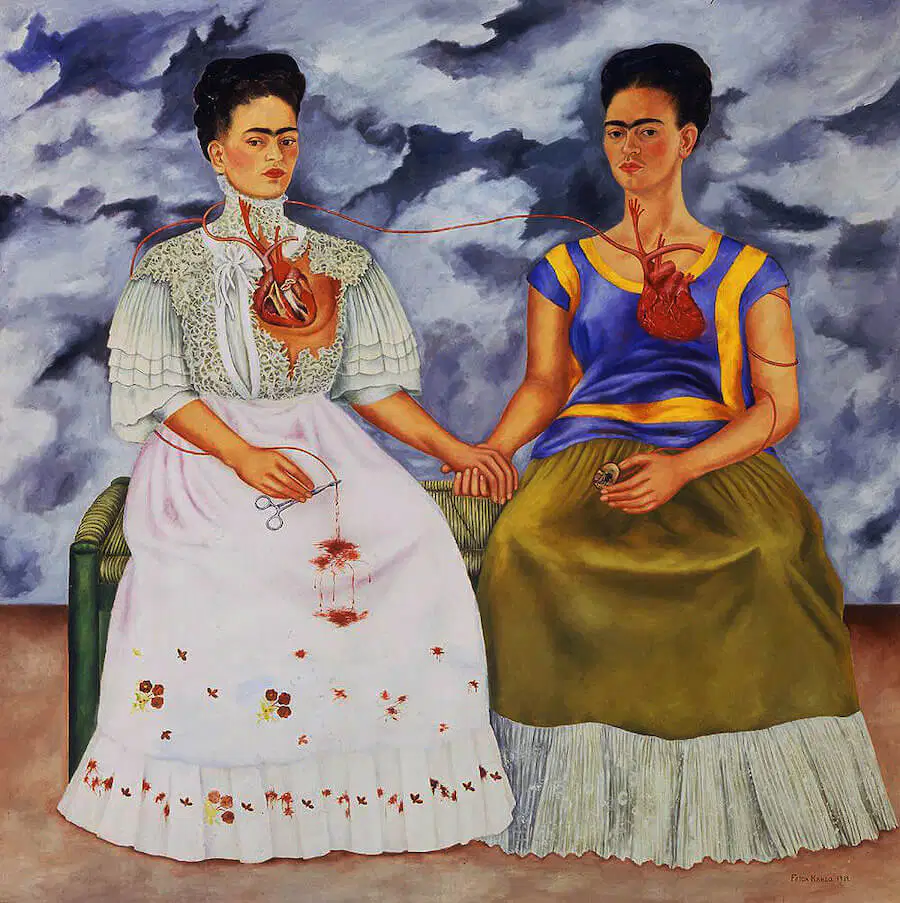
You will need to analyze this painting by Frida Kahlo by explaining the painting's message and the elements of magical realism it contains.
(a)
Briefly explain the criteria of magical realism. What does Salman Rushdie say about the nature of truth in literature?
Hint: Look at the Magical Realism criteria chart and the "Magical Realism is Still Realism" notes.
Essay Question:
Think about the texts:
“The Transformation of Arachne into a Spider” from Metamorphoses by Ovid
“The Metamorphosis: Section I” by Franz Kafka
Write three paragraphs that explain how each story uses fantastical elements to present a “human truth.” Be sure to use evidence from each text to support your response.

