
 Worksheets
Simple Harmonic Motion Concept Builders
Total questions: 38
Worksheet time: 10hrs 30mins
A pendulum's period describes
how much time it takes to complete one vibration
how much distance it travels during one vibration
how many times it vibrates back and forth
A pendulum's frequency describes
how fast it moves from one extreme to the other
how far it moves from its resting position to an extreme position
how often it vibrates back and forth
A pendulum makes 40 complete vibrational cycles in 20 seconds. This means that
the period is 0.5 Hz and the frequency is 40 seconds
the period is 0.5 Hz and the frequency is 2.0 seconds
the period is 40 seconds and the frequency is 2.0 Hz
the period is 0.5 seconds and the frequency is 2.0 Hz
the unit of period is
second
oscillations
meter
the unit of frequency is
joules per second
meters per second
cycles per second
As the frequency of a pendulum increases
the period increases at first then it decreases
the period also increases
the period decreases
the period in unaffected
If the length of the string is decreased by a factor of two, the period of the pendulum will
increase by a factor of the square root of 2
decrease by a factor of square root of 2
increase by a factor of 2
increase by a factor of 2
decrease by a factor of 2
If the length of the string is decreased by a factor of two, the frequency of the pendulum will
increase by a factor of the square root of 2
decrease by a factor of square root of 2
increase by a factor of 2
increase by a factor of 2
decrease by a factor of 2

AP Physics students are studying the effect of object mass (m), spring constant (k), and spring length (L) upon the period. The parameter values used for three trials are shown. Rank the three trials in order of their period (T).
Trial 1: Greatest
Trial 2: Middle
Trial 3: Smallest
Trial 1: Middle
Trial 2: Greatest
Trial 3: Smallest
Trial 1: Greatest
Trial 2: Smallest
Trial 3: Middle
Trial 1: Smallest
Trial 2: Middle
Trial 3: Greatest
If the spring constant increases by a factor of three, the period will
increase by a factor of the square root of 3
decrease by a factor of the square root of 3
increase by a factor of 9
decrease by a factor of 9
decrease by a factor of 3
If the spring constant increases by a factor of three, the frequency will
increase by a factor of the square root of 3
decrease by a factor of the square root of 3
increase by a factor of 9
decrease by a factor of 9
decrease by a factor of 3
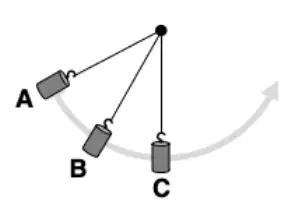
A pendulum is swinging back and forth. The highest point reached by the pendulum is location A. At which location is the pendulum experiencing a zero speed?
A
B
C
All three locations
A pendulum is swinging back and forth. At which location is the pendulum experiencing the greatest restoring force?
A
B
C
All three locations
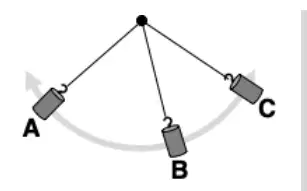
A pendulum is swinging back and forth. At which location is the pendulum moving with the greatest speed?
A
B
C
Not enough information to answer the question
A pendulum is swinging back and forth. At which location is the pendulum experiencing the smallest restoring force?
A
B
C
Not enough information to answer the question
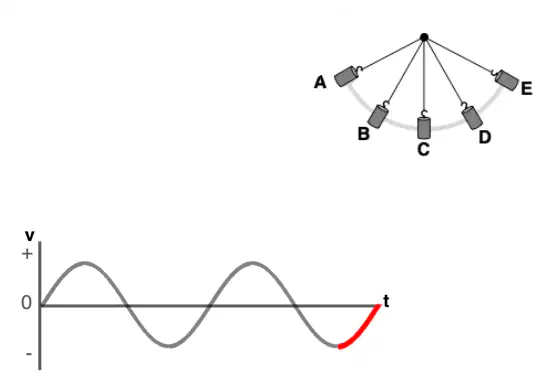
A pendulum is swinging back and forth.
A + velocity represents a pendulum bob moving to the right; a - velocity represents a a leftward motion. Consider the red-shaded section of the graph. This section represents the pendulum bob moving from locations...
A to B to C
C to D to E
D to C to B
C to B to A
B to C to D
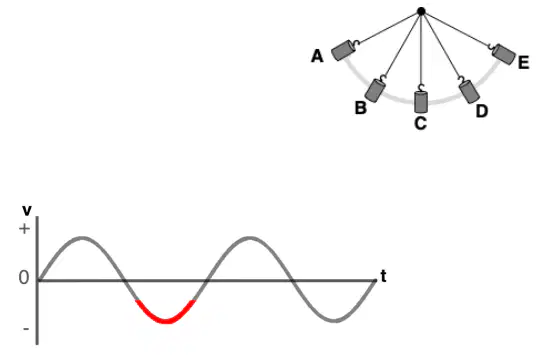
A pendulum is swinging back and forth.
A + velocity represents a pendulum bob moving to the right; a - velocity represents a a leftward motion. Consider the red-shaded section of the graph. This section represents the pendulum bob moving from locations...
A to B to C
C to D to E
D to C to B
C to B to A
B to C to D
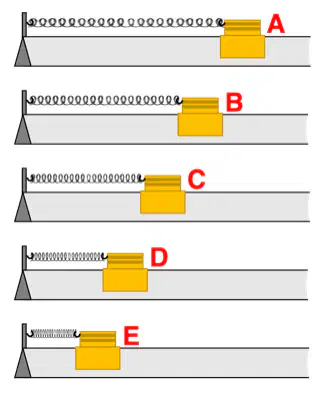
A spring is pulled back to position A and released from rest. It vibrates back and forth. Position C is the equilibrium position. In what manner does the speed change as the spring moves from E to C?
Remains unchanged
Increases
Decreases
First increases, then decreases
First decreases, then increases
A spring is pulled back to position A and released from rest. It vibrates back and forth. Position C is the equilibrium position. In what manner does the net force change as the spring moves from A to C?
Remains unchanged
Increases
Decreases
First increases, then decreases
First decreases, then increases
A spring is pulled back to position A and released from rest. It vibrates back and forth. Position C is the equilibrium position. At what position(s) does it have a speed of 0 m/s?
A
B
C
D
E
A spring is pulled back to position A and released from rest. It vibrates back and forth. Position C is the equilibrium position. At what position(s) is the net force the greatest?
A
B
C
D
E
A spring is pulled back to position A and released from rest. It vibrates back and forth. Position C is the equilibrium position. At what position(s) is its speed the greatest?
A
B
C
D
E
A spring is pulled back to position A and released from rest. It vibrates back and forth. Position C is the equilibrium position. At what position(s) does it experience a net force of 0 N?
A
B
C
D
E
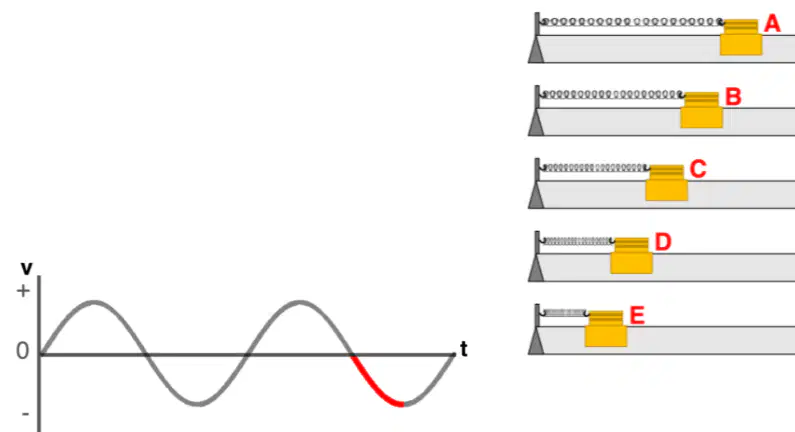
A spring is pulled back to position A and released from rest. It vibrates back and forth. Position C is the equilibrium position. A + velocity represents the spring moving to the right; a - velocity represents a leftward motion. The red-shaded section represents the spring moving from position...
A to B to C
C to D to E
B to C to D
C to B to A
E to D to C
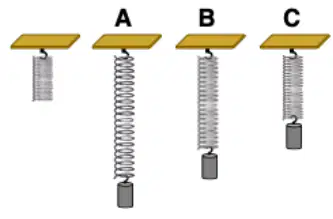
A spring is attached to a ceiling hook. A mass is attached to the spring and pulled down to position A. It is released from rest and vibrates back and forth. Position B is the equilibrium position. In what matter does the speed change as the mass moves from C to B?
Increases
Decreases
Remains unchanged
First increases, then decreases
First decreases, then increases
A spring is attached to a ceiling hook. A mass is attached to the spring and pulled down to position A. It is released from rest and vibrates back and forth. Position B is the equilibrium position. In what matter does the speed change as the mass moves from B to A?
Increases
Decreases
Remains unchanged
First increases, then decreases
First decreases, then increases
A spring is attached to a ceiling hook. A mass is attached to the spring and pulled down to position A. It is released from rest and vibrates back and forth. Position B is the equilibrium position. In what matter does the net force change as the mass moves from B to A?
Increases
Decreases
Remains unchanged
First increases, then decreases
First decreases, then increases
A spring is attached to a ceiling hook. A mass is attached to the spring and pulled down to position A. It is released from rest and vibrates back and forth. Position B is the equilibrium position. At what position(s) does the mass experience the greatest net force?
A
B
C
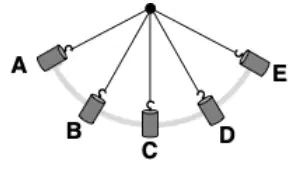
A pendulum is swinging back and forth along its circular arc. What changes would be observed as the pendulum swings from locations C to B to A?
KE: increases
PE: decreases
KE: decreases
PE: increases
KE: increases
PE: increases
KE: decreases
PE: decreases
KE: stay the same
PE: decreases
A pendulum is swinging back and forth along its circular arc. What changes would be observed as the pendulum swings from locations B to C to D?
KE: increases, then decreases
PE: increases, then decreases
KE: decreases, then increases
PE: increases, then decreases
KE: increases, then decreases
PE: decreases, then increases
KE: decreases, then increases
PE: decreases, then increases
KE: stay the same
PE: stay the same
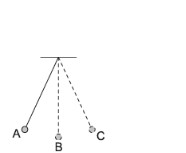
A pendulum oscillates as shown. At which of the following positions is the potential energy equal to the total energy?
A
B
C
Not enough information
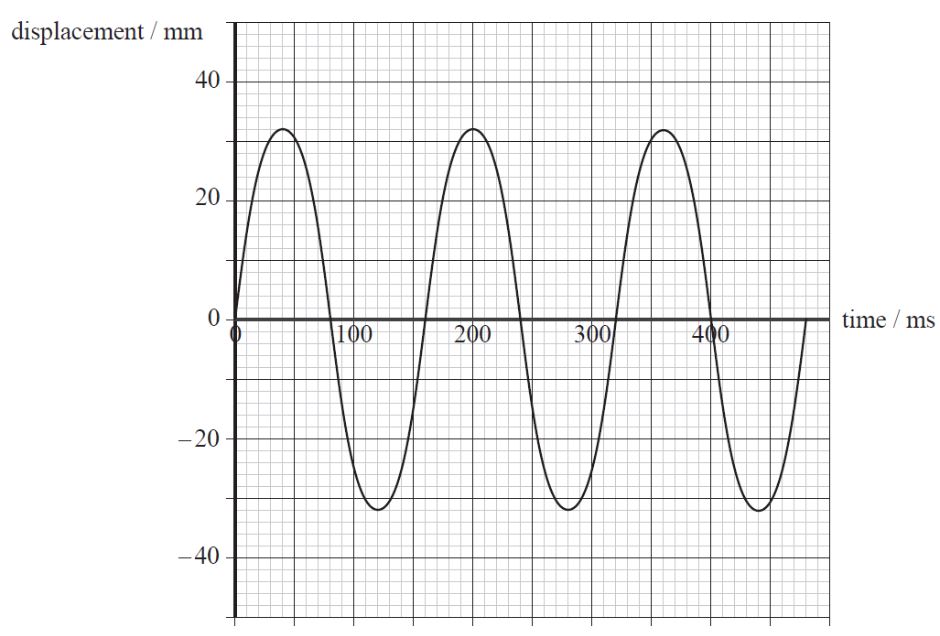
The graph shows the variation with time of the displacement of an object undergoing simple harmonic motion. At which of the following time values is kinetic energy zero?
0 ms
40 ms
80 ms
100 ms
An object of mass 𝑚 is attached to a horizontal spring, stretched to a displacement 𝐴 from equilibrium and released, undergoing harmonic oscillations on a frictionless surface with period 𝑇 . The experiment is then repeated with a mass of 4𝑚. What’s the new period of oscillation?
2T
T
4T
T√2
A simple pendulum of length l. whose bob has mass m, oscillates with a period T. If the bob is replaced by one of mass 4.0 m, the period of oscillation is
.25 T
.50 T
T
2 T
4 T
Which of the following is true for a system consisting of a mass oscillating on the end of an ideal spring?
The kinetic and potential energies are equal at all times.
The kinetic and potential energies are both constant.
The maximum potential energy is achieved when the mass passes through its equilibrium position.
The maximum kinetic energy and maximum potential energy are equal, but occur at different times.
The maximum kinetic energy occurs at maximum displacement of the mass from its equilibrium position.

Refer to the graph below of the displacement x versus time t for a particle in simple harmonic motion. Which of the following graphs shows the kinetic energy K of the particle as a function of time t for one cycle of motion?


Refer to the graph below of the displacement x versus time t for a particle in simple harmonic motion. Which of the following graphs shows the kinetic energy K of the particle as a function of time t for one cycle of motion?


A block on a horizontal frictionless plane is attached to a spring, as shown below. The block oscillates along the x-axis with simple harmonic motion of amplitude A.
Which of the following statements about energy is correct?
The potential energy of the spring is at a minimum at x = 0.
The potential energy of the spring is at a minimum at x = A.
The kinetic energy of the block is at a minimum at x =0.
The kinetic energy of the block is at a minimum at x =A.
The kinetic energy of the block is always equal to the potential energy of the spring.

