wayground logo

Free Printable Worksheets

Font size

S
M
L
XL
Worksheets

EOC Review: Similarity Vs. Congruence

Total questions: 77

Worksheet time: 1hrs 19mins

Name
Class
Date
1.
Two objects that are the same shape but not the same size are _______.
a)
Congruent
b)
Vertical
c)
Similar
d)
Complementary 
2.
The  term "corresponding" means ...
a)
congruent
b)
similar
c)
matching 
d)
multiply 
3.
What is true about the shape and size of similar figures?
a)
Same shape and same size
b)
Same shape and not the same size
c)
Different shape and same size
d)
Different shape and not the same size
4.
The term "congruent" means ...
a)
matching
b)
similar
c)
corresponding
d)
equal
5.
What is true about the sides of similar figures?
a)
Corresponding sides are proportional.
b)
Corresponding sides are congruent.
c)
Opposite sides are proportional.
d)
Opposite sides are congruent.
6.
What is true about the angles of similar figures?
a)
Corresponding angles are proportional.
b)
Complementary angles are proportional.
c)
Corresponding angles are congruent.
d)
Complementary angles are congruent.
7.
What side corresponds with AB? 
a)
BC
b)
FE
c)
DE
d)
FD
8.

ΔPQR is similar to ΔSTU\Delta PQR\ is\ similar\ to\ \Delta STU  What side corresponds to side UT?

a)

PQ

b)

RQ

c)

QR

d)

QP

9.
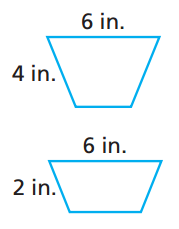
Tell whether the two figures are similar. Explain your reasoning. (Hint: are they proportional?)
a)
Yes, similar because they are the same shape and side lengths are proportional.
b)
No, not similar because they are the same shape, but side lengths are not proportional.
c)
Yes, same shape
d)
No, different sizes
10.
Are the following similar? Why or why not?
a)
Yes
b)
No, the corresponding angles are not equal.
c)
No, the ratios of the corresponding sides are not equal.
11.
Which triangle is similar to the above triangle ?
a)
A
b)
B
c)
C
d)
D
12.
What is the ratio of the height of dad's mug to mom's mug. 
a)
3:2
b)
2:3
c)
6:1
d)
4:6
13.

Use the Cross Products Property to solve the proportion.

a)

s = 38

b)

s = 35

c)

s = 36

d)

s = 32

14.
Which represents the relationship of oranges to fruit?
a)
2:6
b)
2:4
c)
4:6
d)
4:2
15.

Use the Cross Products Property to solve the proportion.

a)

n = 4

b)

n = 14

c)

n = 208

d)

n = 16

16.

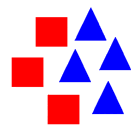
What is the ratio of blue triangles to red squares?

a)

4 : 3

b)

3 : 4

c)

4 : 7

17.
This symbol stands for ...
a)
similar
b)
congruent
c)
proportional
d)
corresponding
18.
Tell whether the two figures are congruent.
a)
Yes, same size and same shape
b)
No, same shape but different sizes
c)
No, different size and different shapes
19.
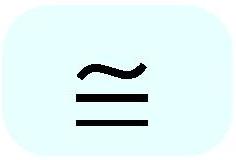
This symbol stands for ...
a)
is corresponding to
b)
is proportional to
c)
is congruent to
d)
is similar to
20.
a)
4 ft
b)
15 ft
c)
18 ft
d)
2 ft
21.
Are the triangles similar?
a)
Yes
b)
No
22.
What does similar mean?
a)
same shape and same size
b)
same size
c)
sames shape
d)
neither
23.
All angles in similar figures are congruent.  
a)
True
b)
False
24.
Are the triangles similar?
a)
Yes
b)
No
25.
Matching sides are called
a)
Corresponding Sides
b)
Corresponding Angles
c)
The Same
d)
Congruent Sides
26.

Determine if the similarity statement is true or false ΔABCΔHGF\Delta ABC\sim\Delta HGF

a)

TRUE

b)

FALSE

27.
If two figures are similar, the corresponding sides are ______________.
a)
equal
b)
congruent
c)
proportional
d)
none of these
28.
In similar Polygons, corresponding sides are ___ and corresponding angles are ___. (Fill in the blanks)
a)
congruent, proportional 
b)
proportional, congruent 
c)
congruent, congruent
d)
proportional, proportional
29.

A figure must have the same shape and size to be _________.

a)

Congruent

b)

Similar

c)

Side Angle Side

30.

Corresponding angles in similar figures are congruent.

a)

True

b)

False

31.
Sides in similar figures must be proportional.  
a)
True
b)
False 
32.

Which of the following statements is true about similar triangles?

a)

The measurements of corresponding angles differ between the two triangles.

b)

Two triangles are similar if their corresponding sides are proportional.

c)

If two triangles are similar, both their corresponding sides and angles are always congruent.

d)

Similar triangles differ in shape but are the same in size.

33.

∆ABC~∆XYZ. Which of the following is not a correct statement?

a)

AB\XY=BC\YZ

b)

BC\YZ = AC\XY

c)

CA\ZX =BA\YX

d)

AC\XZ = AB\XY

34.

Which additional angle’s measure by itself could be used to conclude that ∆ KAG ~ ∆ DMG?

a)

<MGD

b)

<DKA

c)

<KDM

d)

<GAK

e)

<MAK

35.

Triangle ABC with vertices at A(0, 3), B(4, 3), and C(4, 0) is transformed to triangle A’B’C’ with

vertices A’(0, 6), B’(8, 6), and C’(8, 0). What function represents this transformation? (4pts)


( x , y ) -> ( , )

a)

(3x,3y)

b)

(2x,2y)

c)

(3x,2y)

d)

(1x,1y)

36.
Dilate the figure by a scale factor of 3 with the origin as the center of dilation. What are the coordinates of the image?
A(3,3) B(6,6) C(9,3)
a)
A'(9,9) B'(18,18) C'(27,9)
b)
A'(6,6) B'(9,9) C'(12,6)
c)
A'(0,0) B'(3,3) C'(6,0)
d)
A'(1,1) B'(2,2) C'(3,1)
37.
State the coordinate of the image of the given point B (-10,-6) under a dilation with center at the origin with the given scale factor k = 1/2.
a)
(5,3)
b)
(20,12)
c)
(-20,-12)
d)
(-5,-3)
38.
The point (8, 12) was dilated to become point (2, 3). What was the scale factor?
a)
½
b)
¼
c)
4
d)
2
39.

True or False: similar figures are the same shape and size with corresponding sides and angles.

a)

true

b)

false

40.

A figure resulting from a transformation.

a)

Image

b)

Preimage

c)

Transformation

d)

Dilation

41.

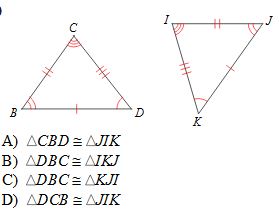
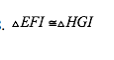
Which is a correct congruence statement.

a)

A

b)

B

c)

C

d)

D

42.

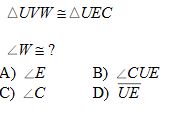
Name the congruent angle.

a)

A

b)

B

c)

C

d)

D

43.
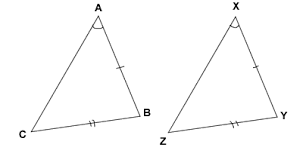
State if the two triangles are congruent.  If they are, state how you know.
a)
A
b)
B
c)
C
d)
D
44.
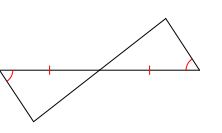
State if the two triangles are congruent.  If they are, state how you know.
a)
A
b)
B
c)
C
d)
D
45.
What additional information is required for the 2 triangles to be congruent by AAS?
a)
A
b)
B
c)
C
d)
D
46.

Are these two triangles congruent? If so, state the theorem.

a)

No, not enough info.

b)

Yes - SSS

c)

Yes - SAS

d)

Yes - ASA

47.

Are these two triangles congruent? If so, state the theorem.

a)

No, not enough info.

b)

Yes - AAS

c)

Yes - HL

d)

Yes - SSS

48.

Are these two triangles congruent? If so, state the theorem.

a)

No, not enough info.

b)

Yes - SAS

c)

Yes - HL

d)

Yes - SSA

49.
Which is NOT a test to prove triangles congruent?
a)
SAA
b)
SSS
c)
SSA
d)
SAS
50.
What are the five ways to prove triangles congruent?
a)
SSS, ASA, AAS, SAS, HL
b)
SSS, SSA, HL, AAS, SAS
c)
SAS, SSA, HL, AAS, SSS
d)
HL, SAS, SSA, SSS, ASA
51.
Use the congruency statement to answer the following: 
<F = ___
a)
<H
b)
<I
c)
<G
d)
not congruent to another angle
52.
Are these triangles congruent? If so, state the rule which you used to determine congruence.
a)
SSA
b)
AAS
c)
ASA
d)
Not necessarily congruent
53.
Congruent by
a)
SSS
b)
SAS
c)
ASA
d)
AAS
54.
What is always the 1st statement in reason column of a proof?
a)
Prove
b)
Given
c)
Reason
d)
Statement
55.
Fill in the blank.
a)
Given
b)
Reflexive Property
c)
Transitive Property
d)
They're the same side!!!!!! 
56.

Which of the following are NOT sufficient to prove two triangles are congruent? Choose all that apply.

a)

SSS

b)

AAA

c)

ASA

d)

SSA

e)

AAS

57.
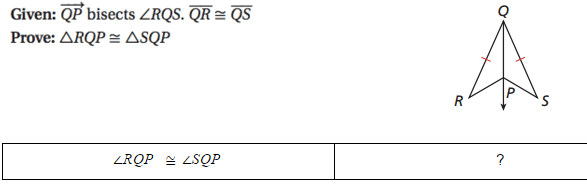
Identify the  missing statement or reason
a)
Given
b)
Vertical Angles Theorem
c)
Definition of Angle Bisector
d)
Alternate Interior Angles Theorem
58.
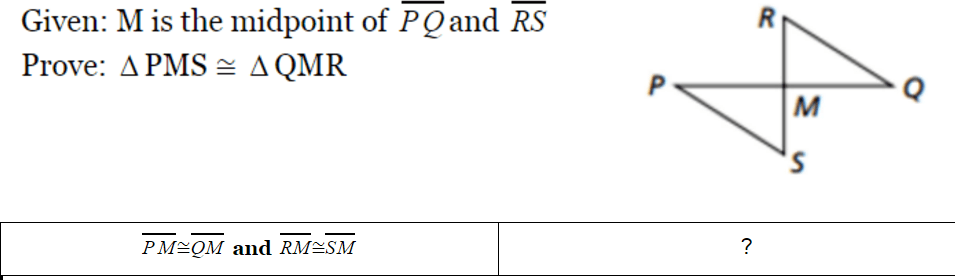
Identify the  missing statement or reason
a)
Definition of Angle Bisector
b)
Alternate Interior Angles Theorem
c)
Reflexive Property
d)
Definition of Midpoint
59.

Match the triangles to the congruence theorem.

a)
1.

SSS

b)
2.

AAS

c)
3.

SAS

d)
4.

ASA

60.

What is #4 Reason?

a)

Alternate Interior Angles

b)

Vertical Angles

c)

Reflexive Property

d)

Angle Bisector

61.

Look at this partial proof, Notice the given information. What would be the reason for statment #2?

a)

Definition of Midpoint

b)

Definition of congruence

c)

Transitive Property

d)

Substitution Property

62.

Which statement is true for

ΔABCΔDEF\Delta ABC\cong\Delta DEF  

a)

AB\angle A\cong\angle B  

b)

AF\angle A\cong\angle F  

c)

AD\angle A\cong\angle D  

d)

AE\angle A\cong\angle E  

63.
State if the two triangles are congruent.  If they are, state how you know.
a)
A
b)
B
c)
C
d)
D
64.
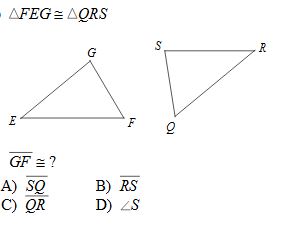
Name the corresponding angle or side.
a)
A
b)
B
c)
C
d)
D
65.
The statement below the image can be proven by...
a)
Vertical Angles
b)
Midpoint 
c)
Alternate Interiors
d)
Reflexive property
66.
Angle GFD and angle EDF can be proven congruent to eachother because they are/using...
a)
Vertical Angles
b)
Midpoint
c)
Alternate Interiors
d)
Reflexive Property
67.
I can prove line segment XM is congruent to line segment YM if M is the ________ of line segment XY
a)
Vertical Angles
b)
Midpoint
c)
Alternate Interior
d)
Reflexive Property
68.
I know angle APB and angle EPK are congruent by using...
a)
Alternate Interior
b)
Vertical Angles
c)
Midpoint
d)
Reflexive Property
69.

Which is a correct congruence statement.

a)

A

b)

B

c)

C

d)

D

70.

ΔCATΔDOG\Delta CAT\cong\Delta DOG  Which of the following must be true?

a)

<C<G<C\cong<G  

b)

<A<D<A\cong<D  

c)

CADO\overline{CA}\cong\overline{DO}  

d)

CTDO\overline{CT}\cong\overline{DO}  

71.

Given that ΔRANΔHOP.Given\ that\ \Delta RAN\cong\Delta HOP.  Which of the following can you NOT conclude as being true?

a)

<R<H<R\cong<H  

b)

<N<P<N\cong<P  

c)

ANOP\overline{AN}\cong\overline{OP}  

d)

RAOP\overline{RA}\cong\overline{OP}  

72.

Are the triangles congruent? Explain your reasoning. Select all that apply.

a)

Yes, by HL

b)

Yes, by ASA

c)

Yes, by SAS

d)

Yes, by AAS

e)

Yes, by SSS

73.

Determine if the triangles are similar. If they are, identify the triangle similarity theorem(s) that prove(s) the similarity.

a)

AA ~ Theorem

b)

SAS ~ Theorem

c)

SSS ~ Theorem

d)

Not similar

74.

Determine if the triangles are similar. If they are, identify the triangle similarity theorem(s) that prove(s) the similarity.

a)

AA ~ Theorem

b)

SAS ~ Theorem

c)

SSS ~ Theorem

d)

Not similar

75.

Determine if the triangles are similar. If they are, identify the triangle similarity theorem(s) that prove(s) the similarity.

a)

AA ~ Theorem

b)

SAS ~ Theorem

c)

SSS ~ Theorem

d)

Not similar

76.

Determine if the triangles are similar. If they are, identify the triangle similarity theorem(s) that prove(s) the similarity.

a)

AA ~ Theorem

b)

SAS ~ Theorem

c)

SSS ~ Theorem

d)

Not similar

77.

State the postulate that proves these triangles are similar.

a)

AA~

b)

SAS~

c)

SSS~

d)

Not Similar